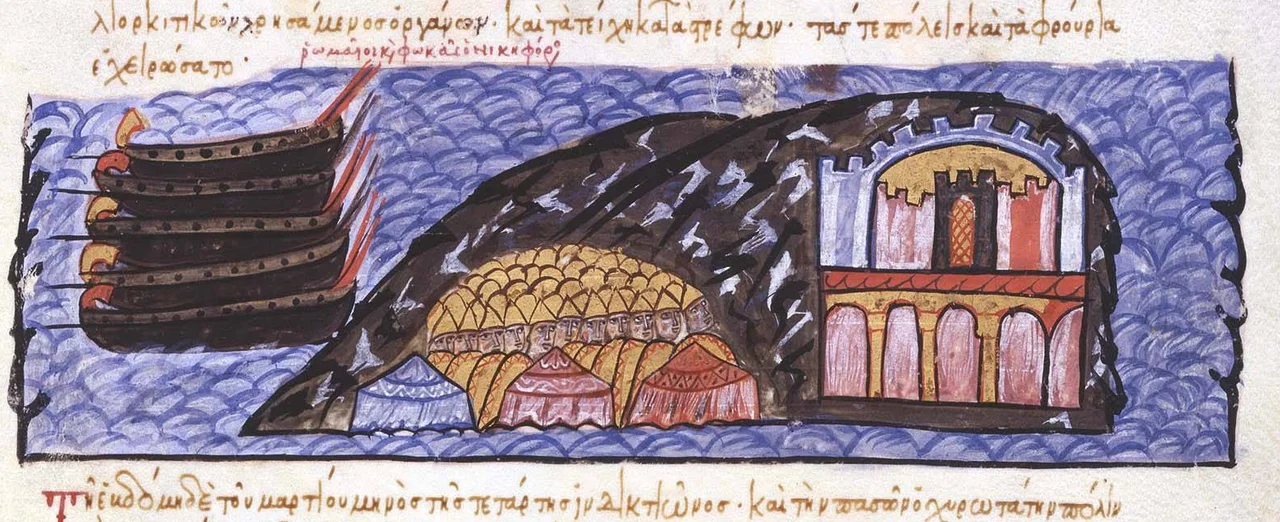

Emirate of Crete
Around 818, an uprising in the Córdoban suburb of al-Rabad was crushed by the emir al-Hakam I, and the surviving residents were ordered into exile en masse. Some made for Fez. Others, perhaps ten thousand strong, took to ships and went east. They surfaced in Alexandria and held the city for some years before an Abbasid general drove them out under the terms of an agreement that allowed them to leave with their families in forty ships. Their leader was a man named Umar ibn Hafs ibn Shuayb ibn Isa al-Balluti, known to history as Abu Hafs, and the place they decided to settle was an island they had raided before: Crete. The state they founded would last for 135 years.
Refugees Who Built a Capital
It is worth pausing on what these people were. They were not invading conquerors in the abstract. They were exiles - men, women, and children whose city had cast them out, who had spent years moving between Mediterranean ports trying to find a place that would let them stay. The historian Warren Treadgold estimates the group at around twelve thousand people of whom perhaps three thousand were fighting men. They brought their families. When they landed on Crete, sometime between 824 and 828 - the chronology is debated - they were refugees looking for a homeland, and the homeland they constructed had a capital. They named it Chandax, after the Arabic word for moat, al-khandaq, because of the deep ditch they dug around its walls. Chandax sat on the north coast of Crete, on the site of what had been a smaller Byzantine settlement. Today the city is called Heraklion, and the harbor that once sheltered the Andalusians' ships still anchors the fishing boats and ferries of modern Crete.
An Ordered State and a Pirate's Nest
Byzantine sources describe the emirate as a corsair's nest, a base from which Muslim raiders ravaged the Aegean coasts. They are not wrong. Cretan fleets did attack Euboea, the Cyclades, the Peloponnese, even the monasteries of Mount Athos. They worked with Syrian fleets that used Crete as a stopover, and after the Syrian admiral Leo of Tripoli sacked Thessalonica in 904, many of the over twenty thousand captured Thessalonians were sold or gifted as enslaved people in Cretan markets. This was real. It also was not the whole story. Arabic sources, and the surviving evidence of the emirate's coinage, describe an ordered Muslim state with a regular monetary economy, extensive trade ties to Tulunid Egypt and the broader Islamic world, and a high standard of living. The need to feed an independent population led to intensive agriculture; sugar cane may have been introduced to Crete during this period. Chandax appears to have been a real cultural center. The emirate raided, and it built. Both things were true at once.
Christians, Muslims, and the Ones Who Stayed
What happened to the Greek Christian population already on Crete when the Andalusians arrived has been debated for a thousand years. The traditional view, drawn from Byzantine polemic, is that they were either killed, enslaved, or forcibly converted. Muslim sources tell a more complicated story. They describe the survival of Christian Cretans as a subject class, paying the jizya tax that protected non-Muslim communities under Islamic rule, while the Muslim majority - some descendants of the Andalusian exiles, some later migrants, some Cretan converts - dominated the cities. The Byzantine writer Theodosius the Deacon describes rural Cretans during the final siege of Chandax descending from the mountains under a leader named Karamountes to help the besieged Muslims, which suggests that whatever ethnic and religious lines existed by 961 had been complicated by generations of intermarriage and shared geography. The countryside seems to have remained largely Christian. The cities became Muslim. Daily life was probably a great deal more entangled than the sources, which were written by partisans, want to admit.
The Reconquest and Its Cost
Byzantine emperors tried to take Crete back for nearly a century and a half. Theoktistos got most of the island in 842 but had to abandon the campaign for political reasons in Constantinople, and the troops he left behind were slaughtered. An expedition under Himerios in 911 was destroyed off Chios on its way home. The eunuch chamberlain Constantine Gongyles led another disaster in 949. Then, in 960, the general Nikephoros Phokas - later emperor - landed with a huge fleet and a methodical plan. He laid siege to Chandax through the winter and stormed the city on 6 March 961. The pillage that followed was thorough. Mosques were torn down. The walls were leveled. The Muslim population of the city was either killed or carried into slavery, and the families who had lived in Chandax for five generations were deported, dispersed, or sold. The last emir, Abd al-Aziz ibn Shu'ayb, was taken to Constantinople in chains and paraded through the streets in Phokas's triumph. His son Anemas converted to Christianity, entered Byzantine service, and died fighting the Rus' at Dorostolon in 971 - one Cretan family's path through a hundred and forty years of empire. Most of the archaeological remains of Andalusian Crete were destroyed deliberately by the Byzantine reconquerors. The emirate is now mostly a story told by its enemies, recovered in fragments through coins, place names, and the few surviving Arabic accounts that escaped the wreckage.
From the Air
Coordinates: 35.3097 N, 24.8933 E (centered on the island; the former capital Chandax / modern Heraklion is at 35.34 N, 25.13 E). Suggested viewing altitude 5,000-8,000 ft AGL for an island overview. Crete runs roughly 260 km east-west; the central spine is dominated by the Psiloritis (Mount Ida, 2,456 m / 8,058 ft) and Lefka Ori (White Mountains, 2,453 m) ranges. Heraklion's Venetian-era fortifications still trace the line of the older walls. Nearest airports: Heraklion Nikos Kazantzakis (LGIR) on the north coast, Chania (LGSA) on the western end, Sitia (LGST) on the east. Summer northerly meltemi winds can produce strong turbulence over the spine; mornings are typically smoother.
Nearby Stories
- Archaeological Museum of Chania 20 km away
- Museum of Typography 32 km away
- Archaeological Museum of Agios Nikolaos 37 km away
- Siege of Chania (1645) 70 km away
- Santorini: The Volcano That May Have Destroyed Atlantis 99 km away
- Battle of Derna (1805) 288 km away
- Siege of Derna 316 km away
- Battle of Sidi Barrani 379 km away