
Archaeological Museum of Chania
For nearly sixty years, you visited the Archaeological Museum of Chania by walking into a Venetian church. The building on Chalidon Street had served as a Franciscan friary, then a museum since 1962, and the great earthquake of 1595 had already mentioned it standing as the largest building in the city. Walking past medieval columns to look at Minoan pottery had a certain disorienting charm. In 2020, the museum closed. Two years later, it reopened on Skra Street in the Halepa quarter, in a purpose-built space that finally has the room and the climate control its collection has needed for a long time. Hadrian's marble portrait still travels with it.
The Towns Underneath the Towns
The museum's collection comes from western Crete and from the parts of central Crete that border it: from Kydonia, the ancient name of Chania itself, and from a list of cities that most visitors will never have heard of. Aptera held one of the great fortified positions on the island. Polyrinia, Kissamos, Elyros, Irtakina, Syia, and Lissos were lesser places, often in ruins by the time the Romans arrived. Axos and Lappa, in the neighboring Rethymno regional unit, contributed pieces too. What ties the collection together is the western Cretan landscape, where mountains drop straight to the sea and the gorges between them have always been the only routes inland. Towns rose, fell, and rose again on the same defensible ridges, and the museum's organization follows that geography rather than a strict chronology.
Hadrian Comes to Dictynaion
On the rugged northwestern peninsula of Crete stood the sanctuary of Dictynaion, dedicated to the local goddess Diktynna. In 1913, archaeologists working there found a marble portrait bust of the Roman emperor Hadrian, unusually well preserved given how exposed the site is to wind and salt. The bust is now in the museum's interior, alongside a portrait bust of an unknown Roman man with the cropped hair and stern jaw of the early Imperial period. Both were carved at a time when Crete was a quiet province, prosperous but provincial, a long way from the politics of Rome. Hadrian was famous for traveling his empire's edges; whether he ever stood in Dictynaion himself is unknown, but local benefactors clearly wanted his face there.
Dionysos, Ariadne, and the Floor
The museum's most photographed piece is a Roman floor mosaic depicting Dionysos and Ariadne, found in a private home in or near Chania and lifted carefully from its original setting. The story it tells is one of the central myths of Crete. Ariadne, the Cretan princess, helped Theseus escape the Labyrinth and then sailed away with him, only to be abandoned on Naxos. Dionysos found her there, and what some painters render as despair others render as transformation. The Roman patron who commissioned this floor knew the story well; the mosaicist arranged the figures so that anyone walking in would step onto the moment of their meeting. A second Roman mosaic in the museum, of Dionysos and a satyr, shows the same workshop tradition translated for a different room.
Ships, Toys, and a Diadem
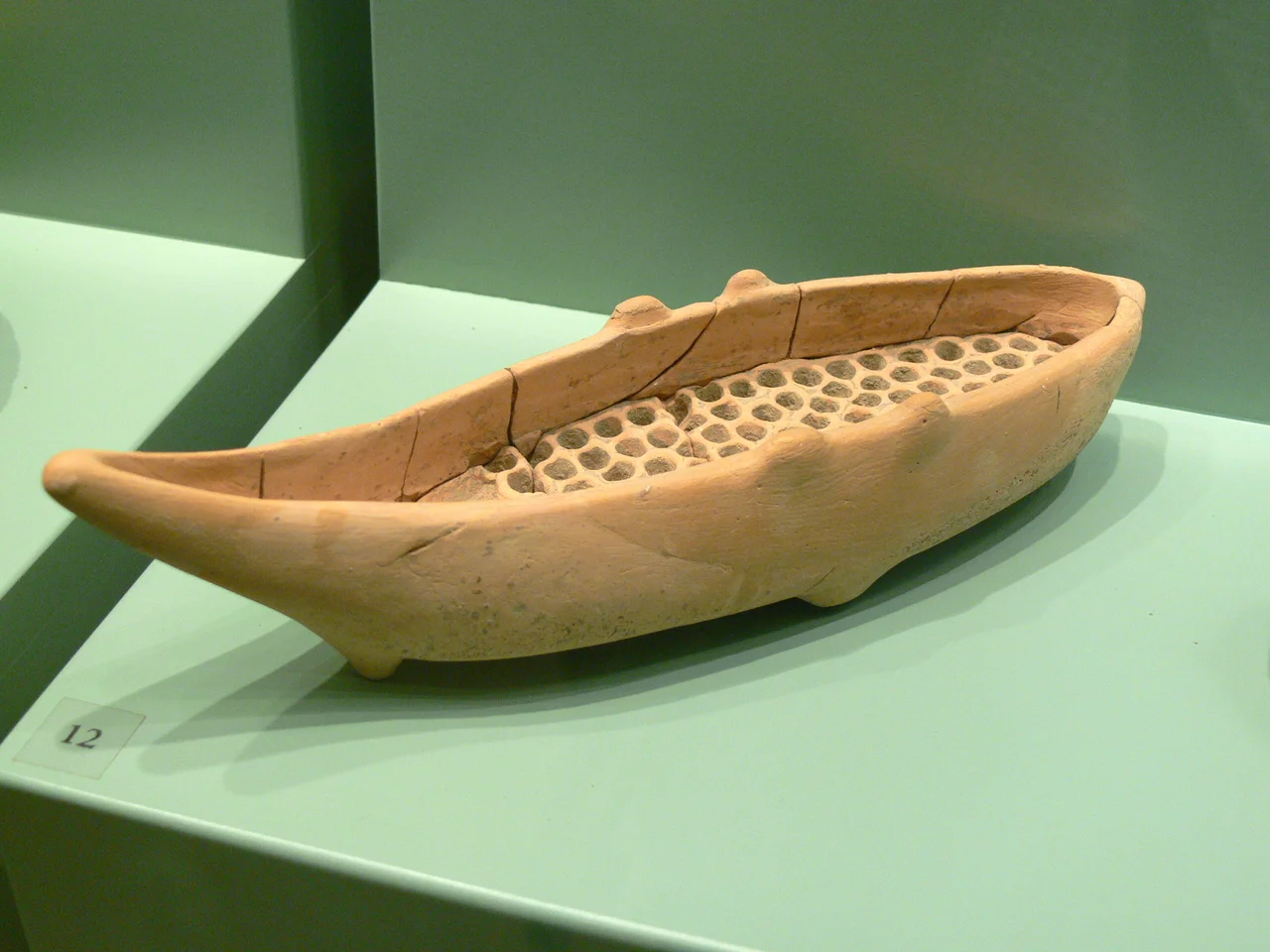
The Minoan collection runs from around 3200 BC into the Late Bronze Age. A marble Cycladic-type tall cup from 3200-2500 BC is among the oldest pieces. An early Minoan model of a wooden ship, found in the Asteroussia mountains around the Odegetria Monastery and dated 1900-1700 BC, is small enough to fit in a hand and detailed enough to identify the rigging. From Aptera comes a clay pyxis, a small lidded box used in funeral ceremonies between 1300 and 1250 BC. From a child's burial in eighth-century BC Crete comes a clay oxen wheel that scholars identify as a toy, the small thing a parent could not bear to leave out of the grave. A gold Greek diadem from later periods shows that Cretan goldsmiths kept their skill even as the island moved through Roman and Byzantine rule. The Late Minoan sarcophagus from the necropolis of Armeni, dated 1400-1200 BC, is the largest piece in the room, and it sits as a quiet anchor for everything else.
From the Air
Archaeological Museum of Chania at 35.5167°N, 24.0369°E, in the Halepa quarter east of the Venetian harbor of Chania. Visual altitudes 2,500-4,500 ft over the Bay of Chania show the harbor, the lighthouse, and Halepa's red roofs east of the old town. Chania International (LGSA, Souda) lies 7 nm east. White Mountains rise inland to 2,400 m and create rotor turbulence on north-wind days. Spring and autumn give the clearest air; summer brings strong afternoon sea breezes.
Nearby Stories
- Arkadi Monastery 3.1 km away
- Emirate of Crete 41 km away
- Minoan Palaces 74 km away
- Siege of Melos 96 km away
- The Eruption of Thera: The Volcano That May Have Destroyed Atlantis 97 km away
- Monemvasia Mosque 102 km away
- Monemvasia 129 km away
- Battle of Derna (1805) 298 km away