
Minoan Palaces
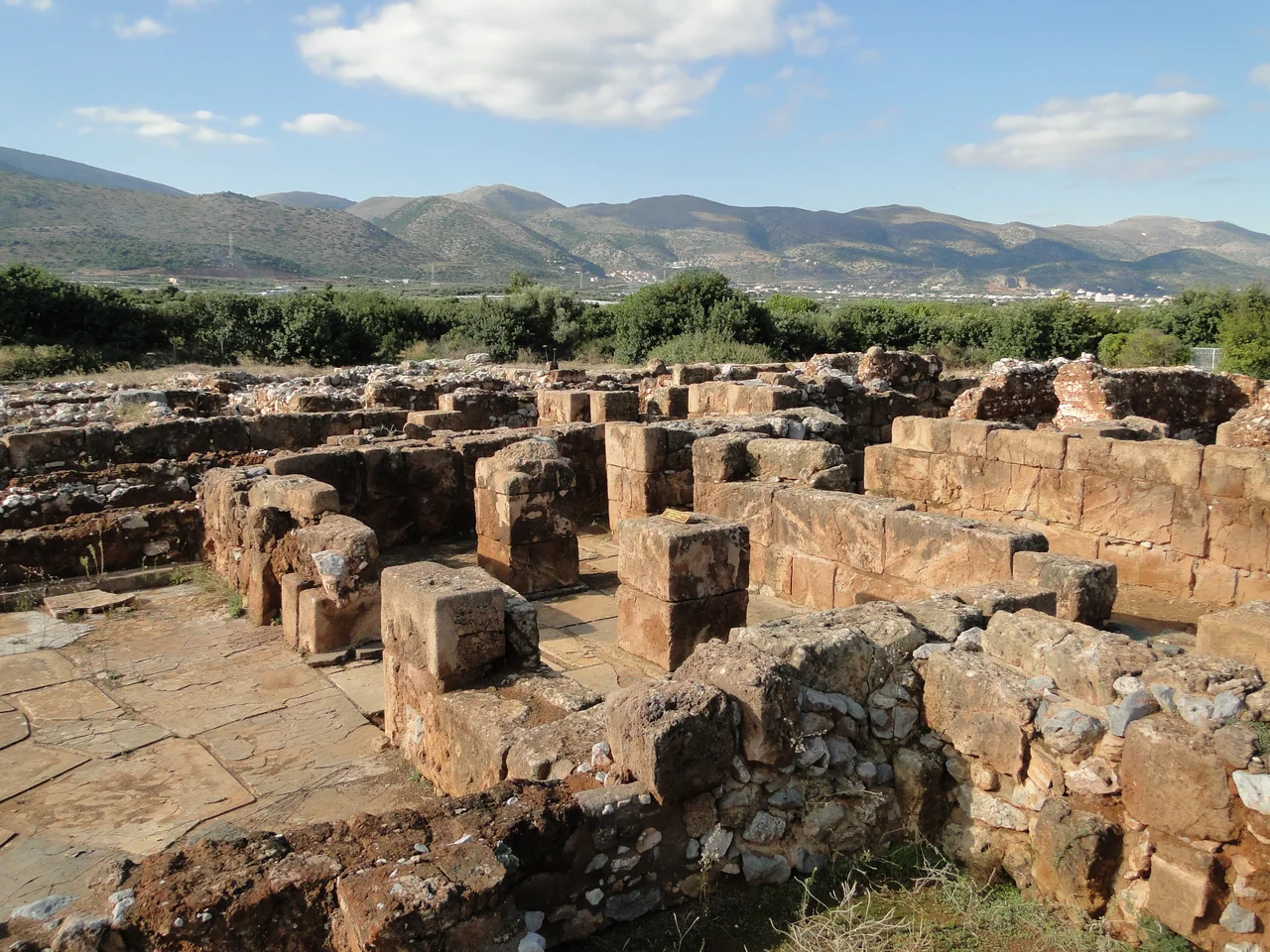
Call them palaces and you have already taken a position. Arthur Evans coined the term in 1900 when he uncovered the great complex at Knossos and decided he was looking at the seat of a Priest-King. A century of digging since has mostly dismantled that picture. The Minoans built no thrones we can confidently identify, left behind no clear royal tombs, and used these buildings for storage, ritual, manufacturing, and administration in proportions we still argue about. Some scholars now prefer 'court-centered building' as a phrase, neutral and accurate. But the word palace stuck because nothing else captures what it feels like to walk into one of these places: the central court opening like a stage, the labyrinth of side rooms, the staircases descending past lustral basins, the storerooms that once held more grain and oil than any single household could consume in lifetimes.
Six on an island
UNESCO recognized six Minoan palaces in 2025 as a single World Heritage cluster: Knossos, Phaistos, Malia, Zakros, Zominthos, and Kydonia. Five of them ring the productive lowlands of Crete. The sixth, Zominthos, sits high on the slopes of Mount Ida and may have served pilgrims climbing toward the sacred cave on its summit. Knossos, Phaistos, and Malia all share central courts of nearly identical proportions, roughly 24 by 52 meters, oriented north to south to catch the rising sun on the inner facade of the west wing. Zakros, on the eastern coast facing Egypt and the Levant, has a smaller court of about 12 by 29 meters and the air of a trading factory. Each palace is unique, each reuses the same architectural vocabulary, and each was rebuilt and remodeled so many times across roughly five centuries that the surviving plans are palimpsests.
The first builders
The first palaces rose around 1900 BC, but the ground beneath them had been gathering meaning for thousands of years. Communal feasts attested in the Neolithic happened in exactly the spaces that would later become the central courts. Walls dating to 2200 BC have been traced beneath the foundations at Knossos, suggesting that the move from village to palace was less rupture than crystallization. Earthquakes destroyed these first palaces around 1700 BC. The Minoans rebuilt them larger, with frescoes and pier-and-door partitions that could open whole rooms to the sky or close them tight against weather, and added ashlar facades borrowed from the Near Eastern temple tradition. Mount Juktas, the sacred peak south of Knossos, was always in the sightline; Mount Ida, holy to the storm god, anchored Phaistos. Geography was theology.
What the rooms reveal
The lustral basin is one of the strangest features. A small sunken room, reached by a short flight of steps, often decorated with religious frescoes, lacking any drain. Evans found unguent flasks in one and decided it was for ritual anointing. Others have read the basins as initiation chambers, or precursors to the classical adyton. The pillar crypt is stranger still: a windowless room with one or two squared pillars marked with the double-axe symbol. No one is certain what happened in either. The storage magazines are easier to read. Rows of pithoi, ceramic jars taller than a person, once held oil, wine, and grain in quantities that argue for centralized redistribution, even if some scholars now think the palaces consumed more than they produced. The Linear A tablets in their archives remain undeciphered, ancient script for an unknown language; the Linear B tablets, which appeared at Knossos only after a Mycenaean Greek elite took over the island, record sheep and figs and olives in an early form of Greek.
Fire on the island
Around 1450 BC, every Minoan palace except Knossos burned. Whether the fires were set by Mycenaean invaders from the mainland, by internal revolt, or by a chain of accidents in the wake of the Thera eruption a generation earlier remains argued. What is clear is that Knossos alone continued, now under Greek-speaking Mycenaean rulers who painted figure-eight shields and tribute processions over the older Minoan frescoes of nature scenes and ecstatic ritual. The bull endured as a symbol; one third of the surviving frescoes from this last phase show bulls. Knossos itself burned roughly a century later. After that, the palaces were over, and Crete entered the Iron Age as Greek territory. The labyrinth survived only as a story.
From the Air
Crete is a long east-west island roughly 35.0-35.6 N, 23.5-26.3 E. The six palaces span its length. Knossos sits at 35.30 N, 25.16 E just south of Heraklion (LGIR), the island's main airport. Phaistos lies at 35.05 N, 24.81 E on the south-central plain near Mount Ida. Malia is at 35.30 N, 25.49 E on the north coast. Zakros is at 35.10 N, 26.26 E on the east coast. Best aerial appreciation comes at 3,000-6,000 ft AGL across the lowland sites; Zominthos requires 5,000+ ft on the slopes of Mount Ida. Chania (LGSA) serves the western end, Sitia (LGST) the east. Watch for strong meltemi winds June-September.
Nearby Stories
- Archaeological Museum of Chania 20 km away
- Museum of Typography 32 km away
- Archaeological Museum of Agios Nikolaos 37 km away
- Siege of Chania (1645) 70 km away
- Santorini: The Volcano That May Have Destroyed Atlantis 99 km away
- Battle of Derna (1805) 288 km away
- Siege of Derna 316 km away
- Battle of Sidi Barrani 379 km away