
Museum of Typography
Yannis Garedakis printed a newspaper called Haniotika Nea in Chania for decades, and over those decades he kept finding old printing presses. A flatbed press from a defunct provincial paper. A lithograph stone from a closed workshop. A Linotype machine that had outlived three operators. He could not bring himself to scrap any of it. By the early 2000s, the storage room next to his press was full and he had begun renting a second room. In 2005, with his wife Eleni, he simply opened the door and called it a museum. Twenty years later, the Museum of Typography occupies 1,400 square meters in the Park of Small Industries in Souda, just east of Chania, and it is the only museum in Greece dedicated to the technology that turned the alphabet into mass communication.
The presses themselves
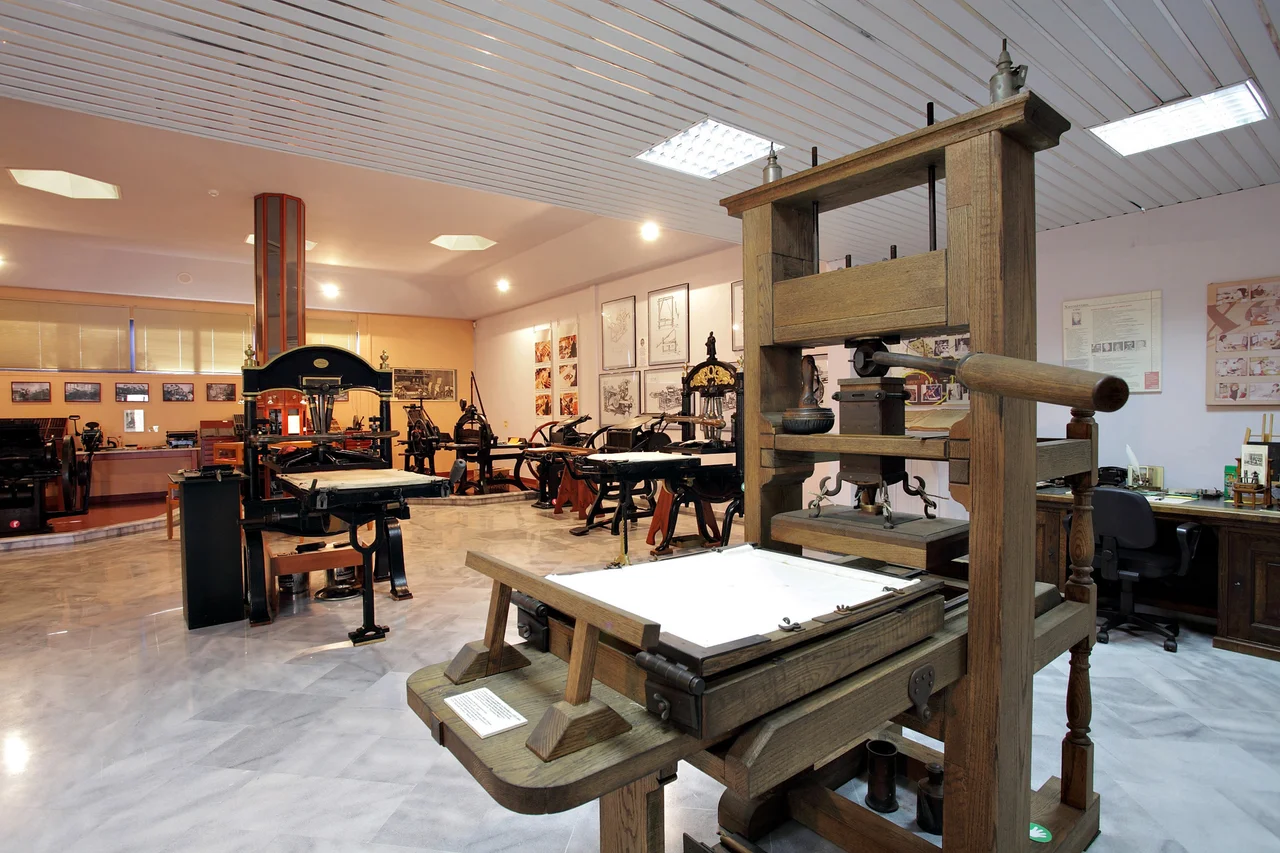
The main hall is dominated by two cast-iron flatbed presses from the early 19th century, each the size of a small car, each weighing more than a ton. Beside them stands a working replica of Gutenberg's wooden screw press from the 1450s, the technology that lit the Reformation and broke the church's monopoly on text. Foot-operated jobbing presses from Germany, the Netherlands, Switzerland, and Greece line the walls. Hand-operated Boston-type presses, small enough to carry, sit on benches where visitors are encouraged to ink them up and pull a sheet themselves. Two typesetting machines anchor the corner: a Linotype, which casts whole lines of metal type from molten lead at the touch of a keyboard, and a Monotype, which casts individual letters. Both still work. Both clank and hiss when you start them. Both are obsolete by half a century, and yet a generation of newspapermen still alive in Greece spent their working lives at machines exactly like these.
The techniques behind the headlines
A new wing added in 2012 walks the visitor through every printing technique the museum has the equipment to demonstrate. Lithography, where ink clings only to the parts of a flat stone an artist has drawn on with grease. Offset printing, the modern descendant. Wood engraving and copper engraving, the high crafts of 18th and 19th century book illustration. Silk screen, the technique that gave the 20th century everything from concert posters to Andy Warhol. One showcase presents the Braille writing method for the blind, donated by the Lighthouse for the Blind of Greece, and lets visitors run their fingertips over raised dots that translate the same alphabet the printing presses set in lead. Another exhibit traces the history of writing itself, mounted as visual essays by the Greek graphic designer Antonis Papantonopoulos.
Crete in print
The last hall is the museum's quiet heart. Behind glass sit rare books and newspapers from the 16th through the 19th centuries, many of them printed in Venice, where the Greek diaspora maintained printing houses while Crete itself was first under Venetian and then under Ottoman rule. The Cretan Wars, the Greek Revolution, the union of Crete with Greece in 1913: the events arrive on the page as broadsheets and woodcuts and engraved maps, censored, smuggled, finally legal. The museum library holds twenty thousand volumes and adds more each year. There are also typewriters here, an underrated piece of communication history, and stacks of polygraphs, the carbon-copy machines that ran the Greek civil service for most of the 20th century. The exhibits all carry labels in both Greek and English, with dates of manufacture and operation.
Young printers
More than five thousand schoolchildren visit the museum every year, brought by their teachers from across Greece. The educational programs are approved by the Greek Ministry of Education, and the kids are not just shown the presses; they are handed composing sticks and metal type and walked through how to set their own names in mirror image, lock them into a chase, ink the form, and pull a print. A 19th-century iron press in the back of the new wing exists for exactly this purpose. Watching an eight-year-old's eyes when the paper comes off the press and they see their own letters in real ink is, the museum's staff will tell you, the whole reason the place exists. The Museum of Typography joined the Association of European Printing Museums in 2012, was nominated for European Museum of the Year in 2016, and joined the European Route of Industrial Heritage in 2020. None of this gets advertised much. Garedakis just wanted the presses to keep printing.
From the Air
35.480 N, 24.066 E. The museum sits in the Park of Small Industries in Souda, on the eastern edge of greater Chania on northwestern Crete. Best viewed from 2,000-4,000 ft AGL with the deep natural harbor of Souda Bay to the north as a landmark. Chania International (LGSA), used jointly with the Greek Air Force at Souda Air Base, is 4 km north and offers easy approach. The White Mountains rise dramatically to the south. Watch for military traffic and meltemi summer winds out of the north.
Nearby Stories
- Arkadi Monastery 12 km away
- Battle of Cape Spada 33 km away
- Santorini: The Volcano That May Have Destroyed Atlantis 110 km away
- Monemvasia Mosque 120 km away
- Monemvasia 148 km away
- Battle of Derna (1805) 279 km away
- Siege of Derna 297 km away
- Operation Battleaxe 409 km away