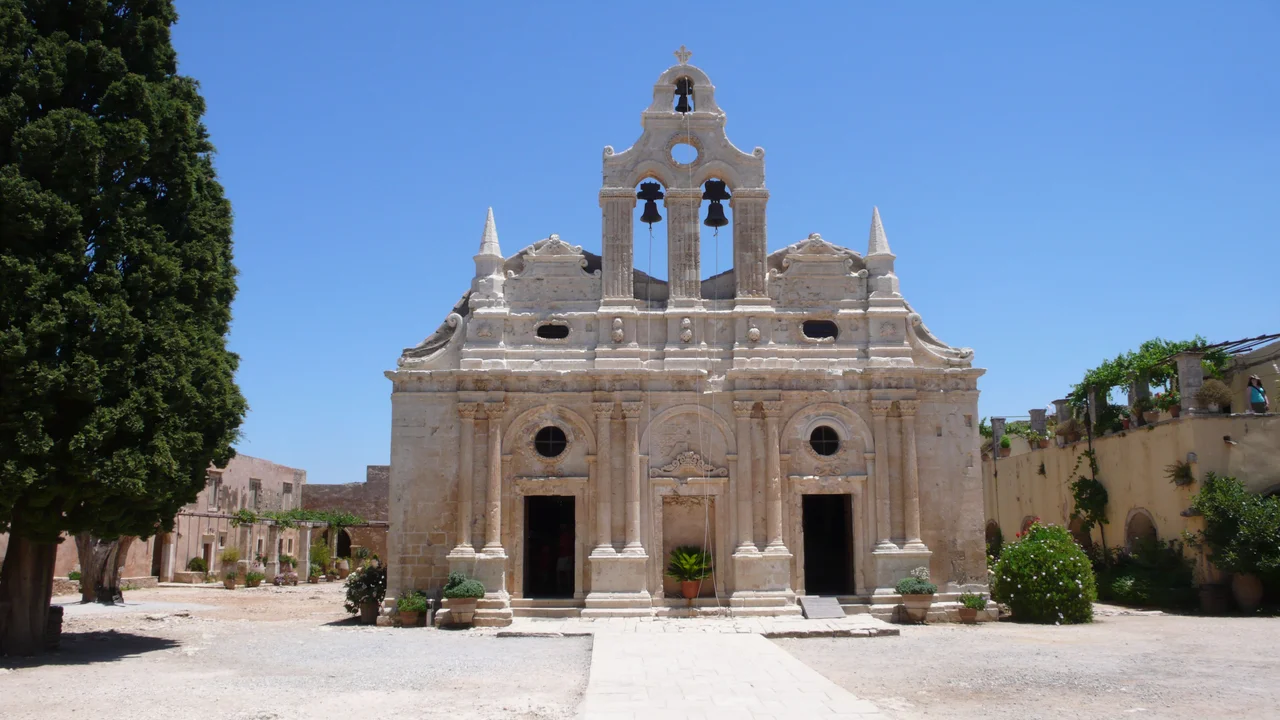

Arkadi Monastery
On the morning of November 9, 1866, the people sheltering in the powder magazine at Arkadi could hear the Ottoman troops at the door. Most were women and children. They had taken refuge in the monastery three weeks earlier, bringing their valuables, hoping the thick walls and the stone bell tower would shelter them. Now the walls had been breached, the men outside were dead or dying, and a Cretan named Konstantinos Giaboudakis stood with a torch over barrels of gunpowder. What he did next made Arkadi a name known across Europe and turned a quiet sixteenth-century monastery on a Cretan plateau into a place that has been understood, ever since, as a wound.
The Plateau Below Mount Ida
Arkadi sits 23 kilometers southeast of Rethymno, on a fertile plateau 500 meters above sea level on the northwest slopes of Mount Ida. Crete's tallest mountain rises to the south. Vineyards and olive groves cover the surrounding hills; pine, oak, and cypress mark the gorges that fall away from the western edge of the plateau. The Greeks of antiquity considered Mount Ida sacred because Zeus, according to legend, was hidden in a cave on its slopes as an infant. Five kilometers northeast of the monastery, the ancient city of Eleftherna had its cultural peak in the time of Homer. The monastery stands in country that has been continuously inhabited for three thousand years, and its founders chose the site for the same reasons everyone else had: water, soil, defensibility, and the long shadow of a holy mountain.
Renaissance Behind a Fortress Wall
The current church was built between 1562 and 1587 under the hegumen Klimis Chortatzis, from the same Rethymno family that gave Crete its great Renaissance poet, Georgios Chortatzis, author of Erofili. The building is a Renaissance Revival basilica with two naves: one dedicated to the Transfiguration of Christ, the other to Saint Constantine and Saint Helen. Four pairs of Corinthian columns frame the facade, set on Gothic pedestals. Above them sit a clock and two Gothic obelisks. Crete was a colony of Venice when Klimis directed the work, and the church carries the colony's stylistic mix - classical proportions, Gothic detail, the looking-both-ways quality of a Cretan Renaissance that was its own thing rather than an imitation of Italy. Around the church the monastery formed a near-rectangle of thick walls, embrasures, and tight gates. It was a working community: stables, refectory, library, school, hospice, with vineyards making a wine the hegumen called Malvoisie.
Two Centuries of Occupation
The Ottomans took Crete from Venice in 1669 and held it for two and a half centuries, longer than the United States has existed. The Cretans rose against them again and again. The London Protocol of 1830 freed mainland Greece but explicitly excluded Crete. By the 1860s, the island was full of grievances - taxation, religious discrimination, the Sultan's reluctance to apply the reforms promised in the 1856 Treaty of Paris. By the autumn of 1866, the latest revolt was three months old and Mustafa Naili Pasha, the Ottoman governor of Crete, was marching fifteen thousand troops with thirty cannon toward the monastery where the Rethymno revolutionary committee had based itself. Inside Arkadi when his army arrived: 964 people, of whom 325 were men, 259 of those armed. The rest - 639 women, children, and unarmed men - had come for shelter.
Three Days, Two Decisions
The siege began on November 7. The Cretans inside, commanded by Ioannis Dimakopoulos under the moral authority of the hegumen Gabriel Marinakis, had been advised by a career military officer named Panos Koronaios that the monastery was not defensible. They had decided to defend it anyway. For two days the Ottoman cannon battered the walls; for two days the Cretans returned fire. On the night of November 8, two Cretans climbed out of windows on ropes, disguised themselves as Turks, slipped through enemy lines, and rode to ask for relief from the rebels in the Amari valley. They came back with the news that all roads were blocked. By the morning of the ninth, the western gate was breached and Ottoman troops were inside the monastery. Thirty-six fighters retreated to the refectory and were killed when the door was forced. The remaining hundreds - women, children, the unarmed - were in the powder magazine.
The Choice in the Powder Room
What Konstantinos Giaboudakis did is impossible to think about clearly, but it has been thought about for a hundred and sixty years. He set fire to the powder. The explosion killed nearly everyone in the magazine - estimates of the dead inside Arkadi over the three days run to roughly 864, of whom most were non-combatants - and a great many of the Ottoman soldiers in the room and on the wall above it. Ottoman casualties from the battle and explosion combined are estimated at over 1500. There is no sanitized way to describe this. Mothers held children. People were burned alive. The hegumen Gabriel had been killed earlier in the fighting. The remaining fighters were captured, the survivors taken prisoner. After the explosion, the Ottoman dead were buried without memorials in the gorges below. The remains of the Cretan dead were collected over the following years and placed in the old windmill outside the western wall, which became a reliquary.
The World Looks at Arkadi
What Giaboudakis and the others may not have known was how widely the news would travel. Victor Hugo wrote letters from exile, published in the Trieste newspaper Kleio, comparing Arkadi to the Destruction of Psara and the Third Siege of Missolonghi. Giuseppe Garibaldi wrote in support of the Cretans; Italian volunteers sailed to fight on the island. The American public was sympathetic; the U.S. House of Representatives debated, and rejected, recognition of Cretan independence in 1868. The revolt itself ended in defeat, and Crete remained Ottoman until 1898. But Arkadi entered the European political imagination in the way that Guernica would later, or My Lai - as the name of an event after which a particular argument could no longer be made. November 8 is the Cretan day of remembrance. The windmill is still a reliquary. The walls still bear the cannon scars.
From the Air
35.31 N, 24.63 E. Arkadi sits on a small plateau 22 km southeast of Rethymno on Crete's north coast, on the northwest flank of Mount Ida (Psiloritis), Crete's highest peak at 2456 meters. From cruising altitude, Mount Ida is the unmistakable mass at the center of the island; Arkadi is on its northern slopes. Nearest airport is Chania (LGSA), 60 km west; Heraklion (LGIR) is 75 km east. The plateau drops sharply into gorges on its western side, distinctive from the air. Best viewing in late morning before the inland clouds build over Mount Ida; afternoon thermals on the lee side can produce moderate turbulence.
Nearby Stories
- Archaeological Museum of Chania 20 km away
- Museum of Typography 32 km away
- Archaeological Museum of Agios Nikolaos 37 km away
- Siege of Chania (1645) 70 km away
- Santorini: The Volcano That May Have Destroyed Atlantis 99 km away
- Battle of Derna (1805) 288 km away
- Siege of Derna 316 km away
- Battle of Sidi Barrani 379 km away