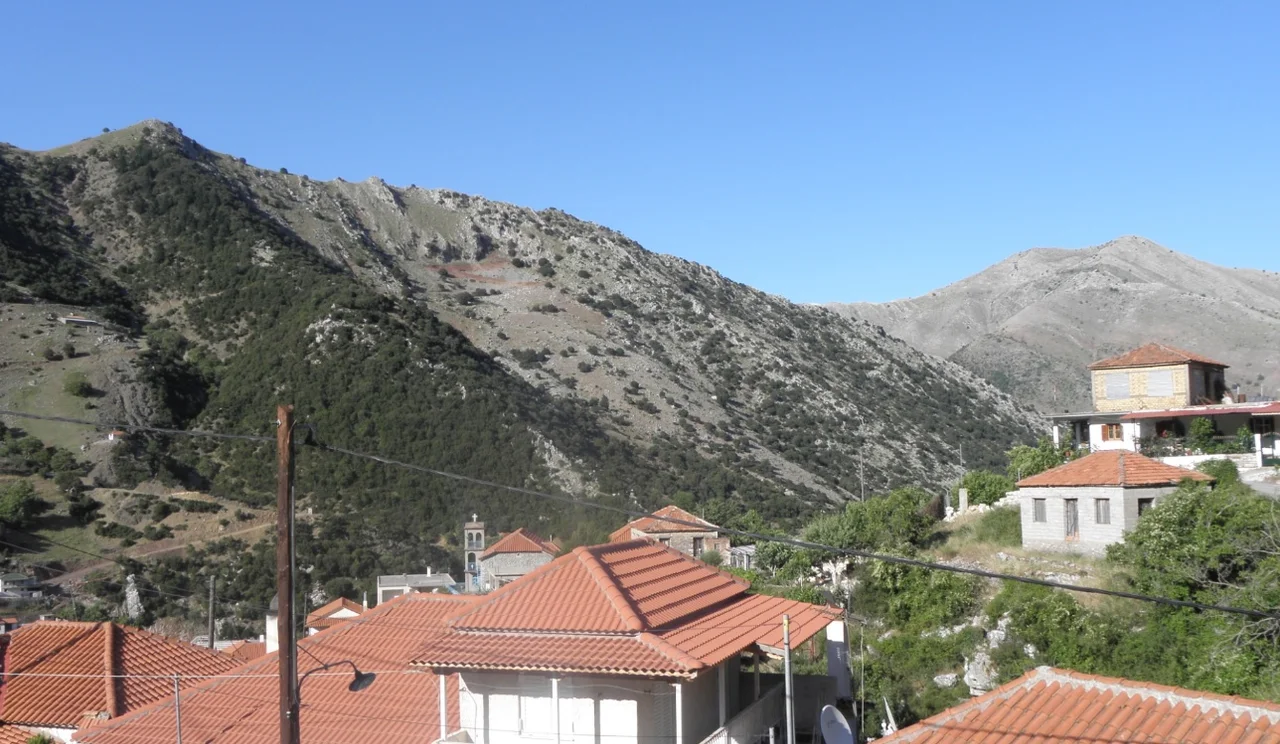

Astras
In 1930, a poet named Theodoros Ksudis looked at this village and wrote: "You hide immortal souls / In your deep forests / And you show yourself to the sky / Like a sky with eyes." He was not exaggerating for effect. The settlement that is now called Astras, built into the forested mountains near the border between Achaea and Elis, has been keeping its secrets for a long time — first as the ancient place called Nousa, then as a Venetian-administered village, then as a hotbed of klephts who fought the Ottoman occupation from the ridges above. The mountains here are not merely scenery. They were, for centuries, a refuge.
Ancient Nousa and Its Origins
The area around Astras has been inhabited since ancient times under the name Nousa, situated a few kilometers from the confluence of rivers at Tripotama. In antiquity, the settlement was part of the territory of Psophis, a city mentioned in Homer's Iliad and significant enough to anchor the surrounding district. Sculptures and other objects of daily use found in the neighborhood of Kaluvia of Astras — the lower settlement — attest to this ancient connection.
Proper historical records for the village begin during the Byzantine period, but the defining rupture came early in that era. In 398 AD, the Visigoth king Alaric I swept through the Peloponnese and destroyed ancient Psophis. The historian Zosimus, writing roughly fifty years after the destruction, recorded that only a few citizens returned to the ruined city. The region did not simply empty, however — the mountain villages above carried on, and Nousa persisted among them. After the fall of Byzantium, the area passed into the hands of the Republic of Venice. When the Venetian census-taker Francisco Grimani came through in 1700, he counted 174 inhabitants in Nousa — 92 men and 82 women, living in 34 families — a remarkably precise snapshot of a mountain community on the edge of the Venetian world.
Klephts and the Cause of Freedom
Under Ottoman rule, the pressures on Nousa were particular. The village suffered especially from Ottoman forces based at the town known as Lala, and the response was characteristic of highland communities throughout Greece: the Nousaites became klephts. The word carries a literal meaning of "thieves," but in the context of Ottoman-era Greece it described armed irregulars who lived in the mountains, outside the control of the occupying administration, and who combined banditry with resistance. For many communities, the klephts were heroes.
Many of Nousa's freedom fighters went on to participate in the Greek War of Independence. According to the National Library of Greece, those who fought from the village included Nikolaos Koulis, Chrysanthos Koulis, Demetrius Karachioutis, Konstantinos Stathopoulos, Vasileios Makris, Aggellis Makris, and Panagiotes Makris — the last known as Makropanagos, who was a relative of the celebrated Giannias, a figure who became feared by the Turkalbanian forces operating in the region of Patras. After liberation, Nousa was incorporated into the Municipality of Lampeia, and in 1997 the village — now called Astras — became part of the municipality of Lampeia under the Kapodistrias administrative reform, and in 2011 part of the municipality of Ancient Olympia under the Kallikratis reform.
The Asketerion of Osios Meletios
Set into the mountainside above the village is the Asketerion of Astras, a two-story structure carved and built within the rock itself. Through its entrance, a ladder of stone leads to the upper floor, where a small chapel holds an image of the Virgin Mary in the style known as Platytera. Near it stand the ruins of the church of Saint John.
The Asketerion was built in the ninth century by Osios Meletios, a monastic founder who established numerous monasteries across this region and its neighbors. The word "asketerion" describes a place of ascetic practice — a hermitage or small monastic cell rather than a great cenobitic foundation. Carved into the living rock of a mountain in a region that had been sending its young men out as mountain fighters for centuries, the Asketerion represents a different kind of endurance: the contemplative life persisting in the same terrain that the klephts would later use as cover.
A River of Myth, a Village of Today
The river Erymanthos flows through the area near Astras, and tradition places one of the labors of Heracles here: the capture of the Erymanthian boar, the great wild pig of the mountain. The myth attaches itself naturally to terrain like this — steep, forested, the kind of landscape where large animals could plausibly hold out against pursuit. Whether or not anyone in the village thinks much about Heracles, the river still runs cold from the mountain heights.
As of the 2011 census, Astras had a population of 132 people, down from 143 in 2001. The village retains what local descriptions call its "traditional character," with most residents involved in agriculture. In summer it draws tourists — the forests, the Asketerion, the mountain air, the road through to Lampeia. The annual feast of Saint George, the village's protector, remains the social anchor of the year. Toward the lower end of the settlement lies Kaluvia of Astras, and a mountain road through the fir forest connects the village to Lampeia, formerly called Divri. The village is small and quiet; the mountains around it hold a history that is anything but.
From the Air
Astras lies at approximately 37.897°N, 21.844°E in the mountains near the Achaea-Elis border, at moderate elevation in heavily forested terrain. From the air, the village is visible as a small clearing in the fir-covered ridges above the Erymanthos river valley. Recommend viewing at 4,000–6,000 feet to appreciate how completely the forest envelops the settlement and how the mountain road winds through it. The nearest major airport is LGRX (Araxos/Patras), approximately 55 km to the northwest. Visibility in these mountains can close rapidly when cloud moves in from the Corinthian Gulf; approach from the north in clear conditions.
Nearby Stories
- Battle of Picotin 6.3 km away
- Dimitsana 6.4 km away
- Phlius 13 km away
- Salmeniko Castle 14 km away
- Battle of Lepanto 14 km away
- Pyramid of Hellinikon 16 km away
- Antikyra 29 km away
- Strofades 56 km away