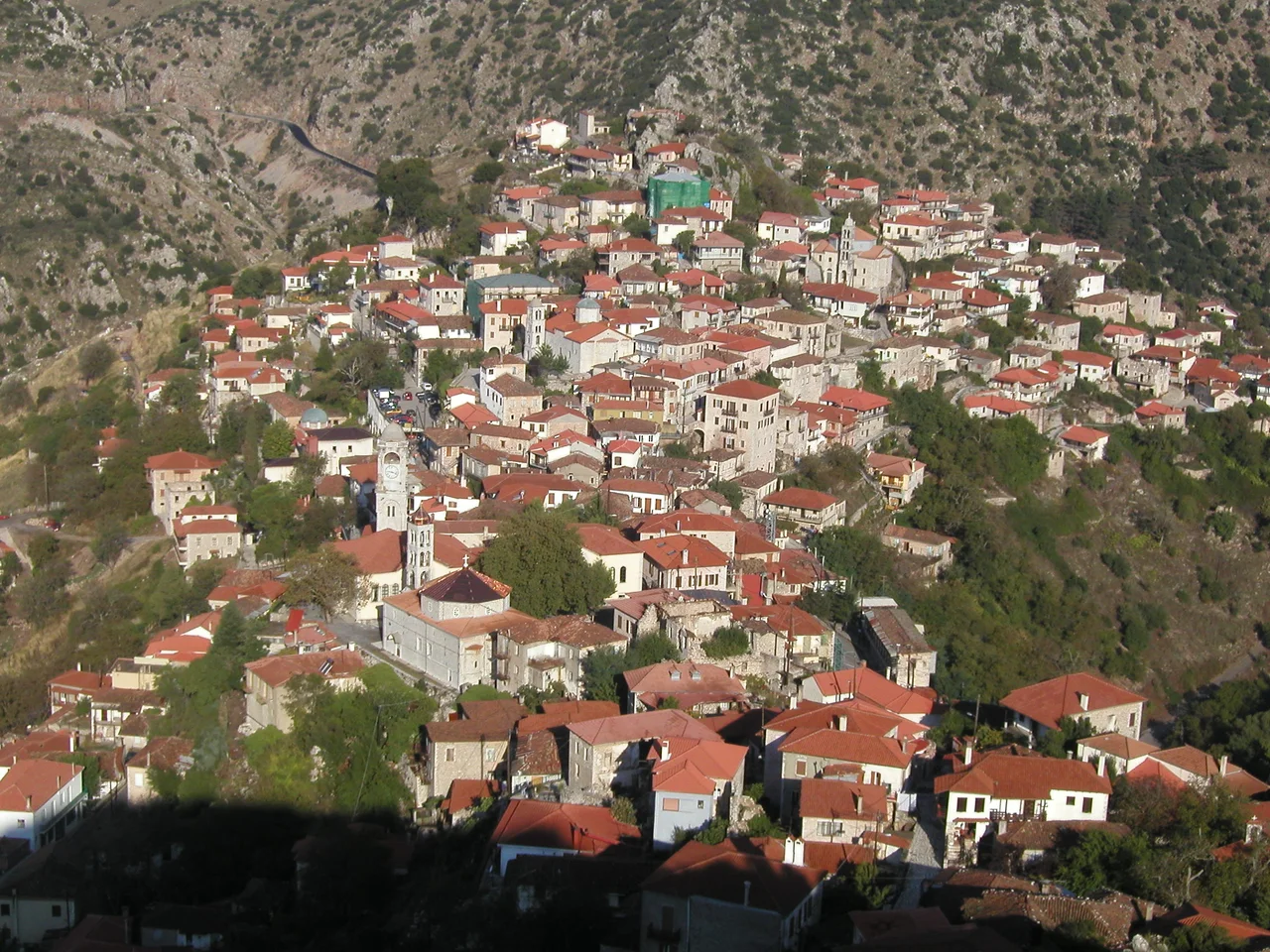

Dimitsana
In the middle of the 18th century, a bishop named Ananias Lakedaimonias quietly set up what appeared to be small home industries on the slopes of a mountain village in Arcadia. They were, in fact, gunpowder mills — built in secret, concealed from Ottoman authorities, and designed to arm an uprising. The plan was discovered in 1764, and Ananias and his partners were killed for it. But the mills were not forgotten. When the Greek War of Independence broke out in 1821, Dimitsana's fourteen gunpowder mills ran day and night, supplying the revolution with its most essential commodity. The village earned a name that still echoes: "the Nation's powder keg."
The Amphitheater on the Hillside
Dimitsana sits at 950 meters on a mountain slope in the Gortynia region of Arcadia, built over the ruins of the ancient town of Teuthis — a settlement that once sent warriors to Troy and later contributed colonists to Megalopolis. The village faces south, and from that side the view opens wide across the Megalopolis plain to the distant peaks of the Taygetus range. Stone-built mansions line the narrow streets, most of them now restored, their facades a characteristic sample of the local Gortynia architecture. The village has been officially registered as a traditional settlement, a designation that protects its historic character. Philosophou Monastery, founded in 963, stands 2.5 kilometers away in the gorge of the Lousios river — an anchor of spiritual life here for over a thousand years.
The Nation's Powder Keg
The story of Dimitsana and the revolution is not only about the mills themselves but about the knowledge that sustained them. In 1764, the same year Ananias was killed, a monk named Agapios built a library in the village and transferred books there from the monastery. The library grew steadily, supported by donations from the Ecumenical Patriarchate in Constantinople, and beside it a seminary flourished — the Phrontisterion Hellenikon Grammaton, the "Tuition Centre of Greek Literature." Bishops and scholars graduated from it across the decades. Among them were Gregory V, who became Ecumenical Patriarch of Constantinople, and Germanos III of Old Patras. Both men's family houses still stand in Dimitsana today. When the war came in 1821, the mills consumed so much paper for their gunpowder cartridges that a large portion of the library's books were destroyed — the written word converted into the means of liberation.
Gregory V: The Patriarch from the Mountains
Gregory V was born in Dimitsana in 1746, the son of a local family. He studied at the village's seminary before rising to become Ecumenical Patriarch of Constantinople — the spiritual leader of Orthodox Christianity worldwide. His relationship with the Greek independence movement was complicated: he publicly condemned the uprising, likely in an effort to protect the broader Orthodox community under Ottoman rule. The Ottomans did not believe him. On Easter Sunday, April 10, 1821, he was arrested and hanged in his full clerical vestments at the gate of the Patriarchate in Constantinople. The gate through which he was led remains closed to this day. His execution provoked outrage across Europe and generated a surge of sympathy for the Greek cause. A statue of Gregory V now stands in Dimitsana's central square, and his family home is preserved as a site of memory.
Water, Stone, and Memory
The Open-Air Water Power Museum, established in 1997 just outside the village, brings the pre-industrial landscape back into focus. Created by restoring abandoned facilities, it includes a functioning flour mill, a tannery, a tanner's house, a traditional cauldron, and — completing the circle — a gunpowder mill. Visitors can walk through the mechanisms that once defined economic life in this mountain community. Inside the village, Dimitsana's library now holds approximately 35,000 books, manuscripts, and documents, along with museum collections of weaving, looms, handicrafts, and archaeological finds. The Elementary School, funded by a donation from financier Andreas Syngros and built between 1898 and 1910, first served as a girls' school and later as a county court. In the gorge below town, both the Old and New Philosophou Monastery and the Prodromou Monastery nestle into the walls of the Lousios — reminders that this landscape has always been shaped by people who came here not only for shelter, but for something harder to name.
From the Air
Dimitsana is located at 37.595°N, 22.040°E in the Arcadian highlands of the central Peloponnese, at approximately 950 meters elevation. The village is visible from altitude as a cluster of stone structures on a prominent mountain slope, with the Lousios gorge cutting deeply to the west and the Megalopolis plain opening to the south. The nearest major airport is LGKL (Kalamata International), approximately 75 km to the southwest. Approach from the south offers the best views of the village's amphitheater-like setting against the ridge. Clear weather provides sightlines to the Taygetus range beyond the plain.
Nearby Stories
- Battle of Meligalas 5 km away
- Battle of Picotin 13 km away
- Kastanitsa 13 km away
- Phlius 14 km away
- Cleitor 16 km away
- Pyramid of Hellinikon 16 km away
- Agios Andreas, Katakolo 19 km away
- Strofades 39 km away