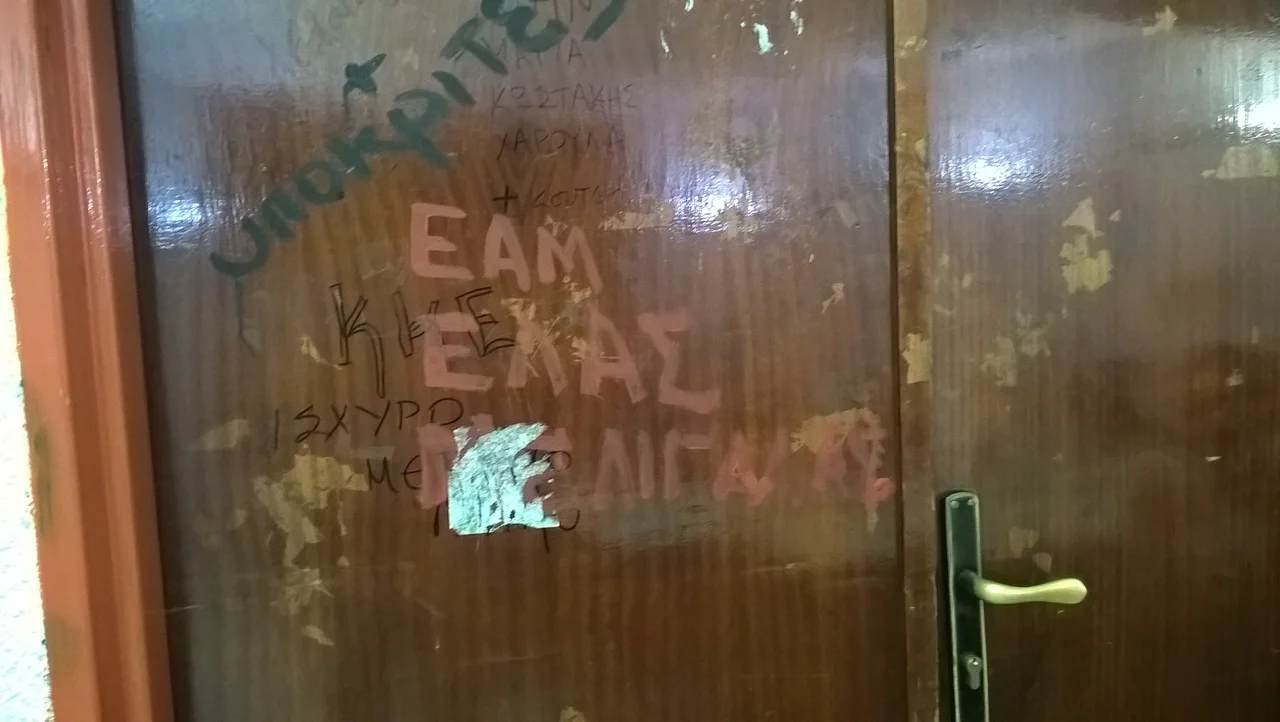

Battle of Meligalas
On 13 September 1944, ELAS — the Greek People's Liberation Army, the armed wing of the left-wing resistance movement EAM — began its siege of Meligalas, a town in Messenia where around a thousand members of the collaborationist Security Battalions had gathered as the German army withdrew from the Peloponnese. Two days later, the town fell. What happened in the days that followed — the executions, the bodies cast into a well at the edge of town — has not stopped being argued about in Greece in the eight decades since.
The Context of Occupation
The Security Battalions were Greek paramilitary units formed under the Axis occupation governments from 1943 onward. They participated in anti-guerrilla operations alongside German forces, and their actions against partisan-supporting villages — burning homes, carrying out reprisals — made them deeply hated in much of rural Greece. The resistance movement EAM/ELAS regarded them as collaborators subject to the death penalty under wartime legislation issued by PEEA, the Political Committee of National Liberation. At the same time, the British, who backed the Greek government in exile, had by 1944 begun to consider incorporating the Battalions into a post-war national army, and worked to prevent their destruction. This political tension — between the resistance's demand for accountability and the Allies' strategic calculations — shaped the final weeks of the occupation at every level, including at Meligalas.
The Siege and Its Aftermath
As the Red Army's advances in Romania accelerated the German withdrawal from Greece in late August 1944, the collaborationist forces in the Kalamata area retreated to Meligalas. ELAS forces encircled the town. After two days of fighting, on 15 September 1944, the ELAS forces broke through. Hundreds of Security Battalion members were captured. ELAS commander Aris Velouchiotis arrived in the town shortly after its fall. According to a contemporary report preserved in the archives of the Communist Party of Greece, some of the prisoners included inhabitants of the village of Skala, which German forces had burned. In the chaos following the town's capture, an enraged crowd broke through the ELAS militia's lines and lynched some prisoners; twelve others were hanged from lampposts in the central square. Executions of captured Battalionists followed over the subsequent days. The bodies of many were thrown into a well — the Pigada, in Greek — at the town's edge.
Counting the Dead
The number of people who died at Meligalas is itself a matter of historical contest, and the estimates vary widely depending on their source. An ELAS communique of 26 September 1944 reported 800 killed. A Red Cross report, described by observers as attempting objectivity, stated that the number of dead 'exceeded 1,000.' A forensic team recovered 708 corpses from the well approximately a year later. Right-wing sources after the war cited figures ranging from 1,110 to over 2,500 victims. Left-leaning accounts calculated a much lower total: approximately 120 killed in combat and 280 to 350 executed. The monument erected at the Pigada site records 787 names from 61 towns and villages. No figure has been accepted by all parties, and the disagreement over the numbers has itself become part of the political argument about what Meligalas means. Behind every count were individual people — men who had made a choice to join the Battalions, and who now paid for that choice with their lives, regardless of what drove them to join in the first place.
Memory and Division
After Greece's Civil War ended in 1949 with the defeat of the left, the right-wing governments that followed treated Meligalas as a symbol of what they called 'communist barbarity.' Annual memorial services were held, attended by official state representatives. In the speeches and newspaper announcements, the victims were consistently referred to as 'murdered patriots' or 'national-minded persons' — with their membership in the Security Battalions omitted. The ELAS attack on a collaborationist stronghold became, in this retelling, simply an attack on Greek citizens. After the fall of the military dictatorship and the democratic transition of 1974, the political valence of the commemorations slowly shifted. In 1982, the socialist PASOK government declared that the official commemorations had promoted division for forty years and withdrew state participation. The memorial was thereafter organized by the 'Society of Victims of the Meligalas Well,' established in 1980. In recent decades, the anniversary has drawn relatives of the victims alongside far-right groups, while the left has used the name Meligalas to assert the legitimacy of resistance to fascist collaboration. The events of those September days in 1944 have never settled into consensus. They remain, in Greek political life, an open wound.
From the Air
Meligalas sits at approximately 37.223°N, 21.954°E in the Messenian plain, northeast of Kalamata. From the air at 2,000–4,000 feet, the town is visible as a small agricultural settlement amid olive groves and fields. The Pigada well site lies at the town's edge toward Neohori, where a monument now stands. The nearest airport is Kalamata International (LGKL), approximately 22 km to the southwest. The surrounding terrain — flat, open, and fertile — gives little suggestion from altitude of the events that took place here in September 1944.
Nearby Stories
- Agios Sostis 1.5 km away
- Karyes 13 km away
- Koroni 13 km away
- Dimitrios (Shipwreck) 16 km away
- Pyramid of Hellinikon 22 km away
- Agios Andreas, Katakolo 28 km away
- 2023 Messenia Migrant Boat Disaster 34 km away
- El-Kouf National Park 464 km away