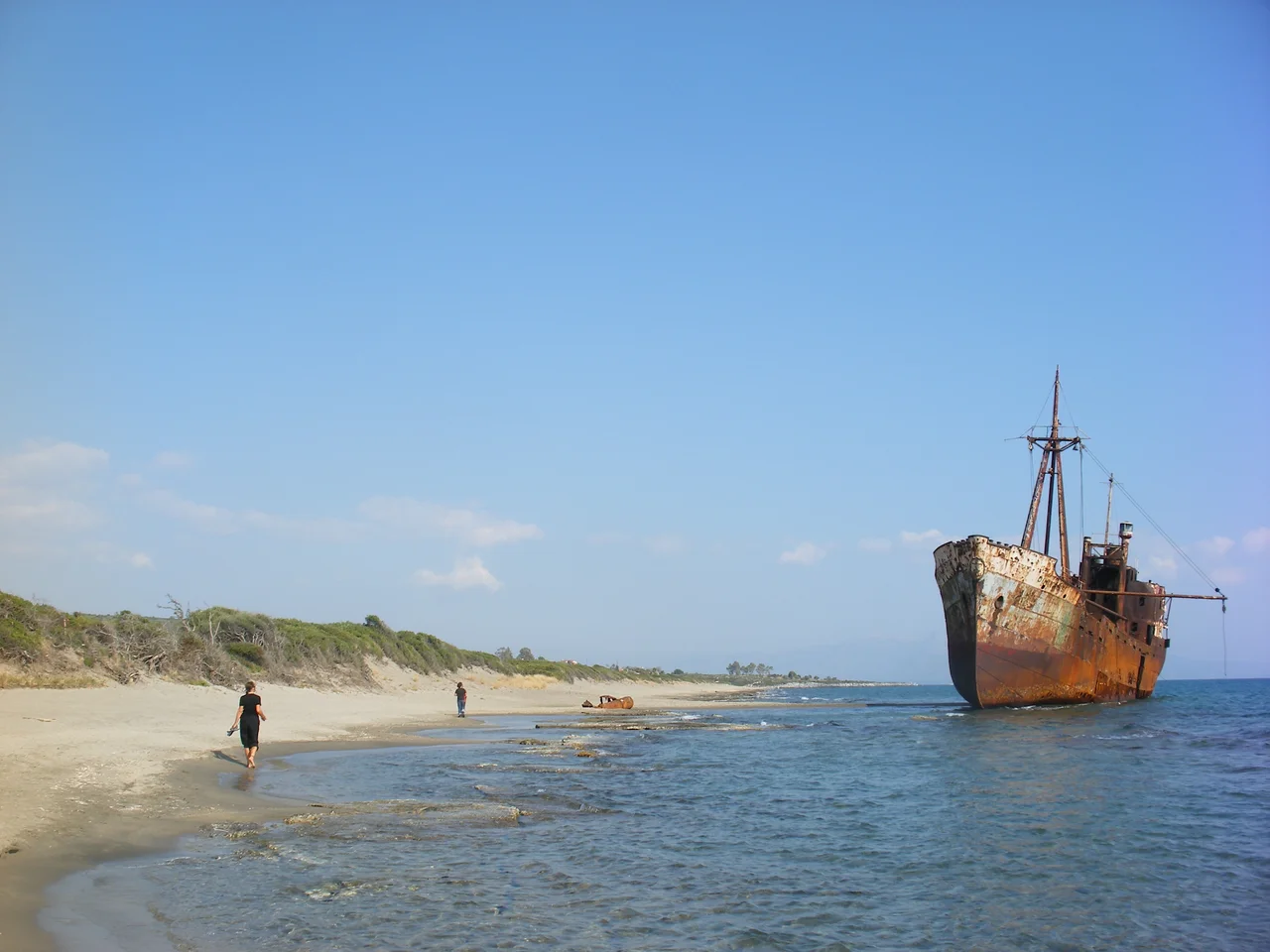

Dimitrios (Shipwreck)
The ship arrived at Gytheio under emergency circumstances in December 1980, its captain ill, its finances complicated, its future uncertain. It stayed for more than a year. Then storms pushed it out of the harbor twice, and by 23 December 1981 it had settled into its current position on the sandy beach at Valtaki, about 5 kilometers south of the port. Nobody came to move it. The owners did not respond. The Dimitrios simply stayed, slowly rusting, slowly becoming something it had never been designed to be: a landmark.
A Modest Ship with a Complicated Past
The Dimitrios was originally named *Klintholm*. Built in Denmark in 1950, it was a small cargo vessel — 67 meters long, rated at 965 gross register tons. By the time it reached Laconia, it had been re-registered in the Prefecture of Piraeus under number 2707 and was owned jointly by two Greek families: 76.75 percent by the Molaris Brothers (Αφοί Μόλαρη) and 23.25 percent by the Matsinos Brothers (Αφοί Ματσινού).
According to Vice Admiral Christos Dounis (1935–2010), former Chief of the Hellenic Coast Guard, who documented Greek shipwrecks in his book *Ta nauagia stis ellinikes thalasses* (The shipwrecks of the Greek seas), the ship made an emergency docking at Gytheio on 4 December 1980 because the captain needed hospital care for a serious illness. After that, financial disputes with the crew emerged, engine problems multiplied, and various lenders imposed insurance measures. The crew was dismissed. Two men — Georgios Daniil and Vasilis Parigoris — were assigned to guard the vessel.
From Port to Beach
The Dimitrios sat at Gytheio through the winter and spring of 1981. By June, port authorities declared it unsafe: the docking ropes were worn through, and the hull was taking on water on the starboard side. They asked the owners to move the ship to an anchorage outside the port. The owners did not respond until November.
On 9 November 1981, at approximately 12:30 p.m., according to Dounis's account, severe weather swept the ship about 3.7 kilometers from its moorings. A temporary anchor held it for a few weeks. Then the anchoring failed too. On 23 December 1981, the Dimitrios ran aground at Valtaki beach. No salvage operation was ever attempted. The ship was simply left where it sat.
The Stories People Tell
The documented history is unglamorous — illness, debt, neglect, storm, abandonment. But the Laconian imagination filled the gap that paperwork left. The most widely circulated story holds that the Dimitrios was seized by port authorities while engaged in cigarette smuggling between Turkey and Italy, then deliberately released to drift onto the beach, where it was set on fire to destroy evidence. Hence the burn damage visible on its hulk.
A second, less common story calls it a ghost ship of unknown origins, crewed by no one, coming from nowhere.
Vice Admiral Dounis's documentary account contradicts both versions. There were owners, there were crew, there were specific dates, and the stranding was the result of storms, institutional neglect, and financial paralysis rather than deliberate conspiracy. But the documented version lacks a certain drama. Both stories persist.
Rust and Light
What the Dimitrios has become, in the decades since 1981, is something its original owners could not have anticipated: a tourist attraction and a photographer's subject. The ship sits on the sand at Valtaki within walking distance of the beach, accessible at low tide, tilted slightly, its hull eaten by salt and time into shades of orange and brown that shift through the day as the Mediterranean light changes. The Laconian Gulf stretches behind it. The Taygetos mountains are visible to the northwest.
The wreck is part of the Evrotas municipality in Laconia. It has appeared in photographs, travel guides, and social media posts for decades — a symbol of something, though people disagree on what. Abandonment. Decay transformed into beauty. The persistence of wreckage in a place that otherwise insists on blue skies and clear water. The ship does not move. The sea has not consumed it. It simply waits on the sand at Valtaki, forty-some years after the storm that left it there.
From the Air
The Dimitrios wreck sits at approximately 36.789°N, 22.586°E on Valtaki beach, Laconia, southern Peloponnese. Kalamata International Airport (LGKL) is approximately 65 km to the northwest. Approaching from LGKL on a southeastward heading, the Taygetos range dominates the western skyline before the coast of the Laconian Gulf comes into view. At 2,000–3,000 feet the beach at Valtaki is distinguishable as a sandy strip south of Gytheio, with the rusted silhouette of the Dimitrios visible against the pale sand — a dark horizontal mark on an otherwise undeveloped shoreline. The port of Gytheio lies roughly 5 km to the north. Visibility is generally excellent in summer along this coast.
Nearby Stories
- Battle of Agios Vasileios 11 km away
- Battle of Makryplagi 16 km away
- Conquest of Coron (1685) 17 km away
- The Dokos Shipwreck 32 km away
- Hydra: Fire Ships and Stone Mansions 61 km away
- Battle of Cape Spada 107 km away
- Siege of Chania (1645) 168 km away
- Temple of Zeus, Cyrene 417 km away