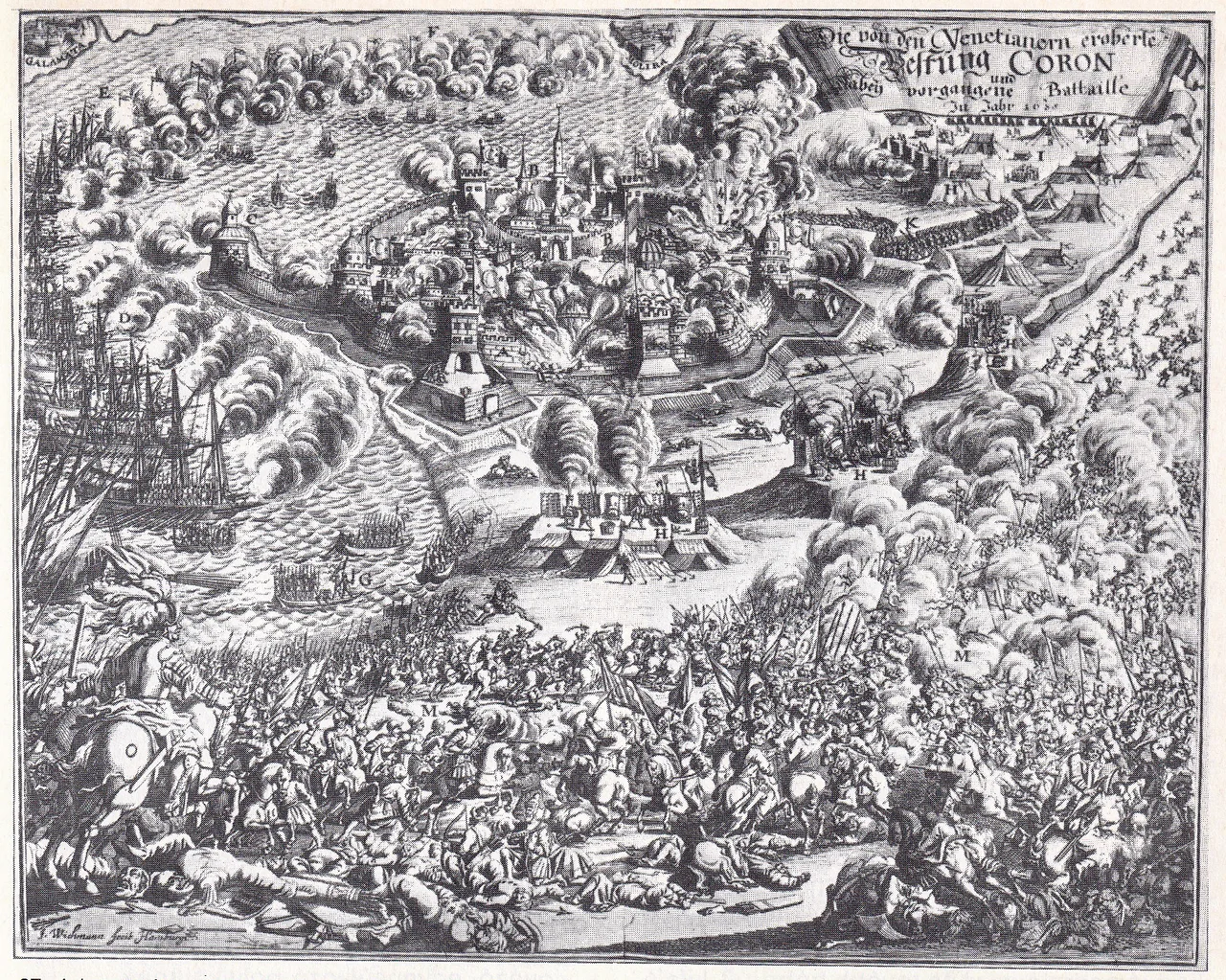

Conquest of Coron (1685)
On August 11, 1685, the white flag went up over the citadel at Coron. The Ottoman garrison had held out for weeks against a Venetian besieging force of some 8,200 men, and now they were willing to surrender. While terms were being negotiated, a cannon accidentally discharged. The Venetian troops, already primed for battle, interpreted the explosion as treachery. They stormed the citadel. By the time it was over, approximately 1,500 people — soldiers and inhabitants of the fortress — were dead. What had been a surrender became a massacre, triggered by an accident, ending with consequences that nobody had planned for and that shaped what followed across the entire Peloponnese.
Eyes of the Republic
Coron — known today as Koroni — sits on a promontory at the southwestern tip of Messenia, overlooking the Messenian Gulf. For three centuries before 1500, it had been a Venetian possession, and the Republic called it, alongside the neighbouring fortress of Modon (now Methoni), the "chief eyes of the Republic" — their strategic position gave Venice control of the sea-lanes between the eastern and central Mediterranean. When the Ottomans took both fortresses in 1500, the loss was felt as a humiliation that rankled for generations. When Venice declared war on the Ottomans in 1684 — the first and only time in the long Ottoman-Venetian wars that the Republic made the first move — the Venetian commander-in-chief Francesco Morosini had his objectives clearly in mind: recover the Morea as recompense for the recent loss of Crete, and begin with the fortresses that had once defined Venetian power in the eastern Mediterranean.
A Coalition Army, a Contested Hill
The Venetian force that landed on the Messenian coast in June 1685 was genuinely multinational. Of its approximately 8,200 men, 3,100 were Venetian mercenaries and a further 1,000 were Schiavoni soldiers, 2,400 had been hired from the Duchy of Brunswick-Lüneburg, 1,000 came from the Knights Hospitaller of Malta, 400 were Papal troops, and 300 served under the flag of the Grand Duchy of Tuscany. The fleet was similarly composed of Venetian, Tuscan, Hospitaller, and Papal vessels. The siege opened on June 25, when the Ottoman garrison withdrew into the citadel at the tip of the promontory while the town itself fell without resistance. An Ottoman relief army under Halil Pasha arrived from Kalamata on July 7 and made camp near the Venetian lines, separated by a small hill that both sides fought over repeatedly. The olive groves around the citadel were cut down to deny cover to the Ottomans. For weeks, the fighting seesawed between the besiegers and the relief force, while tunnelling operations attempted to undermine the citadel's western bastion.
The Accident That Became a Massacre
On August 7, a Venetian pre-dawn attack routed the Ottoman relief army, freeing Morosini's forces to focus entirely on the citadel. Four days later, on August 11, Venetian engineers detonated mines packed with 250 gunpowder barrels beneath the western bastion. The explosion breached the walls. Three hours of hard fighting followed, and then — at the moment when the general assault signal was given — the Ottoman garrison raised the white flag. Fighting stopped. Surrender negotiations began. Then a cannon accidentally fired. The troops, who had been fighting for weeks under constant pressure and losses, took the discharge as a sign that the Ottomans were not surrendering in good faith but were attempting treachery. They stormed the citadel. The garrison — soldiers, civilians, men, women, children — approximately 1,500 people in total, were killed. The accident ended in a slaughter that the sources record without celebration, as a fact of the siege's final hours.
The People Taken as Slaves
Those who were not killed in the massacre faced a different fate. At least 1,336 Turkish and Jewish inhabitants of Coron were taken as enslaved people following the siege, divided among the Christian coalition forces according to their share of the fighting. Of that number, 334 were assigned to the Knights Hospitaller, who transferred one third of them to the Papal forces. Hospitaller records indicate that the majority were Turks, with around 20 Jews among them; the Greek inhabitants of Coron appear not to have been enslaved. The Hospitallers returned to their base at Valletta, Malta, selling some captives en route at ports including Gallipoli and Augusta. Of those who reached Malta, only 60 were adult men; the remaining captives were women and children — an unusual demographic for Malta's slave trade, where adult male galley slaves predominated. Surviving records document individual fates: two women were given to the Viceroy of Sicily; an eight-year-old girl was sold to a Muslim slave who tried to free her, had her confiscated by the Treasury, and was then sold to a Hospitaller knight for 53 scudi. Most of the Jewish captives were eventually freed in 1686 and 1687, leaving for Smyrna or Venice. Some of the Turkish captives were freed in the 1690s. Most who left Malta did not return to Coron — it was still under Venetian occupation.
What the Siege Began
The fall of Coron was the opening move of a campaign that reshaped the Peloponnese. With the fortress secured, Mani rose in revolt, and the Venetians under Hannibal von Degenfeld defeated another Ottoman army at the Battle of Kalamata on September 14, 1685. By the end of September, the remaining Ottoman garrisons in Mani had surrendered. Morosini's campaign in 1686 completed the conquest with the capture of New Navarino fortress and Modon. The Morea remained in Venetian hands as the "Kingdom of the Morea" until 1715, when Ottoman forces recaptured the entire peninsula. Coron itself, the fortress on the promontory where all of this began, still stands at Koroni today — its walls reconstructed and modified across the centuries, but the promontory, the sea, and the strategic geography unchanged.
From the Air
Koroni (ancient Coron) lies at approximately 36.79°N, 21.96°E on the southwestern Messenian coast, at the tip of a promontory jutting into the Messenian Gulf. From the air at 3,000–5,000 feet, the fortress is clearly visible on its promontory, with the town clustered along the slope below it and the Messenian Gulf spreading to the north. The nearest major airport is LGKL (Kalamata International), approximately 44 km to the northeast. Across the gulf to the north, the fortress of Methoni (Modon) — Coron's historic twin — is visible on a clear day at the far southwestern tip of the Methoni peninsula.
Nearby Stories
- Ithomi, Messenia 6.7 km away
- Dimitrios (Shipwreck) 8.7 km away
- Battle of Agios Vasileios 20 km away
- 2023 Messenia Migrant Boat Disaster 20 km away
- Strofades 43 km away
- Battle of Cape Spada 146 km away
- Siege of Chania (1645) 218 km away
- El-Kouf National Park 425 km away