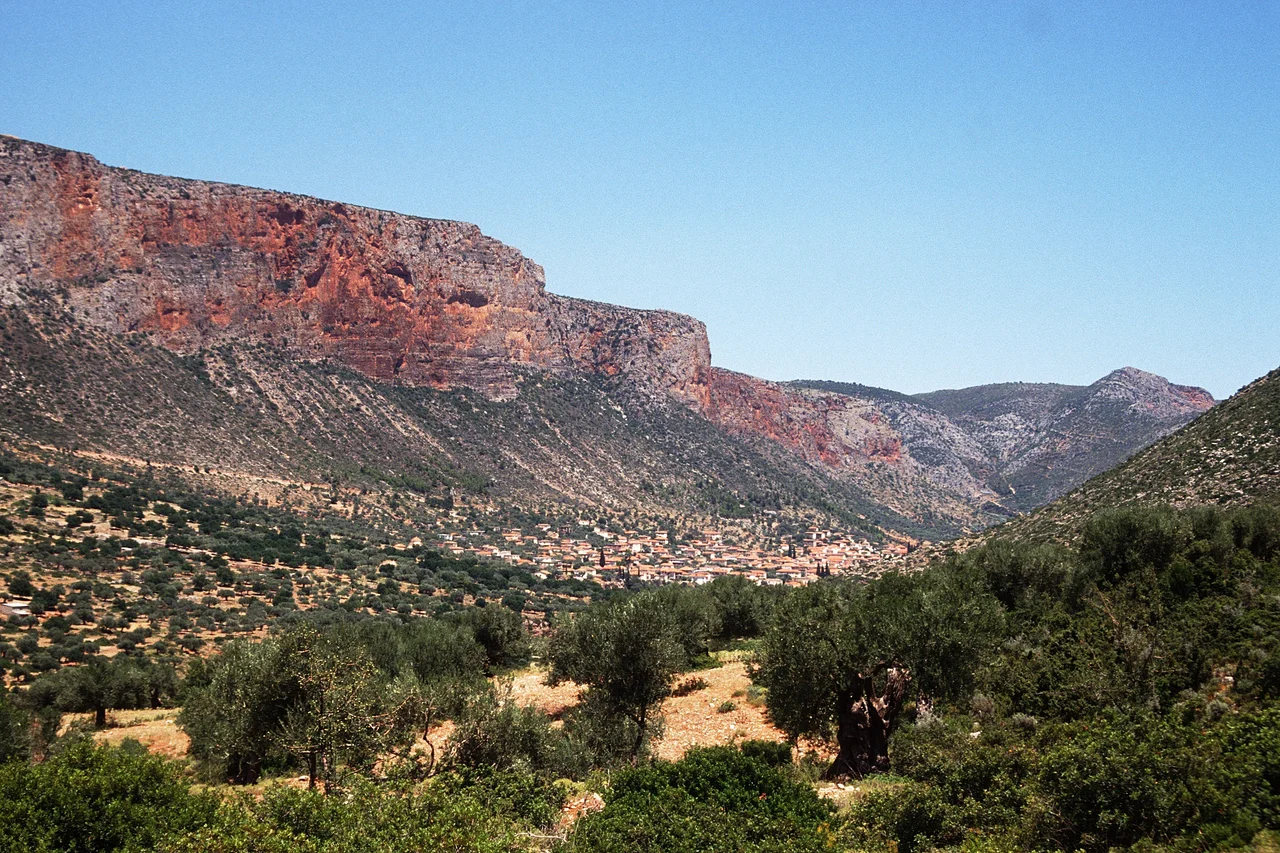

Battle of Agios Vasileios
The village of Agios Vasileios had survived centuries on the slopes of Mount Parnon, tucked into folds of stone where the Arcadian highlands drop sharply toward Laconia. It would not survive the morning of 22 January 1949. Before sunrise, nine hundred nationalist Mountain Raiders encircled it in the snow, armed with intelligence extracted from captured DSE telephone operators who had been forced — at gunpoint — to send their comrades false orders. The men sleeping in those houses had no idea they had walked into a trap set partly by people they trusted.
A Mountain Under Siege
By late 1948, the Democratic Army of Greece — the DSE, communist-led and battle-hardened — controlled nearly every major peak on the Peloponnese. Taygetus, Parnon, Mainalo: nearly five thousand fighters held the high ground, supplied tenuously by sea, increasingly isolated from the Eastern Bloc. The nationalist government in Athens knew it. So did the Americans and British who were bankrolling the war. Operation Peristera — named, with grim irony, for the dove — was the response: twelve thousand additional troops rushed south, bringing total government forces in the Peloponnese to forty-four thousand.
The operation's architects were not squeamish about means. On the night of 24–25 December 1948, roughly forty-five hundred civilians — most of them politically neutral, guilty of nothing more than living in the wrong village — were swept up in mass arrests and deported to the detention islands of Trikeri and Makronisos. The nationalist strategy explicitly included what official reports described as the extrajudicial killing of communist supporters among the civilian population. These were not incidental atrocities. They were policy.
Forged Orders, Falling Snow
The 240 fighters who ended up in Agios Vasileios that night were exhausted in the particular way of men who have been cold and hungry for weeks. They had just spent three days attacking the coastal town of Leonidio — a diversionary raid, an attempt to draw nationalist forces away from the mountains. It failed. The 55th Brigade fought for five hours, fired two Panzerfaust rockets, and withdrew when word arrived that the Raiders were moving.
The battalion commander, Alekos Tsoukopoulos, needed rest for his men. He directed them toward Pigadi Chioni, but new orders arrived redirecting them to Agios Vasileios for the night. Those orders were forged. Nationalist soldiers had captured DSE telephone operators and coerced them to send the false message — Greek forcing Greek to lure Greek into an encirclement. The Raiders slipped into position around the sleeping village. They had even learned the DSE's guard passwords. When the first gray light touched the Parnon ridgeline on January 22nd, the trap was already closed.
The Village Square at Dawn
Tsoukopoulos gathered his officers in the village square when the shooting started from multiple directions. In the chaos he didn't know — couldn't know — that the road northeast toward Pigadi and Toumpano was still open. He dispatched his companies outward: Panagiotis Skagos toward Toumpano height, Dimitrios Koutroulakis toward the school and houses on the Platanaki road, Konstantinos Papakonstantinou toward Achlada height.
Koutroulakis' company ran into an ambush almost immediately — Raiders hidden inside a house opened fire and cut them down. Koutroulakis and Papakonstantinou eventually linked up, but panicking civilians had mixed into the retreating column, slowing everything. When they finally ran into the main Raider force — roughly five hundred men — the outcome was swift and devastating. The communists were killed or captured nearly to a man, around eighty people caught in that one hammer blow. A DSE machine-gun platoon at the village graveyard managed to suppress the nationalists long enough to hold the Pigadi road open, buying minutes that saved some lives. Staff officer Giorgis Sampanis and political officer Dimitris Kottis died in the square trying to rally stragglers — shot by nationalist commandos while Tsoukopoulos watched.
Eventually Tsoukopoulos saw that the Pigadi road was open and led the remnant of his command out through the blizzard that had begun to close around the mountain.
Prisoners Who Did Not Return
Raider commander Psarrakis did not follow orders to hold his position after the battle. He withdrew — and as his force moved out through the snow, he murdered the prisoners they had taken, those who could not keep pace with a fast-moving column in those conditions. Two DSE companies pursued the Raiders before the blizzard swallowed them.
The nationalist army's after-action report claimed 181 DSE killed and 78 captured, but it deliberately did not distinguish combatants from civilians. Other estimates placed the dead at 70–80 fighters, with perhaps 35 of the 60-odd captured subsequently executed. Nationalist losses were 30 killed and wounded, 7 taken prisoner. The numbers are contested, as they always are in civil wars, where the victors write the first draft and the losers sometimes write nothing at all.
Scapegoat on the Mountain
Tsoukopoulos survived the breakout. Twelve days later, on 2 February, he stood in the village square of Agios Vasileios — the same square where he had tried to organize his defense — and was tried by a DSE tribunal. Political officer Panos Kontogiannis stood beside him. Both were sentenced to death. Kontogiannis confessed, expressed remorse, and had his sentence suspended. Tsoukopoulos was shot on 3 February 1949.
Some of the men who had fought alongside him, including Papakonstantinou, believed he was scapegoated — that the defeat could be traced to the forged orders, to the intelligence failures, to the impossible position his battalion had been maneuvered into, not to any failure of command on his part. They may have been right. But civil wars, like most wars, require someone to blame when things go wrong, and Tsoukopoulos was available.
The battle effectively ended the DSE's presence on the Peloponnese. By the close of 1949, the communist resistance in southern Greece was finished. In the final months, many DSE fighters chose death over capture, knowing what surrender often meant. The mountain kept its secrets, as mountains do.
From the Air
You're over the eastern Peloponnese at 37.187°N, 22.689°E, roughly 90 km north of Kalamata International (LGKL). The broad ridge below is the Parnon massif, and at 6,000 feet you can read the terrain clearly — the way the mountain funnels movement, the narrow roads that become traps in winter, the snowpack that would have been deep on the morning of 22 January 1949. Look for the pale vertical stripe of limestone on the cliff face to the northwest: that's where the Elonas monastery clings, a hermitage built into the rock that has watched over this valley for centuries. The village of Agios Vasileios sits in the folds below. From here it looks peaceful. It always does, from altitude.
Nearby Stories
- Psari, Trikolonoi, Arcadia 6.7 km away
- Evrotas Valley 12 km away
- Siege of Gardiki-Arcadia 12 km away
- Lerna 13 km away
- Troezen 15 km away
- Conquest of Coron (1685) 21 km away
- The Dokos Shipwreck 23 km away
- SS Heraklion 83 km away