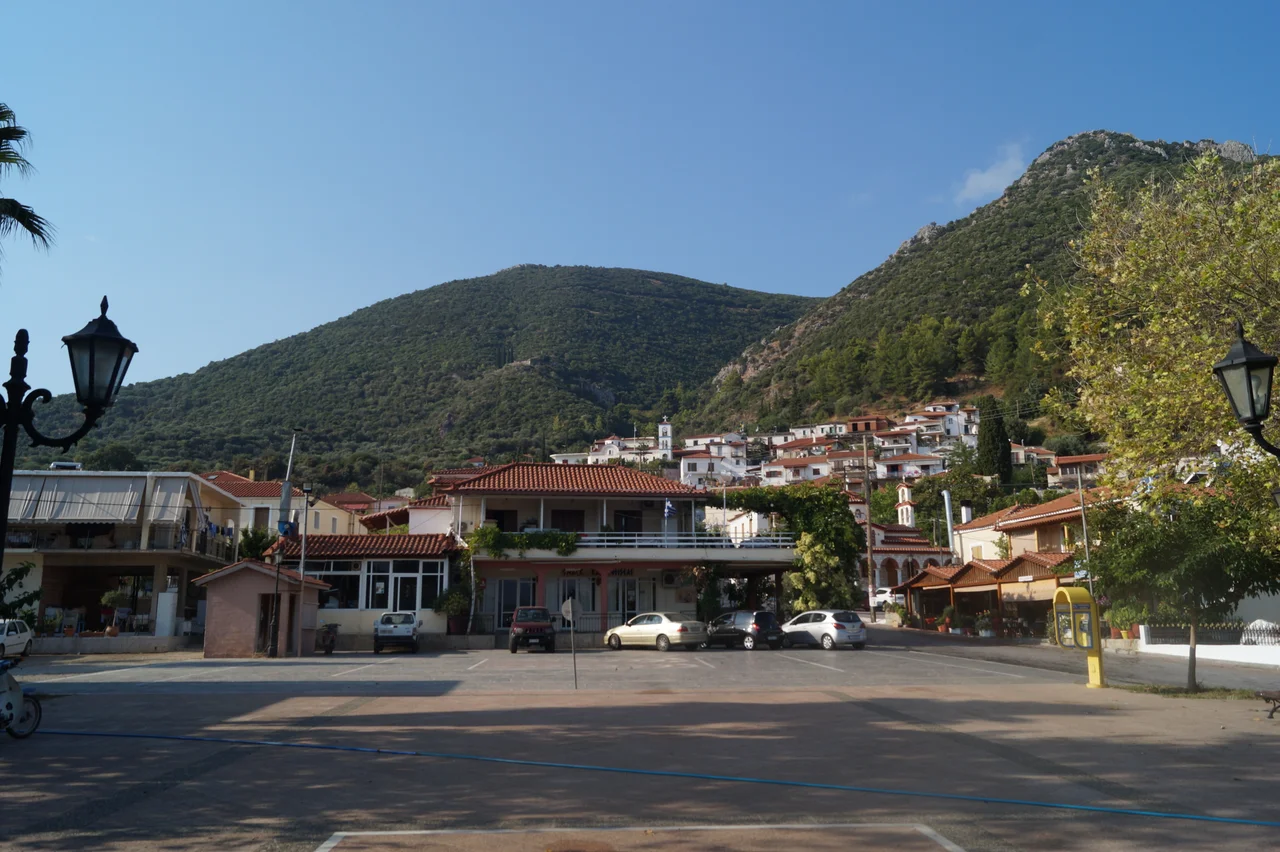

Troezen
In 480 BCE, with the Persian fleet bearing down on Greece, the Athenian statesman Themistocles made a decision that has echoed through history: he ordered the evacuation of Athens. The men would fight at sea; the women, children, and elderly would go to Troezen, across the Saronic Gulf on the Peloponnese coast. The decree was found in 1959 — carved on a stele, discovered in a Troezen coffee house, later dated to about 200 years after the battle, almost certainly a commemorative copy of the original order. Whether the copy is authentic in its text or a Hellenistic reconstruction hardly matters for what it represents: Troezen was the place Athens trusted with its most vulnerable citizens at the most dangerous moment in its history. That is a particular kind of honour.
Where Heroes Are Born
Greek mythology assigned Troezen an unusual distinction: it was the birthplace of Theseus. The story requires some divine arithmetic. Aethra, daughter of the local king Pittheus, slept with both the Athenian king Aegeus and the god Poseidon on the same night. The resulting child, Theseus, would grow up to become Athens's great hero — slayer of the Minotaur, king of Attica, father of the tragic Hippolytus. Before Aegeus returned to Athens, he hid his sandals and sword under a boulder in Troezen and told Aethra that when their son could lift the stone, he should take the tokens and come find him. When Theseus came of age, he lifted the boulder. The city also claimed a spring supposedly formed by Pegasus's landing, and was the setting for Euripides' tragedy Hippolytus — in which Theseus's son, spurning the love of his stepmother Phaedra, is destroyed by the consequences of that rejection, killed when his chariot is attacked by a bull rising from the sea. Seneca and Racine later wrote their own versions of the same story, all set in Troezen.
The Cult of Hippolytus
The mythological resonance of Hippolytus was not merely literary — it was liturgical. A genuine religious cult formed in Troezen around the figure, and Troezen girls traditionally cut a lock of their hair and dedicated it to Hippolytus before their marriage. This pre-nuptial offering is documented by ancient sources and represents one of those moments where Greek myth and Greek religion are inseparable from one another: the story generated a ritual that endured for centuries. Troezen was also responsible for the colonisation of Sybaris in Magna Graecia, founded in 720 BCE — a city that became so famously wealthy and pleasure-loving that 'sybarite' passed into the English language as a synonym for luxurious indulgence. A mother-city that named a colony whose name became a common noun: Troezen was more culturally influential than its modest modern population of 4,668 might suggest.
Athens's Harbour of Last Resort
The relationship between Athens and Troezen runs through Greek history like a recurring theme. Before the Persian Wars, the two cities were connected through the mythology of Theseus; during the war itself, Troezen sheltered the Athenian non-combatants. After the Greco-Persian Wars, Troezen became a formal ally of Athens within the Athenian empire, and was apparently garrisoned by Athenian troops. By the Thirty Years' Peace of 455 BCE, the Athenians were compelled to relinquish Troezen — but the connection persisted. When Demosthenes fled Athens after the Macedonian victory in 322 BCE, his route to Kalaureia on Poros carried him through the waters of the Saronic Gulf, visible from Troezen's coast. The town was also home, in Hellenistic times, to a temple of Isis built by Halicarnassians, for whom Troezen was a mother-city — a reminder that the eastern Mediterranean was far more interconnected in antiquity than geography alone would suggest.
Medieval and Modern Layers
Troezen accumulated names over the centuries, the way layered cities do. In antiquity it was also called Apollonia; in the Middle Ages it was Damala (Δαμαλᾶ), seat of a barony under the Principality of Achaea after the Fourth Crusade in the thirteenth century. The Franks called it Damalet or Elamala. The Ottomans conquered it sometime before the sixteenth century. It was not until 1827 — just fifty-five years after the American Declaration of Independence — that Troezen housed something genuinely unprecedented in its own history: the Third National Assembly, which ratified the first definitive Constitution of Greece and elected the country's first governor. The ancient place where Athens had sheltered its future during the Persian Wars was now the place where Greece defined its future during a different kind of founding. The Decree of Themistocles, the mythological boulder of Theseus, and the Third National Assembly occupy the same patch of ground across the strait from Poros, the distances between them measurable only in time.
From the Air
Troezen (ancient site near modern Troizina) sits at approximately 37.50°N, 23.36°E on the Argolid Peninsula of the northeastern Peloponnese, directly across the Saronic Gulf from Athens. The narrow channel between Troezen's coastline and the island of Poros is clearly visible from altitude — Poros town and Galatas face each other across barely 200 metres of water. The closest major airport is LGAV (Athens International Eleftherios Venizelos), approximately 65–70 km to the northeast across the Saronic Gulf. From altitude, the Methana volcanic peninsula is visible to the north, and the green, forested hills of Poros/Kalaureia to the east-northeast. The village of Galatas, which served as the seat of the former Troizina municipality, marks the coastal access point closest to the ancient ruins.
Nearby Stories
- Agios Vasileios, Corinthia 4.4 km away
- Nafplio 6.1 km away
- Agios Georgios (island) 6.3 km away
- Tsakonia 8.6 km away
- Saronic Gulf Islands 11 km away
- Brauron 17 km away
- Spetses 21 km away
- SS Heraklion 49 km away