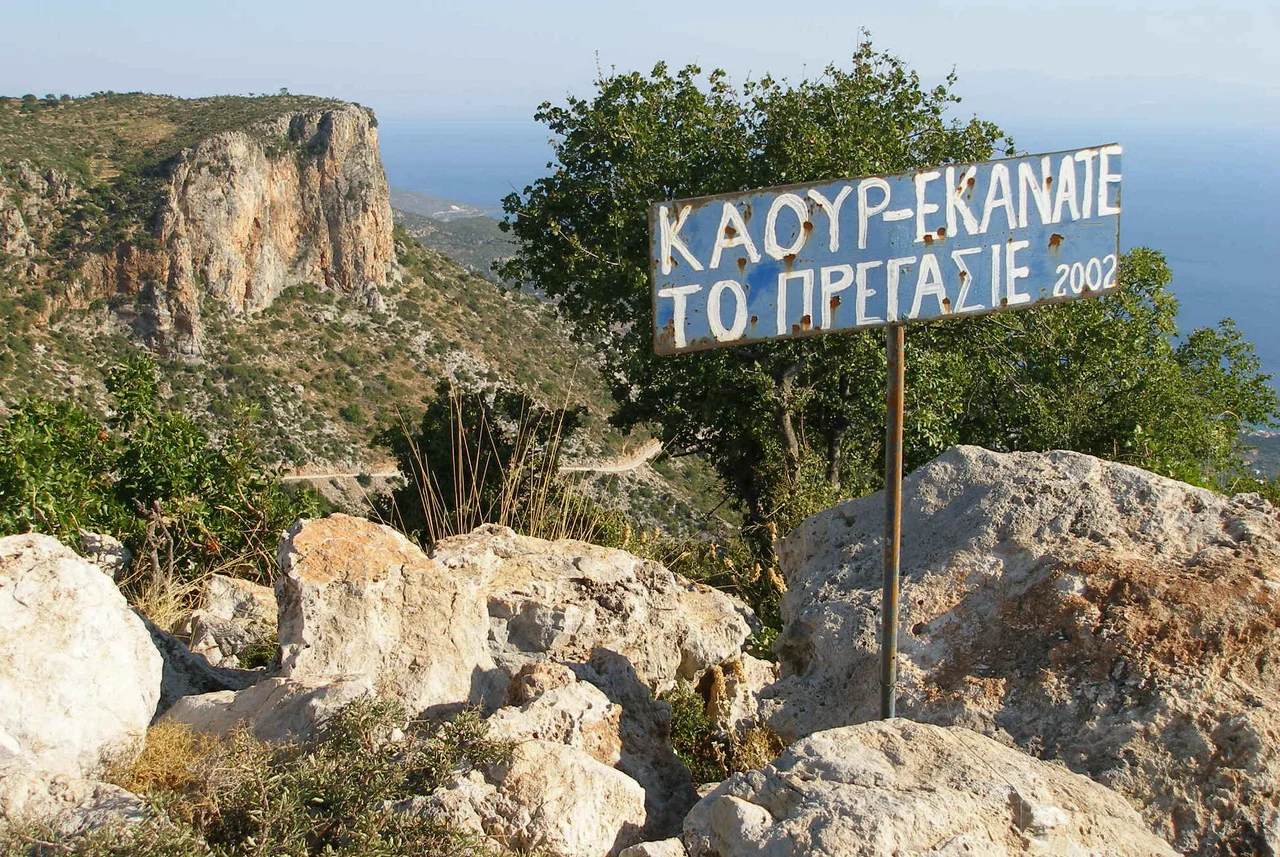

Tsakonia
When Constantine Porphyrogenitus wrote his handbook on governing the empire around 950 CE, he paused to note something unusual about the people living in a remote fold of the eastern Peloponnese. The locals still called them Hellenes — the old word for pagans, worshippers of idols — because they had only just accepted Christianity during the reign of Basil I, who died in 886. The rest of the Greek world had been Christian for six centuries. These mountain people, the Tsakonians, had spent those centuries in a pocket of the Arcadian highlands so isolated that the medieval world had largely passed them by. What they preserved in that isolation was extraordinary: a language — Tsakonian — descended not from the Koine Greek that became the root of modern Greek, but directly from ancient Doric, the dialect of Sparta and Corinth. Linguists consider it the most direct living heir of the Doric tongue. The region where it survives, Tsakonia, is not a political entity on any modern map. It is something older and stranger — a cultural memory of a world before Alexander.
The Last Dorians
All other varieties of ancient Greek — Ionic, Aeolic, Attic — fed into Koine, the common tongue that spread across Alexander's empire and eventually became the ancestor of modern Greek. Doric did not make that journey. Its speakers retreated into the mountains of the eastern Peloponnese, into the steep valleys between Agios Andreas and Leonidio, inland to Kastanitsa and Sitaina, and there they kept speaking their own way. The Tsakonian language that emerged from those centuries of isolation is not a dialect of modern Greek; it is a distinct branch of the Greek family tree, one that diverged long before Koine crystallized. A speaker of modern Greek cannot understand it without study. It carries sounds and grammatical structures that died out everywhere else in the Greek-speaking world two millennia ago.
Genetics confirms what linguistics suggests. A 2017 study found that Tsakonians — both the northern and southern populations — share exceptionally high levels of identity-by-descent with each other, meaning they have married among themselves for a very long time. Their ancestry from Slavic-speaking populations, which left detectable traces in most Peloponnesian communities during the early medieval period, is remarkably low: between 0.2 and 8.2 percent, compared to 4.8 to 14.4 percent in other Peloponnesians. The isolation that preserved the language also preserved the people.
Still Called Pagans
The Tsakonians' late conversion to Christianity is the clearest window into how thoroughly they stood apart from the medieval Greek world. The Byzantine emperor's description — written matter-of-factly, as if he expected no further explanation — places them outside the frame of Christian civilization long after it had become the only frame that mattered to Constantinople. They were still practicing traditional Hellenic customs, still calling their rituals by old names, while the empire fought wars, changed dynasties, and built cathedrals.
What converted them was not persuasion but the slow gravity of empire. Under Basil I, in the second half of the ninth century, Christianity finally took hold. But even that did not dissolve their separateness. Byzantine military records from later centuries mention τζάκωνες and τζέκωνες — Tsakonians — serving as border guards, a role that suited a people who knew the rugged terrain of the eastern Peloponnese better than any outside commander. They fought for the empire that had once called them pagans. When Andronicus II reorganized the navy and preferred Genoese mercenaries to homegrown soldiers, the Tsakonians were let go. The empire moved on. They went back to their mountains.
Prastos and Its Ashes
For centuries, the heart of Tsakonia was the town of Prastos. Constantinople had granted it a special trading privilege — an unusual distinction for a settlement this remote, suggesting that the Tsakonians had negotiated some kind of political accommodation with the capital while keeping their cultural distinctness intact. Prastos sat in the hills, trading and speaking its ancient tongue, aware enough of the wider world to extract commercial advantages from it.
In the Greek War of Independence, that world arrived with fire. Ibrahim Pasha burned Prastos to the ground. The residents scattered — some to Leonidio, some to Tyros, some further afield to the Argolic Gulf coast. The physical center of Tsakonia was destroyed. But the language and the culture did not die with the town. The communities that received Prastos's refugees carried Tsakonian speech forward, and the region that Costakis mapped in his 1951 Brief Grammar of the Tsakonian Dialect still bears the name Tsakonia, still holds the territory from Agios Andreas south to Leonidio, still contains the thirteen villages that define the region's core.
A Shrinking Circle
The Tsakonian language has never stopped contracting. Evliya Çelebi, traveling through the area in 1668, noted that Vatika — far south of Leonidio — was still Tsakonian-speaking. It was later resettled by Arvanite speakers, and Tsakonian retreated. The 14th-century Chronicle of Morea places Tsakonian speech across Cynuria, a territory that now belongs to Arcadia. Costakis himself acknowledged that the language once extended as far as Cape Malea, at the southern tip of Laconia. What had been a tongue of the whole eastern Peloponnese compressed, over the centuries, into a cluster of mountain villages.
Since 1951, the compression has accelerated. The speech community that Costakis documented has shrunk further. Younger generations have shifted to standard Greek for education, commerce, and daily life. Yet the area is still called Tsakonia — not because the language fills it as it once did, but because the culture held. The Tsakonikos, the regional dance with its distinctive circular form, still turns at festivals. The folk costumes remain distinct. Identity proved more durable than fluency. The name Tsakonia belongs now to a community that remembers, even if fewer of its members speak.
What the Mountains Kept
There is a certain irony in how Tsakonia survived. The very qualities that made the Tsakonians marginal in Byzantine eyes — their remoteness, their insularity, their late and apparently reluctant Christianity — are exactly what preserved their language past every force that should have erased it. The Koine flattened dialects across the Mediterranean. The medieval church imposed a standard liturgical Greek. Ottoman rule, then the Greek nation-state, both pushed toward standardization. Each wave broke somewhere in the hills of Arcadia and Kynouria, leaving behind a people who had endured by simply being unreachable.
What they held is irreplaceable. Tsakonian grammar and vocabulary carry features of ancient Greek that exist nowhere else in living speech — not as museum artifacts, not as reconstructions from manuscripts, but as sounds that people have been making in these valleys for two and a half millennia. The mountains of the eastern Peloponnese did not merely shelter a community. They preserved, in the mouths of a few thousand people, a direct acoustic line back to the world before Alexander changed everything.
From the Air
Tsakonia lies along the eastern Peloponnese coast at 37.19°N, 22.83°E, between the Argolic Gulf and the Parnon mountain range. From the air at 8,000–12,000 feet, the terrain reveals why this community remained isolated for centuries: steep ridgelines descend sharply to a narrow coastal strip, with villages perched on terraced slopes above deep valleys. Leonidio, the principal modern town of the region, sits at the mouth of the Dafnon Gorge where it meets the sea — the rust-red cliffs of the gorge walls are visible from altitude in clear conditions. The nearest major airport is LGKL (Kalamata International), approximately 90 km to the southwest. Smaller strips at Leonidio (private/ultralight) serve local use only.
Nearby Stories
- Psari, Trikolonoi, Arcadia 6.7 km away
- Evrotas Valley 12 km away
- Siege of Gardiki-Arcadia 12 km away
- Lerna 13 km away
- Troezen 15 km away
- Conquest of Coron (1685) 21 km away
- The Dokos Shipwreck 23 km away
- SS Heraklion 83 km away