
Lerna
The Greek proverb 'a Lerna of ills' means something like an inexhaustible source of trouble — rooted in the place itself, where catastrophe upon catastrophe accumulated over millennia. A sacred lake so deep that the Emperor Nero could not find its bottom with weighted ropes. An entrance to the Underworld guarded by a serpent of many heads. A two-storey palace built with startling sophistication around 2500 BC, destroyed by fire, then deliberately buried rather than rebuilt — as if the people who came after were afraid of what lay beneath. Lerna, near the village of Myloi at the edge of the Argolic Gulf, is one of those sites where myth and archaeology keep arriving at the same extraordinary place.
Where the Monster Lived
The Lernaean Hydra was not an ordinary monster. Chthonic — meaning born of the earth itself — the many-headed water serpent had guarded these springs since before Heracles arrived to make them famous. Ancient Greeks understood Lerna as one of the gates to the Underworld: a place where the membrane between the living world and whatever lay beneath it was dangerously thin. The Alcyonian Lake, according to Pausanias, was bottomless. Even Nero, who lowered weighted ropes of considerable length into it, found no bottom. Dionysus entered the Underworld through Lerna's waters in search of his mother Semele, guided by a local man named Prosymnus. Rites sacred to Demeter were performed here. At certain ceremonies, according to Plutarch, Dionysus was summoned as 'son of the Bull' with an archaic trumpet, while a lamb was cast into the water as an offering to the 'Keeper of the Gate' — which was, of course, the Hydra.
The House of Tiles
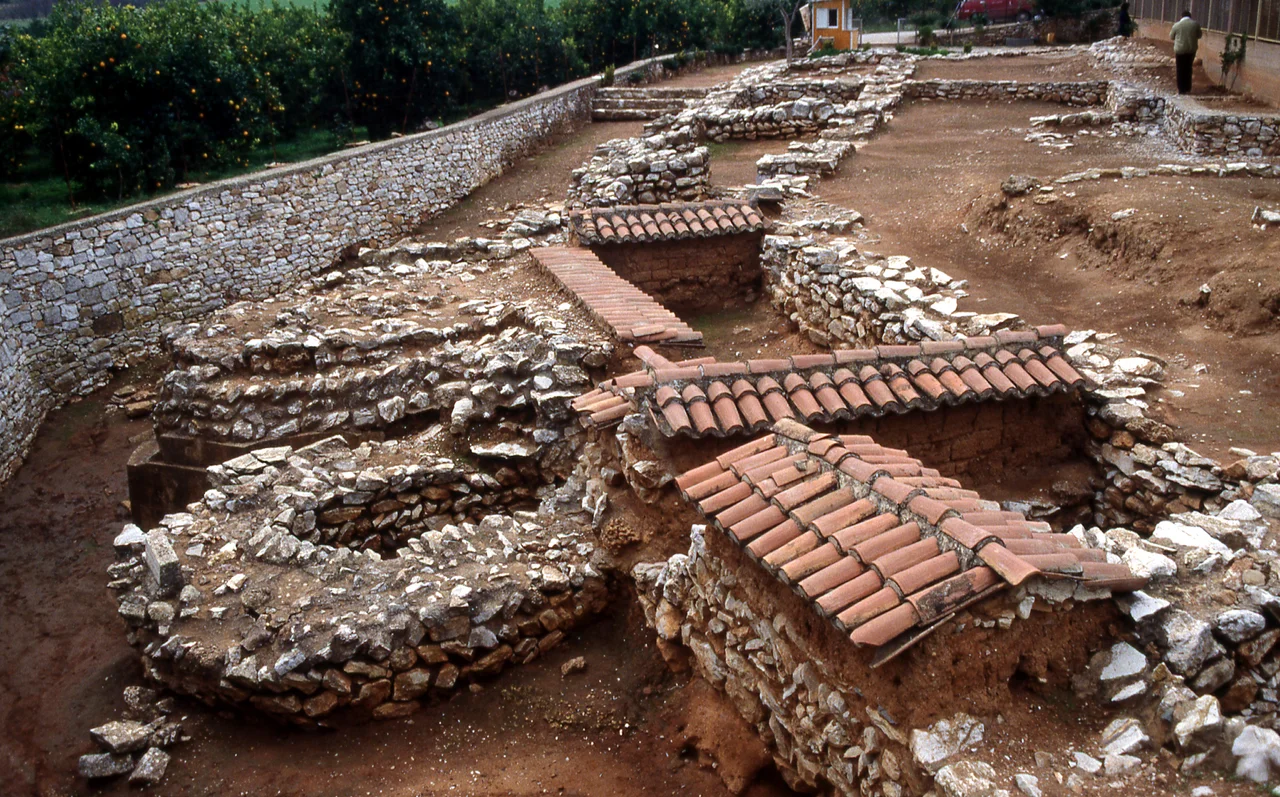
The myth came long before the archaeology, but the archaeology is just as remarkable. Excavations begun by John L. Caskey in 1952 revealed a settlement occupied from the fifth millennium BCE onward — Neolithic, then Early Bronze Age, then Mycenaean. The defining structure of Early Bronze Age Lerna, designated Lerna III in the site's stratigraphy, was an administrative center so substantial it has been called a palace: a two-storey building, strongly fortified by a double ring of defensive walls with towers, its roof sheathed in terracotta tiles. This 'House of the Tiles' dates to the Early Helladic II period, around 2500–2300 BC, making it one of the oldest tiled roofs known in the Greek world. When fire destroyed it, something unusual happened. The ruins were covered by a low earthen mound and left undisturbed — never built over again, as if the site had become sacred or feared. Only much later were shaft graves cut into that mound, by people who had apparently forgotten why the ground there was special.
A Lake That Vanished
The lake that gave Lerna its mythological power no longer exists. In the Early Bronze Age, Lake Lerna was an estimated 4.7 kilometers across — a freshwater lagoon separated from the Aegean by barrier dunes. Over millennia, deforestation increased erosion and silt deposits, shrinking the lake to a malarial marsh. The last remnants were drained in the nineteenth century. Modern geological core-drilling confirmed the site of the vanished lake and reconstructed its ancient dimensions. What remains today is marshy ground near the coast — evocative and slightly melancholy, an absence that explains the presence. Lerna is a narrow pinch point between mountains and sea, on an ancient route from the Argolid to the southern Peloponnese. Its geographic importance drew people here; the springs and the lake gave those people a framework of myth. The Karstic springs remain, flowing as they always have, though the sacred lake is gone.
Five Thousand Years of Evidence
The site's archaeological sequence spans an extraordinary range. Ceramics from the Lerna III period include elegant spouted vessels — the 'sauceboats' that archaeologists have traced across early Aegean sites — alongside bowls with incurving rims and wide saucers with glazed lips. Banded patterns made with the same seal stamp have been found at Lerna, Tiryns, and Zygouries, suggesting a connected world of Early Bronze Age exchange. Later phases show pottery continuity giving way to new forms, early use of the potter's wheel, and the sudden introduction of imports from the Cyclades and Crete. The dead were eventually buried not in separate cemeteries but in excavations between the houses — a custom that blurs the boundary between the living and the departed in a place already conceived as a threshold between worlds. Lerna was abandoned around 1250 BCE, the Mycenaean civilization collapsing around it, the lake slowly filling with silt. The proverb about a 'Lerna of ills' outlasted them all.
From the Air
Lerna lies at approximately 37.55°N, 22.72°E, on the narrow coastal strip south of Argos between the mountains and the Argolic Gulf. From altitude, the site is near the modern village of Myloi, where the hillside meets the coast. The Argolic Gulf is clearly visible to the east, a long inland arm of the sea that makes the entire Argolid legible from the air. Nearest major airport is LGAV (Athens International), roughly 110 km northeast. Flying south from Argos along the coast, Lerna is the flat land before the mountains close in again. Best viewed at 1,500–2,500 feet AGL on clear days, which are common spring through autumn in this region.
Nearby Stories
- Kastanitsa 2.3 km away
- Heroon at Nemea 3.4 km away
- Psari, Trikolonoi, Arcadia 4.2 km away
- Siege of Gardiki-Arcadia 8 km away
- Cleitor 12 km away
- Troezen 15 km away
- Cave of Euripides 24 km away
- SS Heraklion 94 km away