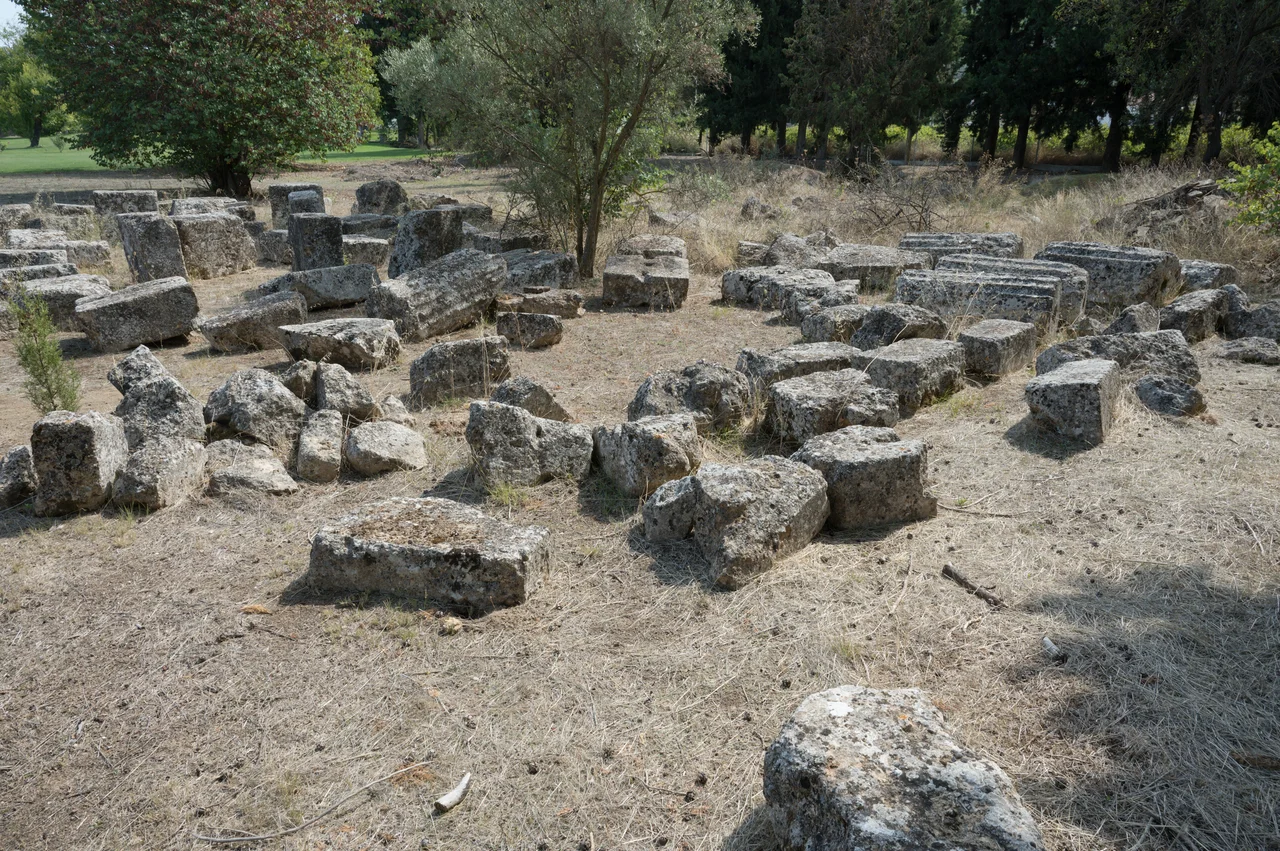

Heroon at Nemea
The mound is not impressive to look at. It sits on the west bank of the Nemea river, an earthen rise within the larger sanctuary of Zeus, and there is nothing about its appearance that announces its significance. But for several hundred years in antiquity, this was one of the most emotionally charged spots in the Greek world: the grave of a child who became a hero, the place where grief became ceremony, and ceremony became competition, and competition attracted athletes from across the Greek-speaking world. Archemorus — the Forerunner of Death — died here, according to the myth. The Nemean Games were born from that death.
A Child Who Could Not Touch the Ground
The story of Opheltes begins with a prophecy. King Lycurgus and Queen Eurydice of Nemea had been warned by the seer Amphiaraus that their infant son must not be set on the ground until he had learned to walk — or he would die. They passed the warning to his nurse, Hypsipyle, herself a woman of extraordinary history: the former queen of the island of Lemnos, she had since been taken into slavery.
When the Seven against Thebes — the seven champions marching from Argos to attack Thebes — passed through Nemea and asked Hypsipyle to lead them to fresh water, she obliged. She set the infant Opheltes in a bed of wild celery in a sacred space and led the men away. In her absence, the serpent that guarded the space found the child and strangled him.
The Seven, stricken with guilt and grief, held funeral games in the child's honor. Opheltes was given the posthumous name Archemorus — from the Greek words for 'beginning' and 'fate' or 'death,' forming the epithet 'Forerunner of Death' or 'Beginning of Doom.' His grave was enclosed within a stone wall at the sanctuary's temenos. The judges of the Nemean Games wore black robes. Victors received crowns of wild celery. Both were signs of mourning, and both persisted across the centuries the games were held.
Before the Hero, the Mound
The first Nemean Games were documented from 573 BCE. The heroon — the sacred precinct built around the hero's burial mound — was constructed around the same time. But the literary sources for the myth of Opheltes are traceable only to the early 5th century BCE, which means the monument almost certainly predates the specific hero it commemorates.
This is not unusual in Greek religious practice. Sacred sites accumulated significance over time, acquiring myths that explained their sanctity after the fact. What the heroon records is the existence of a cult site — a place where something was venerated, where rituals were performed, where the boundary between the living and the dead was maintained. Who or what was originally venerated there before the Opheltes story crystallized around it is a question archaeology cannot fully answer.
In the mid-3rd century BCE, the Nemean Games were relocated to Argos, and the shrine fell out of use. The mythology survived in literary sources; the physical site was largely abandoned.
Seven Lead Tablets
When archaeologists excavated the heroon, they found very little pottery — only a few whole vessels, deliberately placed and buried, suggesting ritual deposits rather than casual use. What they did find, scattered across the site, were seven lead tablets.
Four of the seven bear discernible inscriptions. Each tablet was made the same way: a sheet of lead, inscribed on its surface, then folded and nailed shut. The inscriptions are binding spells — curses directed at a romantic rival. The person making the tablet called on the dead hero's power to turn a lover away from their rival, invoking the rival's body and spirit across as many dimensions as possible, trying to establish walls between the target and the person they desired.
The tablets make sense in the context of Opheltes. In Greek magical practice, the shrines of people who had died young and violently were considered particularly potent for curse work — because such spirits were thought to be restless, to retain energy, to be more willing to act on behalf of the living than spirits who had died peacefully in old age. A child murdered in a sacred space was ideal. The handwriting on the tablets varies enough that scholars believe each was deposited by a different person. The cursive script and some letter forms suggest the tablets were left after the shrine's official religious use had ended, in the 4th century BCE or later — meaning people still came to the mound long after the games had moved away, for purposes the games' organizers had never intended.
Between Two Stories
The heroon at Nemea holds two contradictions lightly. The first is that the site almost certainly predates the myth that explains it — the mound was sacred before Opheltes became the reason for its sanctity. The second is that a place consecrated to the memory of an innocent child became, eventually, a site for erotic curses.
Neither contradiction resolves cleanly. But together they capture something true about sacred sites in the ancient world: their power did not belong exclusively to official religion. People came to the heroon with grief and with hope, with devotion and with need, across the centuries it was active and after it officially closed. The mound of earth beside the Nemea river absorbed all of it.
From the Air
The Heroon at Nemea is located at approximately 37.821°N, 22.661°E, on the west bank of the Nemea river within the sanctuary of Zeus. The earthen mound is a small feature within a larger archaeological landscape; approach at 3,000–5,000 feet from the northeast to see the valley setting with the Temple of Zeus visible to the east. The nearest major airport is Athens International Eleftherios Venizelos (LGAV), approximately 82 km to the northeast. The Nemea valley is notably green and well-watered compared to the surrounding limestone hills.
Nearby Stories
- Aigosthena 2.2 km away
- Kefalari (Argolis) 2.4 km away
- Cleitor 4.2 km away
- Helike 8.7 km away
- Stemnitsa 9.1 km away
- Methana Volcano 12 km away
- Megara 18 km away
- 1981 Gulf of Corinth Earthquakes 24 km away