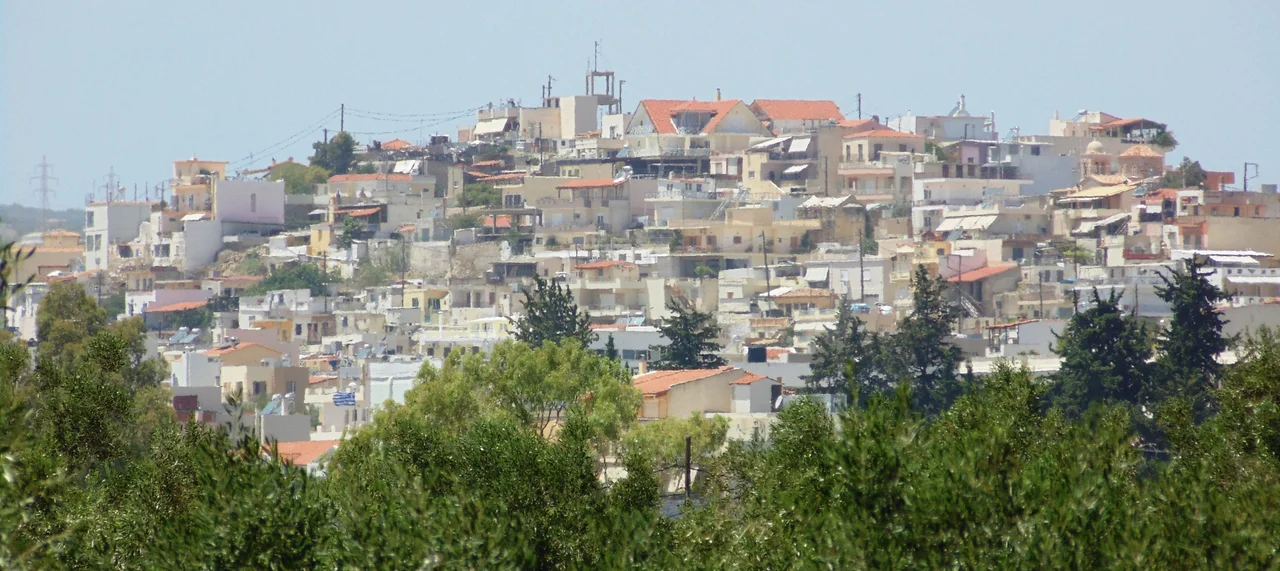

Megara
The ancient Greeks had a saying: 'worthy of the Megarians' share.' It meant dishonored, disrespected, left with the worst portion. And Saint Jerome, writing in the 4th century AD, preserved another proverb about Megara's citizens: 'They build as if they are to live forever; they live as if they are to die tomorrow.' These are not exactly flattering epithets. But they stick to a city that was, for several centuries, one of the most consequential places in the ancient world — a city that founded Byzantium, fought wars on two oceans simultaneously, and, in a moment of tactical desperation, once attempted to defeat a besieging army by releasing flaming pigs against the enemy's war elephants.
Between Two Seas
Megara's geography gave it an unusual strategic position. The city sat on the northern edge of the Isthmus of Corinth — the narrow land bridge connecting the Greek mainland to the Peloponnese — with a harbor on the Saronic Gulf to the east, Nisaea, and another on the Corinthian Gulf to the west, Pagae. This meant Megarian merchants could trade with the Aegean world from one coast and with the western Mediterranean from the other, moving goods across the isthmus by land to avoid the long and dangerous voyage around the southern capes of the Peloponnese. The wealth this generated funded both the city's colonial ambitions and its temples, and Megarians were famously generous builders of sanctuaries.
Behind the city, two acropolises — Karia and Alkathos — provided defensible high ground. In front of it lay the sea. In between, a fertile coastal plain called Megaris supported the agriculture that underpinned its economy, including the export of wool, horses, and other animal products that gave Megara a reputation as a trading rather than a purely military power.
The City That Founded Byzantium
Megara's most enduring contribution to world history may be a colony it planted in the 7th century BC. Around 667 BC, colonists from Megara established a settlement on a rocky promontory between the Bosphorus and the Golden Horn — a site of extraordinary strategic value at the crossroads of Europe and Asia. They named it Byzantium, after their legendary founder Byzas. Fifteen centuries later, the Roman Emperor Constantine I would build a new imperial capital on those same foundations. Constantinople, then Istanbul, now one of the world's great cities: all of it growing from a Megarian colony.
It was not Megara's only colony. Megarian settlers had already founded Chalcedon in 685 BC — just a few kilometers from where Byzantium would later stand, on the Asian side of the Bosphorus — and Megara Hyblaea in Sicily. They operated what some scholars have called a 'colonisation alliance' with Miletos, another city that traced its Apollo oracle to Delphi, with the two cities acting in coordination across the 7th and 6th centuries BC to plant settlements at strategic points around the Mediterranean and Black Sea.
Philosophers, Poets, and the Father of Exercise
The 6th-century elegiac poet Theognis came from Megara, and his verses — some of the most personal surviving from archaic Greek poetry — are saturated with the politics of a city that cycled between democracy and oligarchy, wealth and resentment. Theognis wrote about betrayal, about exile, about the bitterness of a man who felt his city had abandoned him. His poems are some of the oldest personal literature in Western tradition.
In the early 4th century BC, Euclid of Megara — not the mathematician, but a philosopher who studied with Socrates — founded the Megarian school of philosophy, which flourished for roughly a century and became known for its rigorous use of logic and dialectic. Euclid's student Stilpo was one of the most celebrated philosophers of his generation. The Megarian school's work on logic and argument had lasting influence on Stoic philosophy.
And there is Herodicus, the 5th-century BC physician from Megara who, according to later sources, recommended that his patients walk the road from Athens to Megara as part of their treatment. It is one of the earliest recorded prescriptions of exercise in medicine.
Wars, Decrees, and Burning Pigs
Megara spent much of the Classical period being squeezed between larger powers. The city shifted allegiances repeatedly — between Corinth and Athens, between the Spartan-dominated Peloponnesian League and the Athenian Delian League, between Macedon and the Achaean League. Athens issued the Megarian Decree around 432 BC, banning Megarian merchants from Athenian-controlled harbors in what was essentially an early economic sanction; Thucydides and others considered it one of the contributing causes of the Peloponnesian War.
The most vivid episode in Megara's military history belongs to 266 BC, during the Chremonidean War, when the Macedonian king Antigonus Gonatas laid siege to the city and deployed war elephants. The Megarians responded by covering pigs in pitch, setting them alight, and driving them toward the elephants. According to ancient sources, the elephants panicked and fled. The Megarians lost the siege anyway — but the tactical innovation went into the historical record.
The Romans arrived eventually, as they arrived everywhere. According to Plutarch, when Roman troops under Quintus Fufius Calenus besieged Megara around 48 BC, the defenders tried the lion gambit — releasing lions against the attackers. The lions, Plutarch reports, 'rushed among the unarmed citizens themselves and preyed upon them as they ran hither and thither, so that even to the enemy the sight was a pitiful one.'
Megara Today
Modern Megara is a municipality of roughly 40,000 people in West Attica, about 34 km west of Athens on the A8 motorway and 37 km east of Corinth. The ancient city's two harbors are gone as functioning ports; the Saronic Gulf coast is occupied by suburbs including Nea Peramos and the resort beach of Kineta. A small military airfield south of the town carries the ICAO designation LGMG.
The painter Théodore Jacques Ralli, working in the late 19th and early 20th centuries, returned to Megara repeatedly between 1873 and 1909, painting village life — women making rose petal jam, people at prayer, daily domestic scenes — with the affection of an observer who found something to admire in a place that history had repeatedly passed over. His canvases are now scattered through museums and private collections. They show a small Greek town in afternoon light, going about its business between ancient glory and the long ordinary present.
From the Air
Megara sits at approximately 37.995°N, 23.342°E on the western shore of the Megara Gulf, a bay of the Saronic Gulf, about 34 km west of central Athens. Flying west from Athens International Airport (LGAV), the city is identifiable by its coastal position opposite the island of Salamis, with the Isthmus of Corinth narrowing behind it. The nearby military airfield (LGMG) sits south of town. From altitude, the geography of the ancient city's two-harbor position is clearly legible: the Saronic Gulf to the east and, behind the ridge of the Geraneia mountains, the Corinthian Gulf to the west. Recommended viewing altitude: 5,000–8,000 feet captures both gulfs and the full isthmus geography.
Nearby Stories
- Hellenic Geodetic Reference System 1987 3.4 km away
- Mount Helicon 4.2 km away
- Siege of Thebes (292–291 BC) 4.8 km away
- Archaeological Museum of Aegina 6.3 km away
- Berbati Valley 10 km away
- Theatre of Thorikos 14 km away
- Sicyon 15 km away
- Euboea 22 km away