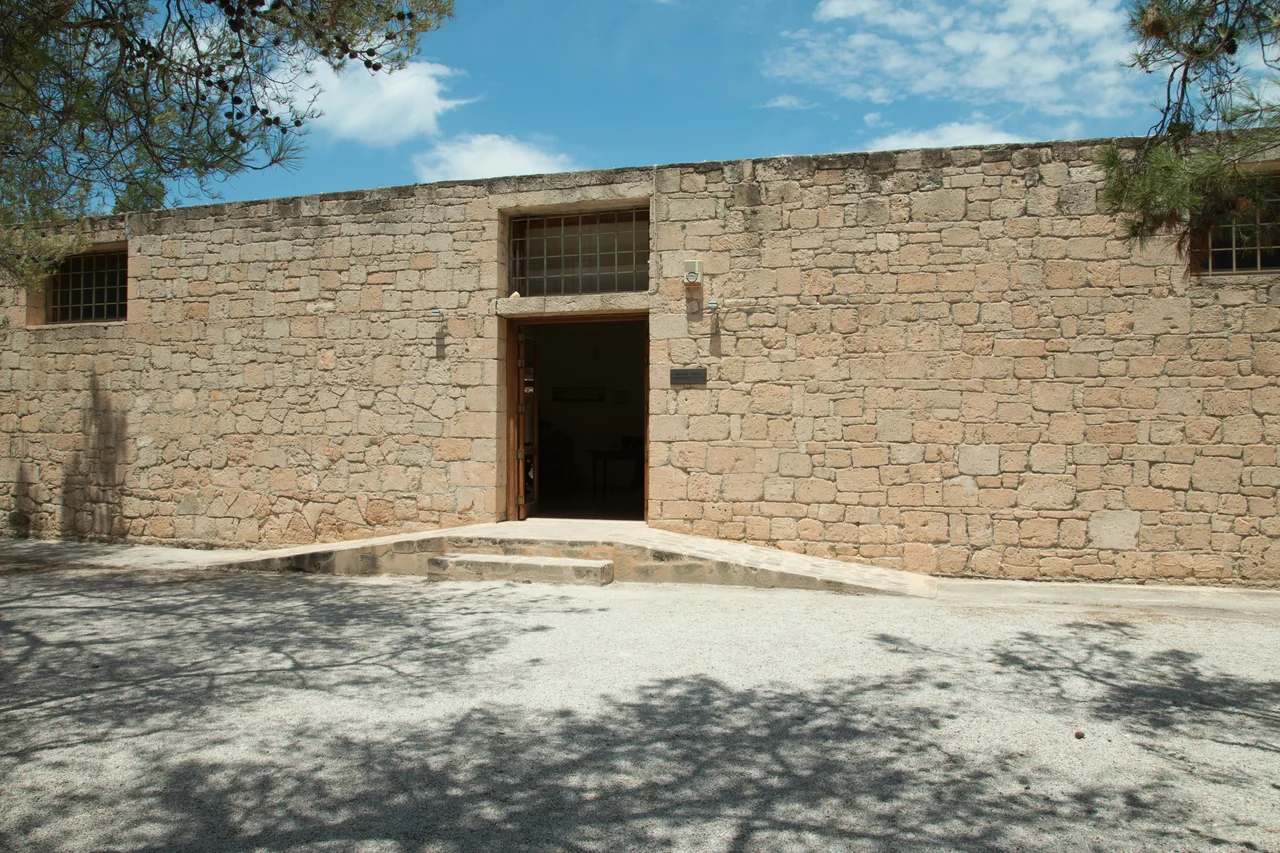

Archaeological Museum of Aegina
Ioannis Kapodistrias had been governor of Greece for less than a year when he founded this museum on 21 October 1828. The country was barely a country — still fighting for its existence, with Athens not yet liberated. But Kapodistrias chose Aegina, the revolutionary capital, as the site for something that no free Greek state had ever had before: a public museum. It was an act of nation-building as much as scholarship, a declaration that the new Greece would be the heir of ancient Greece.
The First Museum of Modern Greece
The significance of the founding date is easy to miss if you approach this building expecting the grandeur of the National Archaeological Museum in Athens. The museum was originally housed in a modest ground-floor structure: stone walls, a tiled roof, an interior patio surrounded by a wooden portico. Since 1980, the collection has been housed in a modern building near the archaeological site of Kolona, the remains of the ancient Temple of Apollo. But inside and around it lies a collection that spans from the Early Bronze Age to the Roman period — pottery, ceramics, alabasters, statuettes, inscriptions, coins, weapons, and copper vessels drawn from Aegina's extraordinarily long occupation. The museum predates Greece's capital. Athens would not be designated as the capital of the new state until 1833. When Kapodistrias walked through these rooms, he was building institutions for a country still being born.
Four Thousand Years in One Courtyard
The collection moves through time in concentrated form. Early Bronze Age pottery from the Early Helladic II period — roughly 2400 to 2300 BC — sits alongside Middle Bronze Age storage jars painted with geometric decorations. Mycenaean figurines from between 1700 and 1050 BC share space with protogeometric pottery from the 10th and 8th centuries BC. A torso of Heracles from the older Temple of Apollo, carved around 570–560 BC, and an early classical sphinx from the same temple dated to around 460 BC represent the island's artistic peak. In the museum's courtyard, an extraordinary artifact survives from a different chapter of the island's history: a mosaic from a 4th-century AD synagogue built by Aegina's Romaniote Jewish community, decorated with geometric motifs. The synagogue was in use until the 7th century AD. Its mosaic is one of the oldest surviving remnants of Jewish life in Greek lands.
Kapodistrias and the Weight of Beginnings
Ioannis Kapodistrias (1776–1831) was not an archaeologist. He was a diplomat and statesman, born in Corfu, who had served as foreign minister of Russia before returning to lead the Greek revolutionary government. His decision to create a museum in Aegina in 1828 reflected a broader conviction: that the new Greek state needed institutions — schools, libraries, museums — as urgently as it needed armies. The building that housed the museum also held, at various times, a school and a workshop for orphaned children. Kapodistrias understood that protecting and displaying the material inheritance of ancient Greece was itself a political act, a way of grounding the modern nation in a long continuum. He was assassinated in 1831, before Athens was fully consolidated as the capital. The museum he founded outlasted him by nearly two centuries.
A Living Archive
Today the museum stands a short walk from Aegina's main port, in the town that served as the seat of the Greek government during the revolutionary years. Its scale remains intimate — this is not a place for sweeping crowds but for careful looking. The museum has the quality of something that has absorbed the weight of its own history without being crushed by it. Visitors move through rooms where pottery made four thousand years ago sits at eye level, where a Corinthian jug from around 600 BC shows the trade connections that once made Aegina a Mediterranean crossroads, and where a funerary relief from the 5th century BC offers a moment of stillness that museums rarely provide. Outside, the mosaic of the ancient synagogue is displayed in the courtyard area, quietly present.
From the Air
The Archaeological Museum of Aegina is located at approximately 37.7496°N, 23.4248°E in Aegina town, close to the waterfront. From altitude, Aegina town is identifiable as the main urban area on the island's northern coast, with the harbor and ferry docks clearly visible. The museum itself is not visually prominent from the air but is a few minutes' walk from the port. Nearest major airport: LGAV (Athens International Eleftherios Venizelos), approximately 35 km northeast. Recommended viewing altitude for the island context: 2,000–4,000 feet.
Nearby Stories
- Megara 4.3 km away
- Berbati Valley 4.4 km away
- The Dokos Shipwreck 11 km away
- Mines of Laurion 12 km away
- Sicyon 12 km away
- Hellenic Geodetic Reference System 1987 12 km away
- Villa of Herodes Atticus 15 km away
- Kythnos 46 km away