
Mines of Laurion
Sometime around 483 BCE, Athenian miners broke into a new vein deep below the rocky hills of Laurion. Unlike the two veins before it, this one did not surface — it had to be chased down through shafts and galleries cut into living rock. The silver that came up from those galleries would pay for 200 warships. Those warships would win the Battle of Salamis. Salamis would end the Persian invasion. And the Golden Age of Athens — the Parthenon, the tragedies, the philosophy — would rest, quietly and largely unacknowledged, on what happened in those underground chambers: the labor of tens of thousands of enslaved people, chained, naked, and branded, crawling through passages no taller than a crouched man, in air thick with oil-lamp smoke, for wages paid only to the men who owned them.
Down Into the Dark
The mines of Laurion had been worked since at least the late Neolithic, around 3200 BCE — isotopic traces of Laurion lead turn up in Mycenaean bronze-age objects scattered across Greece. But the scale that changed history came in the 5th century BCE, when Athens began systematically exploiting a new and unprecedentedly rich contact between marble and schist deep beneath the Attic hillsides.
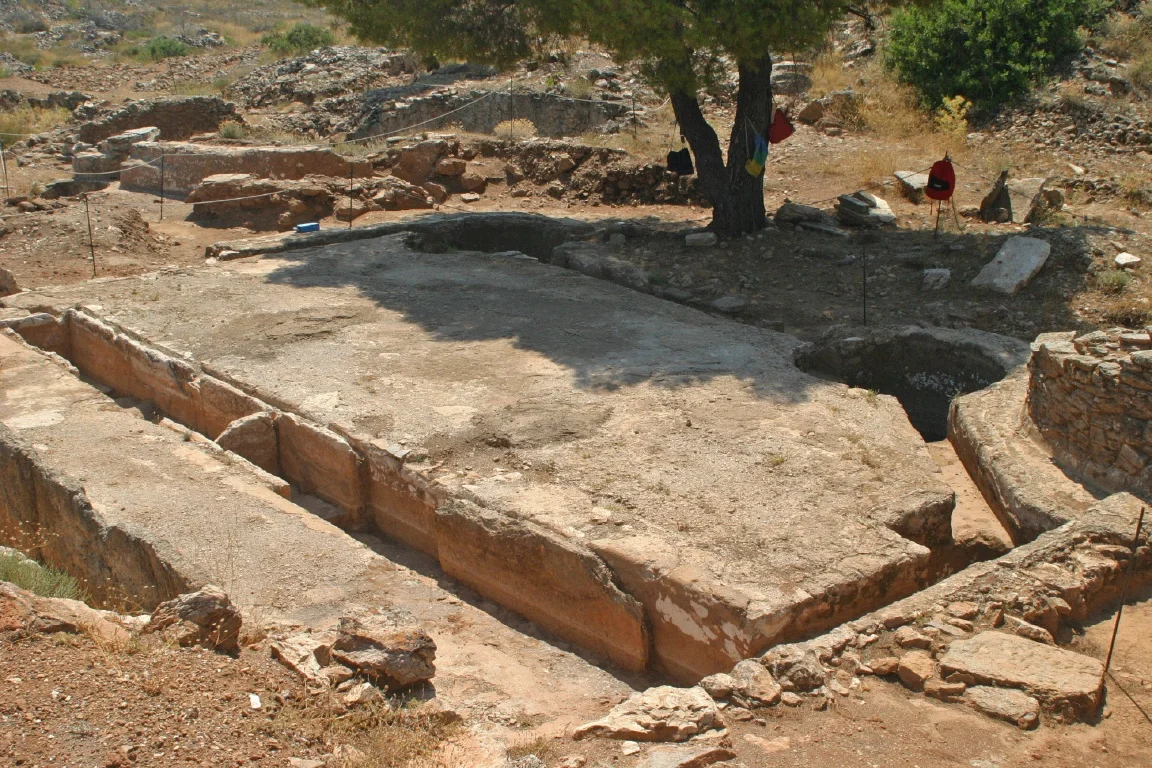
Around 700 ancient mine shafts have been discovered at Laurion, along with some 200 ore-processing stations where silver was separated from lead. The ore traveled on the backs of workers, most of them enslaved, from the dark of the galleries to the washing tables on the surface. Estimates suggest nearly 20,000 enslaved people worked these mines at the height of their productivity — extracting ore, hauling it, washing it in sluice troughs fed by carefully engineered cisterns, and heating it in furnaces to separate lead from silver. The silver content of the raw ore was only 0.1 percent. The rest was labor.
The People Who Made Athens Possible
The source article puts it plainly: these were men and an unknown number of children, "chained, naked, and branded," working ore seams "illuminated only by guttering oil lamps." It was, in the words of the ancient record, "a miserable, dangerous, and brief life."
They were not a faceless mass. They were people with bodies that bent under loads, lungs that filled with rock dust, and eyes that adjusted over years to almost total darkness. Their names are mostly lost, as enslaved people's names usually are. But their work produced 100 talents of silver — roughly 2.6 tonnes — at exactly the moment Athens needed it most. When the Persian fleet was marshaling for its second invasion in 480 BCE, the statesman Themistocles persuaded the Athenians not to distribute this windfall among themselves but to build a fleet. The 200 triremes that Laurion silver built met the Persians at Salamis. Greece did not fall. Athens rebuilt.
When the Silver Ran Out
The mines' story did not end with the Golden Age. They continued operating, with interruptions from war and exhaustion, through the Hellenistic period and into Roman times, when enslaved people at Laurion joined large-scale revolts around the time of Rome's Second Servile War (104–100 BCE). Sulla's siege and sack of Athens in 87–86 BCE ended mining for centuries.
In 1864, the mines reopened under a private company. Renewed extraction processed both fresh ore and ancient slag heaps left by classical miners. Zinc and lead fueled commercially significant operations into the 20th century; iron ore continued into the 1950s; the last profitable sulfide deposits were exhausted in 1978. But the 19th-century revival had its own violence. In 1896, a miners' strike was met by company guards, and four workers were killed. The miners responded by destroying company offices. The government sent police, then military. More workers died. The demands went largely unmet, and a permanent military garrison was stationed at the mines.
What the Ground Holds
The geology beneath Laurion is extraordinary in its own right. The silver deposits formed at three distinct contacts where layers of Kamariza marble meet schist — a sequence of lead, zinc, and silver sulfide minerals laid down in the deep past through metamorphic and marine transgressive episodes. The landscape itself still bears the marks of antiquity: ancient spoil heaps, the depressions of filled shafts, the circular outlines of ore-washing stations visible from the air. The Mineralogical Museum of Lavrion now holds the mineral collection; hiking trails let visitors walk the industrial archaeology of what was, for two centuries, perhaps the most consequential patch of ground in the ancient Mediterranean world.
From the Air
The Mines of Laurion lie at 37.71°N, 24.04°E, on the southern tip of the Attica peninsula about 60 km southeast of Athens. From the air, the mining district is visible as a network of spoil heaps and worked hillsides in the low, scrubby terrain between the town of Lavrio and the cape. Approach from the north following the eastern Attic coastline. The nearest major airport is Athens International Eleftherios Venizelos (LGAV), approximately 40 km to the north. Recommended viewing altitude for the broader mining landscape: 2,500–4,000 feet AGL. The Aegean is visible to the south and southeast; on clear days, the columns of the Temple of Poseidon at Cape Sounion are visible roughly 8 km to the south.
Nearby Stories
- Salamis Naval Base 1.9 km away
- Battle of Andros (1790) 5 km away
- Temple of Aphaia 5.8 km away
- Hydra: The Island That Refused the Car 13 km away
- Gyaros 14 km away
- Saint Ephraim Monastery, Nea Makri 16 km away
- Kythnos 30 km away
- Archaeological Museum of Sifnos 53 km away