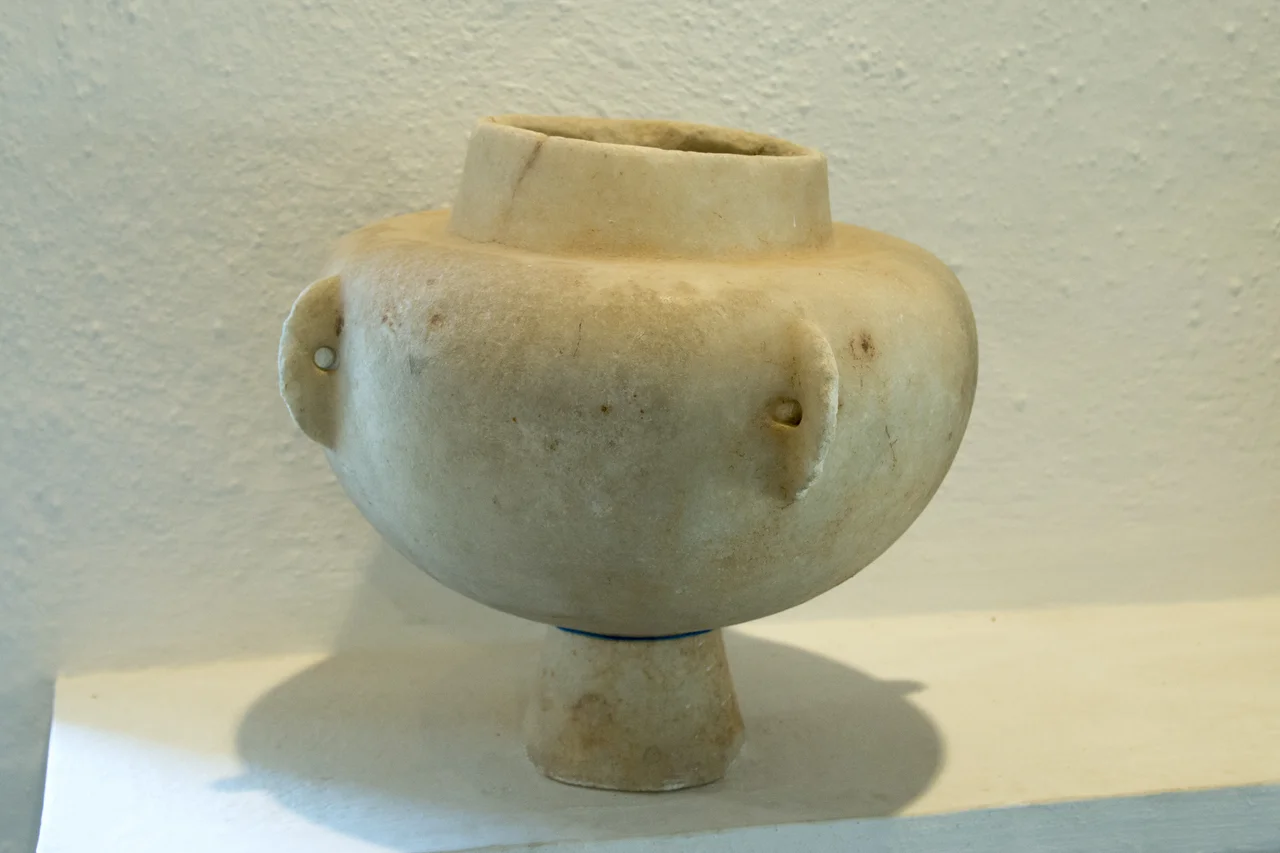

Archaeological Museum of Sifnos
Kastro was the capital of Sifnos for roughly three thousand years — from the Archaic period until 1836 — which means the medieval town built over ancient foundations, which in turn covered earlier settlements still. The Archaeological Museum of Sifnos sits inside this layered place, housed in a building that belongs to the medieval nucleus of the Kastro itself. Opening its doors in 1986 after restoration by the Greek Ministry of Culture, it holds objects spanning from the early Bronze Age to the late Byzantine period. Five millennia in a few rooms, on a hilltop over the Aegean.
What Five Thousand Years Looks Like
The collection is almost entirely local — finds from Sifnos and its immediate surroundings rather than objects assembled from across the Greek world. That geographic focus gives the museum an unusual coherence. A marble chandelier, a kandila, from the third millennium BC arrived from the same island soil as a Roman portrait of a man carved perhaps two thousand years later. Between those poles: cases of geometric and archaic pottery, a Protocorinthian cotyle from the early 7th century BC, and fragments that track the island's engagement with every major cultural phase of ancient Greece. The collection does not shout. It accumulates, quietly, into something substantial.
The Kouros and the Lyre Player
Two objects in the collection stand out for the stories they carry. An eroded head of a kouros — the standing male figure that archaic Greek sculptors produced across the Mediterranean world — dates from around 550 BC and was made in marble. Time has softened its features into near-abstraction, but the form remains unmistakable. The other is a marble stele inscribed with a Hellenistic-period decree honouring a lyre player from Delos. That a small Cycladic island would formally honour a musician from a neighbouring island with an inscribed marble slab suggests how seriously the ancient world took music and cultural exchange — and how connected even modest islands were to the wider Greek world.
Built into the Kastro
The building itself is part of the attraction. Kastro — the medieval fortified village perched on a rocky promontory above the sea — is one of the most complete surviving examples of a Cycladic medieval town. Its lanes include Roman sarcophagi built into walls, ancient columns incorporated into house facades, and a well-preserved section of Classical fortification wall. The museum building fits inside this layered fabric naturally, a medieval structure that now contains things far older than itself. The restoration opened the museum to the public in 1986, and it operates Tuesday through Sunday, from 08:30 to 15:00.
From Bronze Age to Byzantium
The latest objects in the collection bring the story forward to roughly 1700 AD: a fresco from a church in the Kastro, painted at a time when the island had passed through Venetian, Ottoman, and Byzantine hands in succession. That fresco closing the sequence — after the Early Cycladic chandelier that opens it — is a span of more than four thousand years of human presence on one small island. Sifnos was never a major power in the ancient world after its gold-and-silver wealth ran out in the Classical period. But it was continuously inhabited, continuously productive, and the museum in the Kastro is the most concentrated evidence of that continuity anywhere on the island.
From the Air
The Archaeological Museum of Sifnos is located in Kastro village at approximately 36.974°N, 24.746°E, on the eastern coast of Sifnos. Kastro sits on a promontory overlooking the sea and is visible from the water as a dense cluster of white and ochre buildings on a rocky headland. The nearest major airport is LGAV (Athens International Eleftherios Venizelos); Sifnos has no airport. Ferries arrive at Kamares on the western coast, roughly 8 km by road from Kastro. From the air at around 5,000 feet, Sifnos presents as a long north-south island with the denser green of its eastern side visible compared to the more barren west. Kastro appears as a compact settlement on the eastern cliff. Flight approach from Athens would follow a southeast track over the Saronic Gulf and into the Cyclades.
Nearby Stories
- Ios 2.4 km away
- Italian submarine Jantina (1932) 9.6 km away
- Temple of Sangri 11 km away
- SS Heraklion 19 km away
- Syros 23 km away
- Milos 33 km away
- Agios Georgios (island) 38 km away
- Monemvasia 107 km away