_08.jpg)
Temple of Sangri
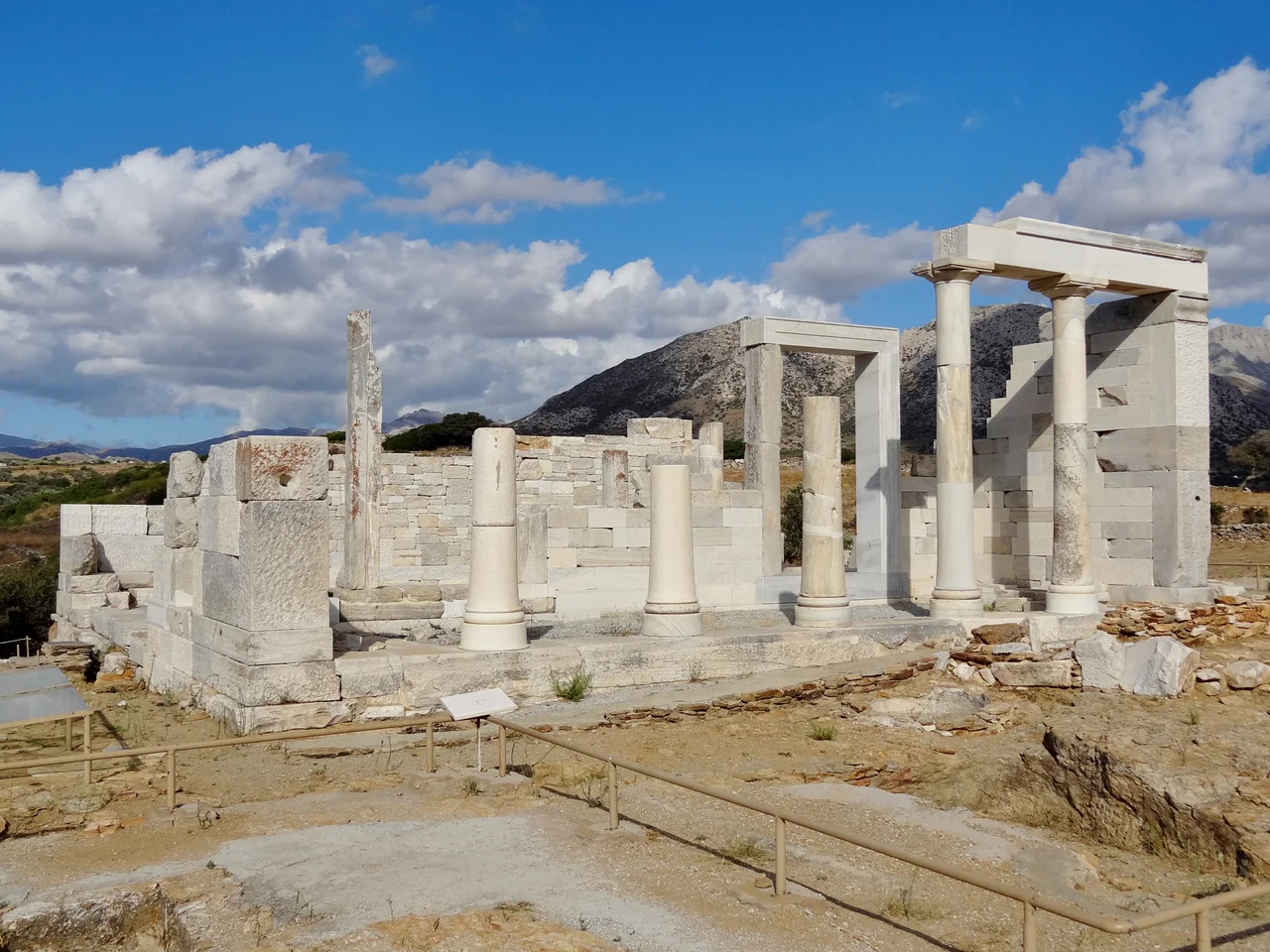
It breaks every rule. Greek temples are rectangles, almost always elongated. The Temple of Sangri is nearly a square, 13.29 by 12.73 meters. Greek temples face east. This one faces south. Greek columns get thicker as they rise, a subtle bulge called entasis. The columns at Sangri narrow as they rise. Greek temples sit on a stepped platform called a crepidoma. This one is built directly on its smoothed foundation, no platform at all. The building was raised around 530 BC on the Cycladic island of Naxos, in farmland 1.5 kilometers south of the village of Sangri, and it was constructed entirely from Naxian marble. The whole thing was reconstructed in the 1990s using its own surviving stones, a process made possible because so many parts had survived.
Demeter on a Hilltop
The temple was probably dedicated to Demeter, goddess of grain and the harvest, or possibly to her daughter Kore (Persephone). The dedication makes geographical sense. The Gyroulas plateau where the temple sits is fertile farmland in a region of Naxos famous in antiquity for agriculture. There are also indications of a cult to Apollo at the same site. Because of the temple's unusual square plan and unique features, archaeologists sometimes refer to it as a telesterion, a building used for mystery initiations like those at Eleusis. Whether it actually served that function is unproven, but the architecture invites the comparison. This was not a standard processional temple meant for a public crowd to circle. It was something more enclosed, more interior, more focused on what happened inside the cella.
The First Marble Roof
The most extraordinary feature is the roof. Until this temple, Greek roofs were made of timber and clay tile. The architects at Sangri used marble for the roof itself, the oldest known marble roof in any Greek building. Seven beams, each about four meters long, supported the roof of the pronaos. Each beam was cut with an upward curve of nearly two centimeters, so that every structural element above had to be specially shaped to match. The whole building has a common subtle curvature running through it, an extraordinary technical achievement for the 6th century BC. Inside, light entered the naos through gaps between the marble roof tiles, even when the doors were closed. The effect must have been like sunlight filtering through a stone forest, diffuse and oddly even. Demeter, goddess of growing things, was illuminated by light that fell from above as if through leaves.
Strange Columns and Painted Capitals
The five columns of the south facade stand in antis, set between forward-projecting wall ends. The columns are in Samian style, but unfluted, smooth marble shafts rather than the typical channeled ones. They taper upward, the opposite of normal Greek practice. The capitals were not carved with the wreath-leaf pattern that defined Ionic style. Instead, the leafy decoration was painted onto the smooth double echinus, with painted bands wrapping the abacus above. The five interior columns rose to slightly different heights, ranging from 5.4 to 6.46 meters, but all had the same diameter at the base, 50 centimeters. The whole exterior was originally plastered and painted. The walls inclined outward at about 3 percent, the opposite of the slight inward lean used in most archaic temples. Whoever designed this building was working out an alternative grammar of what a Greek temple could be.
Demolished into a Basilica
The temple operated through the late Roman period and would have been closed during the persecution of pagans in the 4th century AD under the Christian emperors. In the 6th century AD, the building was largely demolished and a three-naved Christian basilica was built directly on the same site, using the same marble blocks. This is a story repeated all over the Greek world. The Christian builders cleared the temple but kept the marble. They reset the blocks into walls, columns, and floors of the new church. The basilica's apse is still partly visible at Gyroulas today, just east of the reconstructed temple. Two thousand years of religious reuse on a single piece of farmland.
Sixteen Hundred Pieces, Reassembled
Nikolaos Kondoleon investigated the site in 1949. From 1976 to 1985, a joint team from the University of Athens and the Technical University of Munich, led by Vassilis Lambrinoudakis and Gottfried Gruben, conducted full excavations. They found roughly 1,600 surviving pieces of the original temple, scattered as the basilica was demolished and as the marble weathered out of the Naxian soil. Because every part of the building had its own specially shaped curvature, the pieces could be measured and matched to their original positions. A partial restoration was completed in 1994. A small site museum opened in August 2001. Today the temple stands again, low against the green Naxian landscape, the southern facade reassembled with its strange tapering columns. From the air the building reads as a small marble cube on a green hilltop, distinct against the surrounding olive groves.
From the Air
Located at 37.03 N, 25.43 E on the Cycladic island of Naxos, in the Gyroulas area about 1.5 km south of Sangri village in central Naxos. Elevation roughly 200 meters on the Tragea plateau. Nearest airports: Naxos Island National Airport (LGNX) 12 km west, Paros (LGPA) 25 km west across the strait, Mykonos (LGMK) 50 km north. Best viewed from low altitude (below 600 meters AGL) on a southern approach. The reconstructed temple is small and sits among olive groves, but the white marble against the green plateau is distinctive. Nearby Mount Zas, the highest peak in the Cyclades at 1,001 meters, provides a primary visual reference 8 km east-northeast.
Nearby Stories
- The Big Blue 15 km away
- Italian submarine Jantina (1932) 17 km away
- Archaeological Museum of Sifnos 19 km away
- Miaouli Square 20 km away
- Astypalaia 37 km away
- Ikaria 38 km away
- Milos 49 km away
- Monastery of Saint John the Theologian 58 km away