.jpg)
Astypalaia
From the air, Astypalaia looks like a butterfly mid-flight: two broad wings of rock cinched together at the center by a sliver of land barely 126 meters wide. At the narrowest point, called Stenó, you could almost throw a stone from one sea to the other. The island sits at the western edge of the Dodecanese, far enough from its neighbors that scholars still argue whether it truly belongs to that group at all, or whether its whitewashed houses and its light make it a stray cousin of the Cyclades. The 1,376 people who live here probably don't lose sleep over the classification. They live on an island that wears its layers openly.
The Castle on the Hill
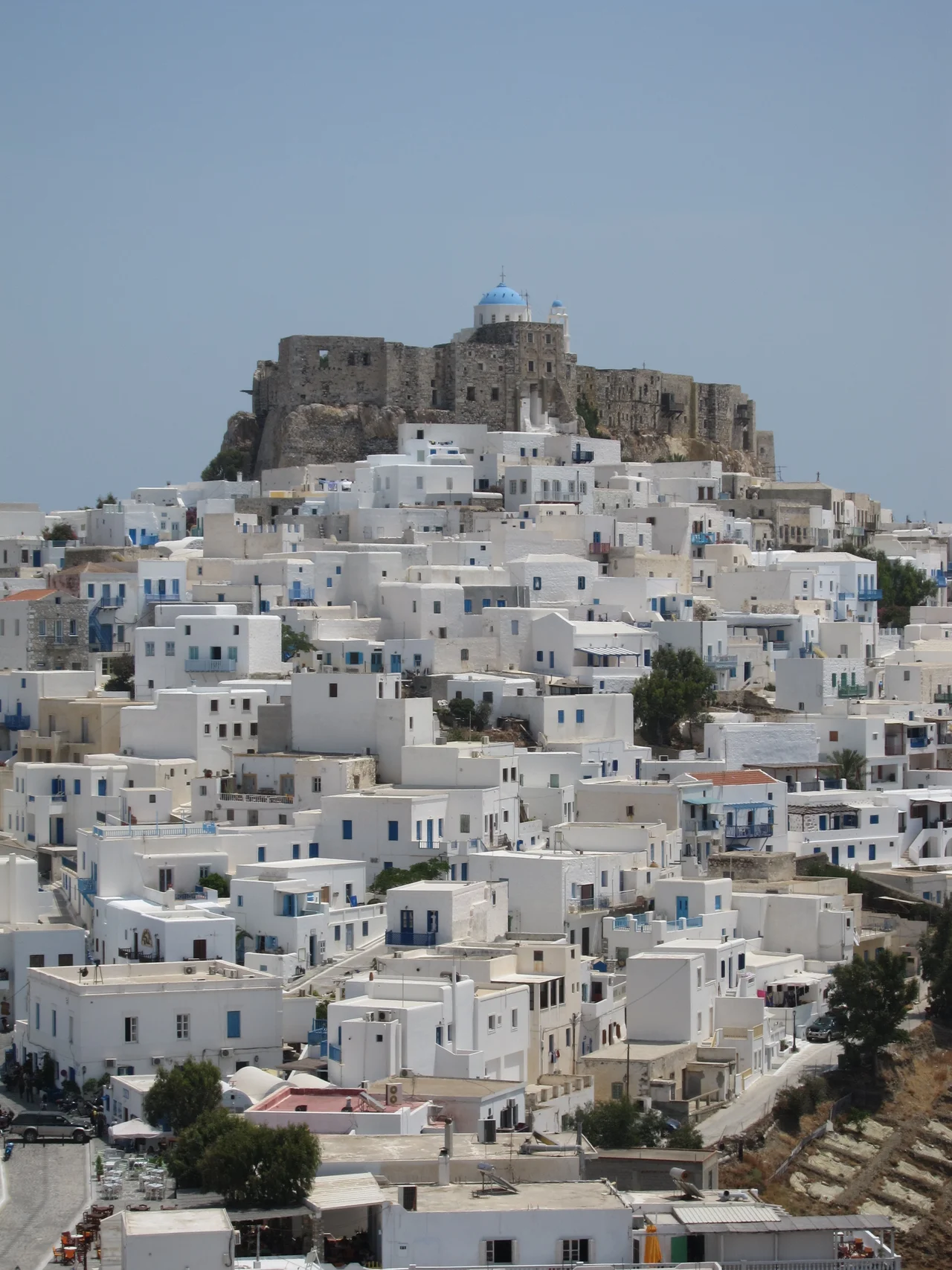
Climb to the top of Chora and you reach the reason the whole town exists. The Querini castle crowns the highest hill, a Venetian fortress of pale stone that has watched over the harbor for centuries. The Venetian nobleman Giovanni Querini purchased the island, declared himself its lord, and raised the castle and palace here. The island became Stampalia to the Latins, İstanbulya to the Ottomans, and the Querini name stuck to the rock for generations. The castle was not built on virgin ground. This same hill was the religious and political heart of the ancient city-state, and worked stones from vanished temples are wedged into the castle walls and the older houses below. Stand at the ramparts and you are standing where Astypalaians stood three thousand years ago, looking at the same blue.
A Cemetery of Small Lives
On the western flank of the castle hill, at a place called Kylindra, archaeologists uncovered something that asks to be approached gently. Between roughly 750 BC and Roman times, the people of Astypalaia buried at least 2,700 newborns and infants here, each one placed inside a ceramic pot. It is the largest cemetery of children and infants ever found anywhere in the world. Infant remains rarely survive in ancient graves, but here the trade pots, the amphorae meant to carry oil and wine, cradled tiny bones for millennia. A separate burial ground at nearby Katsalos held the adults and older children. The separation suggests these families set their smallest losses apart, perhaps under the care of goddesses tied to childbirth. Since 2000, researchers from University College London have studied these remains, and through them, the growth and grief of an ancient community.
An Equal of Rome
In 105 BC, this small island and the vast Roman Republic signed a treaty as equals. The text survives, carved into stone found on the island. By its terms, Astypalaia would not aid Rome's enemies, and Rome would not aid Astypalaia's; if either was attacked, the other would come to its defense. Rome had no real need to flatter a speck of rock in the Aegean, which is precisely what makes the inscription so revealing. At the close of the second century BC, the Republic still maintained the courtesies of reciprocity with Greek city-states, the forms of partnership even where the substance had tilted long ago. Pliny the Elder later recorded that Rome granted the island the status of a free state. The stone remembers a moment when an island could look an empire in the eye.
The Electric Island
Astypalaia's newest chapter looks forward rather than back. In 2023, the Greek government and the Volkswagen Group announced a plan to turn the island into a laboratory for climate-neutral mobility, a model of how a small place might move without burning fossil fuel. Grants are replacing cars and vans with electric vehicles, ride-sharing and demand-responsive transport are arriving, and a 3.5-megawatt solar power station with battery storage will feed the new fleet. There is something fitting in this. An island that buried its infants in oil amphorae, that signed treaties in stone and watched Venetians build castles from temple rubble, is now testing what the next century of island life might feel like. The butterfly is still in flight.
From the Air
Astypalaia lies at roughly 36.58°N, 26.38°E in the southeastern Aegean, the westernmost of the Dodecanese. From altitude, look for the unmistakable butterfly outline pinched at the Stenó isthmus, with the whitewashed Chora and its Querini castle on the eastern wing. The island airport sits near Maltezana (Analipsi); the nearest scheduled field is Astypalaia National Airport (LGPL), with Kos (LGKO) and Santorini (LGSR) within short hops. Clear Aegean visibility makes the two-lobed coastline and pebble beaches easy to identify.
Nearby Stories
- 1956 Amorgos Earthquake 5.5 km away
- Battle of Rhodes (1912) 13 km away
- Bodrum Castle 35 km away
- Koufonisi 36 km away
- Monastery of Saint John the Theologian 44 km away
- Bodrum 53 km away
- Battle of Rhodes (1943) 123 km away
- Archaeological Museum of Agios Nikolaos 135 km away