
Battle of Rhodes (1943)
Lieutenant Colonel Marcello Fossetta watched the German guards at Maritsa airfield put down their rifles and settle in to watch a film. It was the evening of 8 September 1943, the Italian armistice with the Allies had just been announced, and the men he had been ordered to consider enemies were sitting unarmed in a makeshift cinema. He radioed his command. A surprise attack would be easy. The order came back: do nothing. General Kleemann had given his word. Three days later, Rhodes was lost, and tens of thousands of Italian soldiers were on their way to a captivity that most of them would not survive.
An Island Caught Between Allies
Rhodes had been Italian since 1912, the jewel of the Dodecanese, with the Palace of the Grand Master of the Knights serving as Admiral Inigo Campioni's seat of government. On paper, the island was a fortress. The Italian garrison numbered around 34,000 army troops, 2,100 sailors, and 3,000 air force personnel - a force that should have made any German move suicidal. But the Germans had been quietly working their way onto the island for months. Two anti-aircraft batteries became four, then a panzergrenadier battalion arrived in April 1943, then two more. By June, General Ulrich Kleemann had built the Sturm-Division Rhodos: 6,000 to 8,000 men, 25 Panzer IVs, self-propelled guns, and a separate radio network the Italians could not hear. When the armistice was announced, Campioni outnumbered Kleemann roughly five to one. None of that would matter.
Three Days of Confusion
The instructions from Rome never arrived - the courier carrying them was stuck in Pescara because of bad weather. Around 20:30 on 8 September, Campioni held a meeting at the Palace of the Grand Master. Without orders, no decisions were made. British leaflets dropped overnight, signed by General Henry Maitland Wilson, urging the Italians to seize the German positions; their authenticity seemed dubious, and Campioni did not act. Through the night Kleemann pressed for freedom of movement. He was refused, calmly, while his troops quietly tightened their grip. The first German attacks came around noon on 9 September. By 14:30 the Maritsa airfield was in German hands. Italian artillery destroyed the Panzers parked on the runway, but their own aircraft burned beside them. The Bianco coastal battery fought until it was wrecked. The Dandolo battery was overrun, its gunners taken prisoner.
The Parachute Rescue That Wasn't
On the night of 9 September, two British majors and a sergeant with a portable radio dropped from the dark sky onto Rhodes. One was George Jellicoe, son of the Jutland admiral; the other, Julian Dolbey, broke his leg on landing. They were brought to the Palace and met with Campioni. He asked when reinforcements would arrive. Dolbey told him the truth: at least a week. Campioni asked for diversionary landings in the south. Dolbey said the British did not have the means. The next morning, the Italian destroyer Euro arrived from Kos with two hundred reinforcements - the only ones that ever came - and was promptly sent back. Mount Paradiso fell, then Mount Fileremo. By the evening of 10 September, the high ground belonged to Kleemann.
Surrender
At 10:30 on 11 September, two German officers arrived at the Palace. The terms were unconditional: cease fire across the island, release all German prisoners, lay down arms. Campioni had thirty minutes to agree before the Luftwaffe bombed the city of Rhodes. He took stock. Four artillery batteries left in action. Civilian casualties certain. No British relief possible. He chose surrender. When the news reached the Italian troops, many wept. Some, who had been grinding the Germans down, assumed the radio had it backward - that it was the Germans who had given up. Soldiers shattered the stocks of their rifles before throwing them on the heaps. German prisoners were unlocked from Italian barracks and handed back their weapons in front of the men who had captured them.
The Sea That Swallowed Them
What followed was worse than the battle. On 19 September, between 1,584 and 1,835 Italian sailors and airmen were loaded onto the captured motorship Donizetti and sent toward mainland Greece. A British destroyer, not knowing what she carried, sank her. There were no survivors. On 12 February 1944, the steamer Oria, carrying more than 4,000 Italian prisoners from Rhodes, ran aground in a storm off Cape Sounion. Twenty-one men were rescued. At least 4,062 drowned. About 1,580 men eventually escaped from Rhodes. Around 6,520 were listed missing after the war - most of them at the bottom of the Aegean. Ninety were executed by the Germans, forty without trial. Campioni was taken to a camp in Poland, handed to Mussolini's puppet republic, tried for defending the island he had been sworn to defend, and shot. Sergeant Pietro Carboni hid in the Rhodian interior with one Italian civilian and one carabiniere, sabotaging the occupation until German troops killed him on 20 December 1944.
From the Air
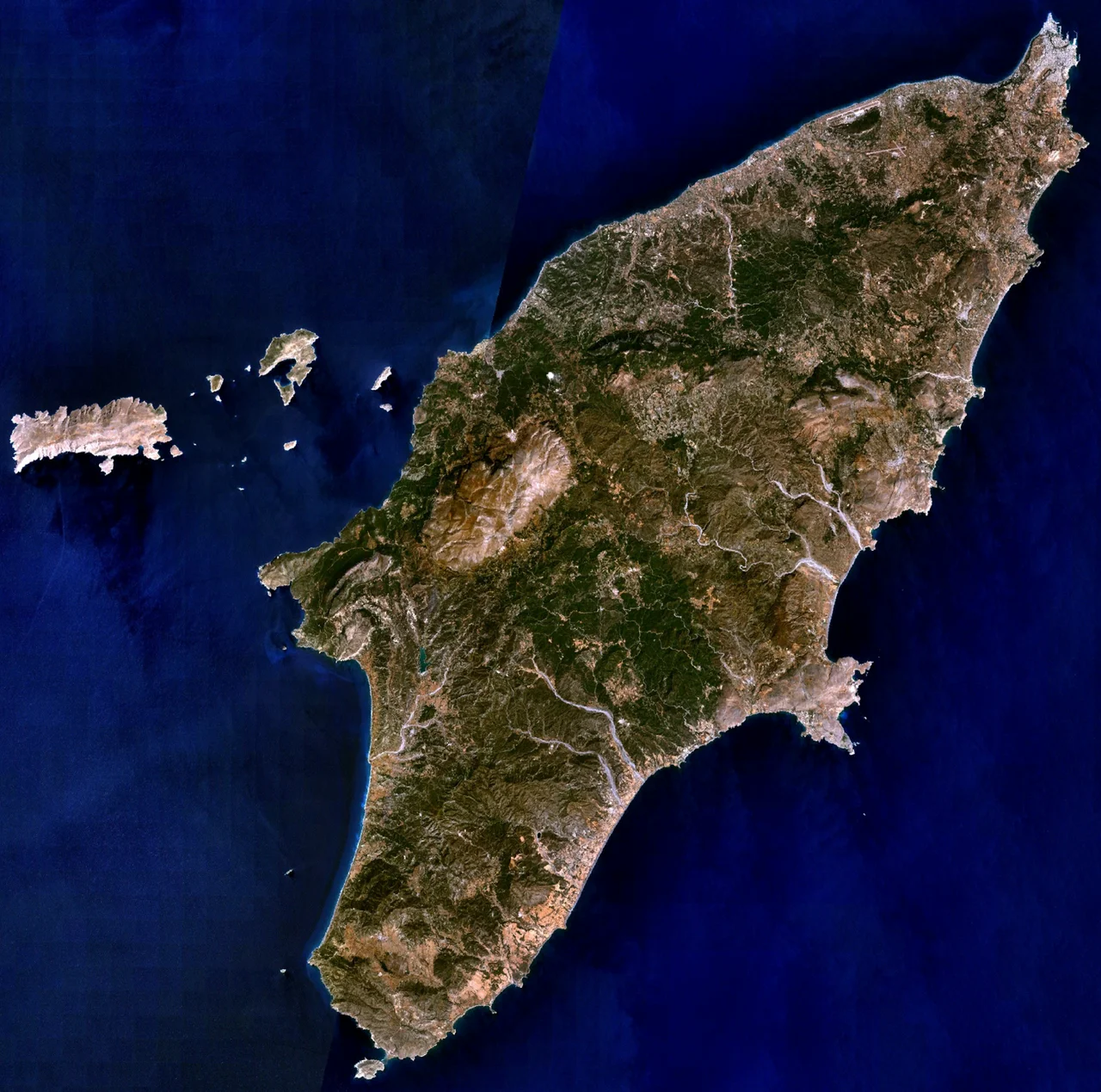
36.34N, 27.92E. The Battle of Rhodes covers the entire island; the most significant sites cluster around the northern tip. From 6,000-8,000 ft, look for the medieval city of Rhodes Town and its harbor (Mandraki) at the northern point - the Palace of the Grand Master is the largest fortified complex in the old town. Mount Smith rises west of the city, where the Majorana battery fired its last rounds. Diagoras International Airport (LGRP), built on the old Maritsa airfield where the September 1943 fighting concentrated, sits 14 km southwest of Rhodes Town. Nearest alternates: Karpathos (LGKP, 110 km south) and Kos (LGKO, 130 km north). The Aegean here is famously clear; Lindos promontory, where the Dandolo and Morosini batteries stood, is visible 50 km southeast along the eastern coast.
Nearby Stories
- Battle of Rhodes (1912) 20 km away
- Bodrum Castle 70 km away
- Astypalaia 94 km away
- Toplou Monastery 142 km away
- Antalya Museum 200 km away
- Antalya 211 km away
- Archaeological Museum of Agios Nikolaos 223 km away
- Agios Neophytos Monastery 383 km away