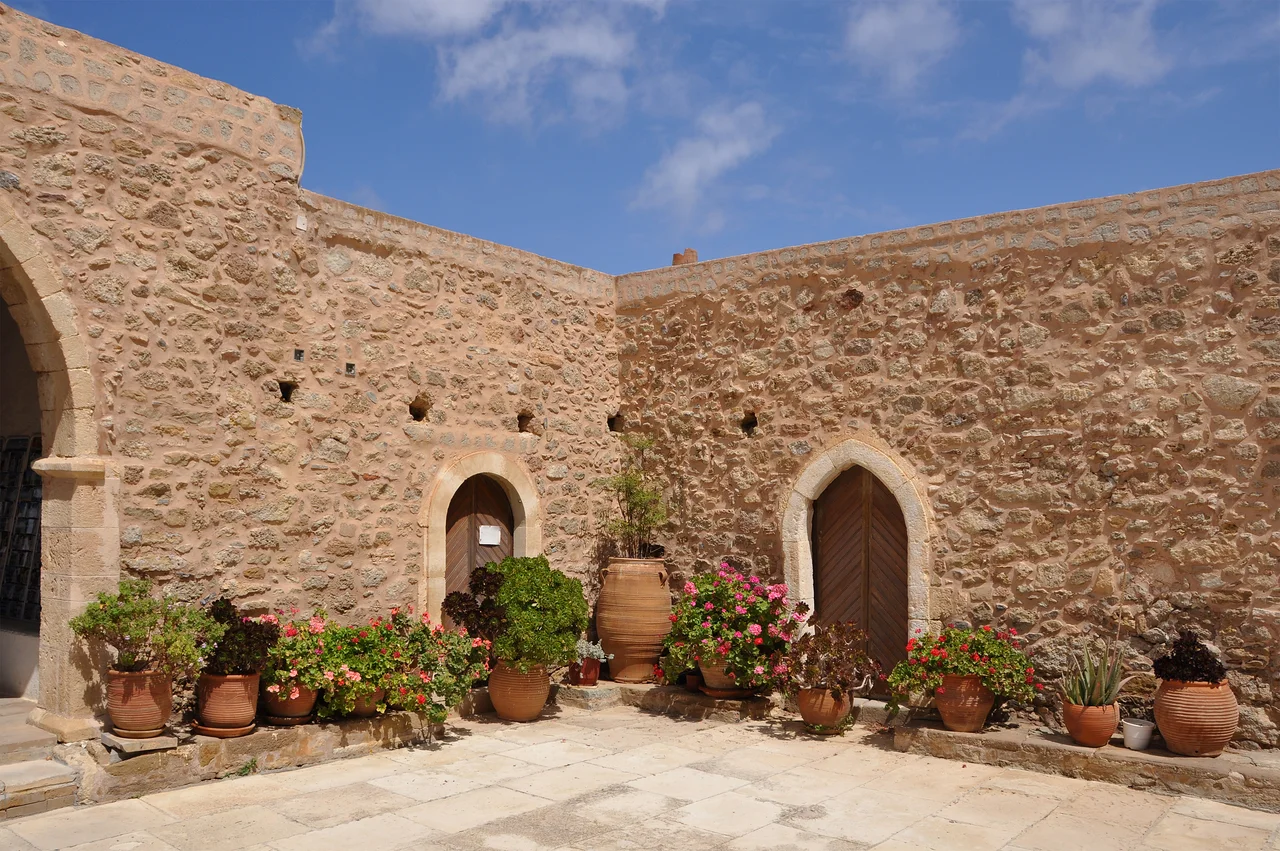

Toplou Monastery
The cannon is gone, but the name remains. Moni Toplou - 'place of the cannon' - is what Ottoman Turks called the squat, fortress-like monastery that stares down the wind on Crete's easternmost cape, and the name stuck so hard that the original Greek title, Panagia Akrotiriani ('Our Lady of the Cape'), now lives mostly in legal documents. From the air, Toplou looks less like a place of worship than a small stone keep dropped onto a brown, treeless plateau, hunched against the meltemi winds that sweep down off the Aegean. That impression is correct. The monks who built and rebuilt this place understood that on the eastern edge of the last Latin principality, prayer alone would not keep them alive.
A Cape at the Edge of Empires
The Itanos promontory juts northeast from Crete toward nothing - just open sea between here and the Cyclades. In the 14th century, when the first frescoes were painted on the walls of the small northern church that still stands inside the courtyard, Crete belonged to Venice and Constantinople still belonged to the Byzantines. Both were Christian; only one was the right kind, depending on whom you asked. The Venetians ruling the island were Roman Catholic. The monks at Toplou were Greek Orthodox. For more than two centuries that schism mostly mattered in writing, while the actual neighbors got on with the work of farming, fishing, and surviving on a peninsula so dry that 'one of the driest areas on Crete' is not just a tourism phrase. The monastery was placed beside a copious spring draining into the gorge below - the only logical place to build anything at all.
The Corsair Centuries
After Constantinople fell in May 1453, the Aegean became a hunting ground. Turkish privateers worked their way through the Cyclades, then turned south. They sacked Sitia in 1471. They reached the undefended monastery in 1498 and sacked that too. In 1538, Suleiman the Magnificent gave the pirate Hayreddin Barbarossa two hundred galleys and pointed him at the Greek islands. Barbarossa burned crops, took farm animals, and carried off villagers to be sold. By 1612, the mayor of Sitia - himself a former rector of the monastery - was begging the Venetian Senate for help: the walls were too low to defend. Venice sent two hundred gold ducats and a courteous note, observing that the church seemed 'well attended by many subjects of our kingdom.' Catholic money, Orthodox prayers, the same enemy at the gate. By the time Toplou's bell-tower was finished in 1558, the monks had effectively become a small armed garrison who also made wine.
Slaughter and Survival
Toplou's history reads as a list of catastrophes survived rather than years lived. Eastern Crete fell to the Ottomans in 1646 and the monastery was abandoned. It was reinhabited in 1704 under the protection of the Patriarch. In 1821, during the Greek War of Independence, Ottoman troops slaughtered the monks who had returned, and the buildings stood empty until 1828. The Cretan revolt of 1866 brought another devastation. Then came 1941 and the German occupation, and Toplou faced its fourth great test in five hundred years. The abbot and his monks hid resistance fighters and sheltered a wireless radio behind the courtyard's three-story walls. When the Germans found them, the abbot and two of the monks were tortured and executed. Their portraits hang now in a long row inside, painted by Thomas Papadoperakis - faces of men who knew what they were risking and chose to do it anyway.
What Survives
Today the road from Sitia to the famous palm beach at Vai runs straight through Toplou's premises, and the monks - still in their blue robes, still under the abbot - charge a small entrance fee. Inside the heavy stone gate are a museum of Byzantine icons and engravings, a shop, and the trapezaria, the monks' dining hall, with frescoes by the icon painter Manolis Betinakis on the walls. The monastery presses olives from its surrounding groves and bottles its own wine. It also owns the entire 26-square-kilometer Cavo Sidero peninsula, inherited centuries ago from the long-vanished classical city of Itanus, and that ownership has put Toplou in the middle of a long modern fight - over a planned mega-resort with three golf courses on one of the driest, most ecologically rare corners of the island, opposed by the local population, environmentalists, and ultimately Greece's highest administrative court. Six hundred years of fending off raiders, then fending off a real estate company. The weapons change. The cape does not.
From the Air
Toplou Monastery sits at 35.22°N, 26.22°E on the Itanos promontory of eastern Crete, about 6 km north of Palekastro. From cruising altitude the monastery shows as a small dark rectangle on a tan, treeless plateau; Cape Sidero, the easternmost point of Crete, juts northeast into the Sea of Crete from the same peninsula. Best viewed at 8,000-12,000 feet on a clear day. Nearest airports are Sitia Public (LGST) about 25 km west and Heraklion (LGIR) about 130 km west; Kasos Island (LGKS) lies to the southeast.
Nearby Stories
- Galatas Palace 39 km away
- Santorini: The Volcano That May Have Destroyed Atlantis 100 km away
- Battle of Rhodes (1912) 106 km away
- Astypalaia 121 km away
- Rhodes 155 km away
- Operation Crusader 359 km away
- Battle of Sidi Barrani 376 km away
- Rommel Museum, Mersa Matruh 405 km away