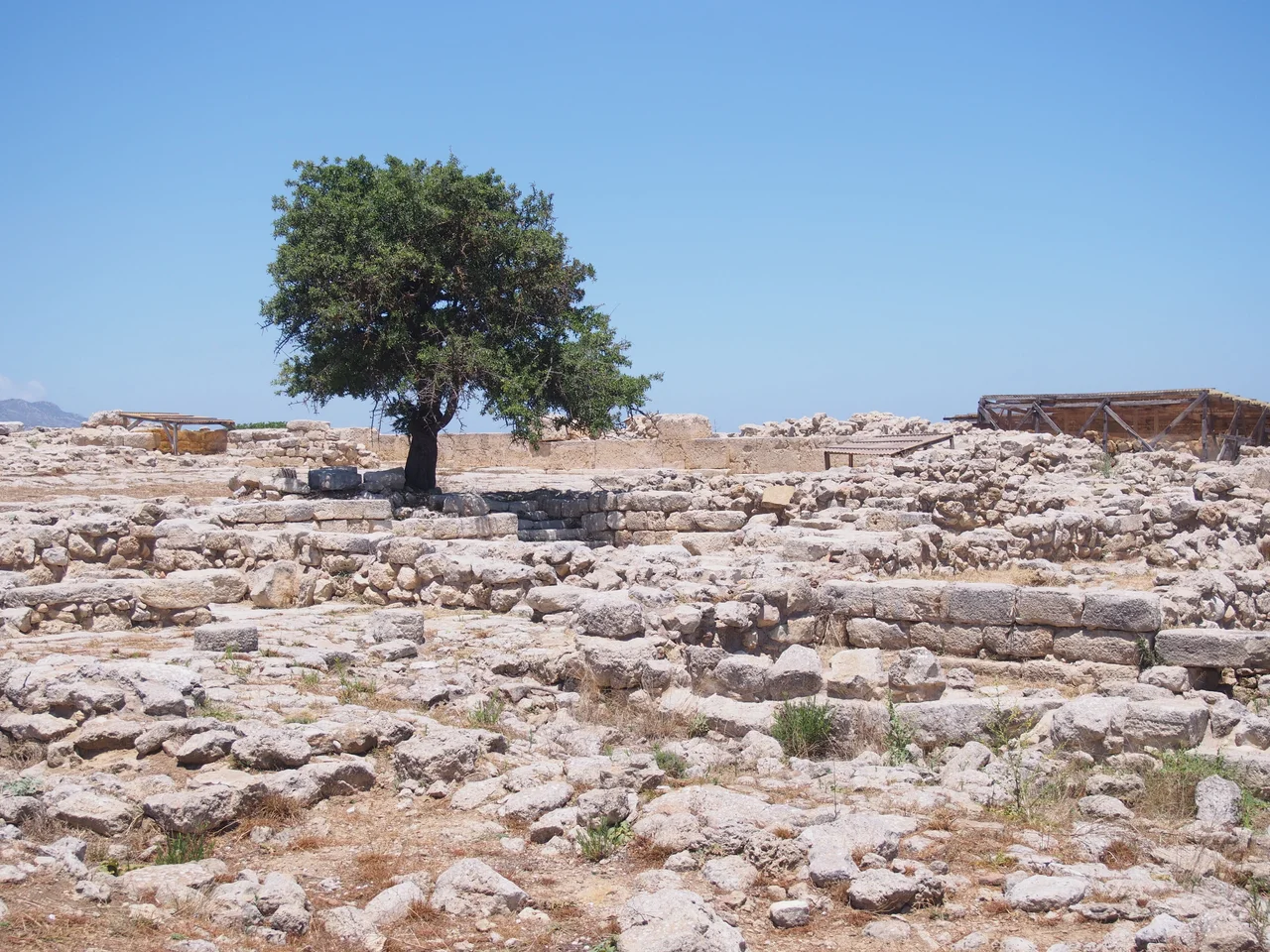

Galatas Palace
In 1992, looters with shovels were illegally digging into a low hill called Galatas Kephala, about thirty kilometers southeast of Heraklion, when their pits revealed walls that did not belong to the village above. The Greek archaeological service moved in. The dig that followed, led by Dr. George Rethemiotakis, took five years before he was able to announce, in 1997, what he was actually looking at: a fifth Minoan palace. Crete was supposed to have four - Knossos, Phaistos, Malia, Zakros - and now there was this. What made Galatas strange was not just its discovery. It was that the building had been built, used, and destroyed within roughly a single generation, and never rebuilt.
The Shape of a Minoan Palace
Walk through the foundations and the plan repeats a pattern Cretan archaeologists know well. A central paved courtyard runs north and south, sixteen meters by thirty-two, the focal point that organizes everything around it. A four-wing building once surrounded the court - east, west, south, and north - though only the east wing is well preserved. The other wings were heavily damaged in antiquity, and the north wing has not yet been fully excavated. Total area of the palace itself is about four thousand square meters. The architectural vocabulary is unmistakably Minoan: ashlar masonry, light wells, dressed stone thresholds, and the characteristic central court that distinguishes Cretan palaces from contemporary Mycenaean megaron-centered buildings on the mainland. Knossos, Phaistos, Malia, and Zakros all share this organization. Galatas joined the list at the smallest end, but it joined as a peer.
A Hearth You Could Cook a Bull On
What makes Galatas genuinely unique among Cretan palaces is what its excavators found inside. Most striking is a vast hearth measuring three meters by one and a half - the first hearth of that size discovered anywhere on Crete, large enough to roast meat for hundreds of people. Two smaller hearths nearby were apparently dedicated to cooking for feasts. Ceramic finds in their vicinity - dozens of conical cups, serving vessels, and storage jars - suggest organized communal eating on a substantial scale. This is unusual. Minoan palaces generally show their wealth through wine, oil, and grain stored in pithoi for redistribution; cooking on this scale, in a central palace context, suggests Galatas may have functioned as a regional gathering place where elites from surrounding villages came to eat together. Whether the feasts were religious, political, economic, or all three is impossible to say at this distance, but the kitchen tells you they happened.
Built and Burned in One Generation
The chronology is what makes Galatas an outlier. The site was first occupied in the Protopalatial period - Middle Minoan IB, roughly 1925 to 1875 BC - as an ordinary settlement. Centuries later, in the early Neopalatial period, around 1750 BC, the palace itself was constructed on top of the older village remains. And then, at the end of the early Neopalatial Middle Minoan IIIA phase, perhaps as little as fifty to seventy-five years after construction, the building was destroyed by fire and abandoned. It was never rebuilt as a palace. The other Cretan palaces - Knossos, Phaistos, Malia, Zakros - all show layers upon layers of construction across centuries, with multiple destruction-and-rebuilding events that complicate their chronologies. Galatas is uniquely simple: one palace, one occupation, one fire. For archaeologists this is a gift, because the contents that survived under the collapsed roofs all belong to a single moment in Minoan civilization rather than to centuries of overlapping use.
The Goddess in Building 6
Excavation has continued in the settlement that surrounded the palace. In 2007, in a large mansion called Building 6 just southwest of the central court, archaeologists uncovered a single-room shrine containing a goddess figurine. The shrine had two occupation layers - Middle Minoan IIIA and Late Minoan IA-B - meaning the religious space outlived the palace itself by perhaps a century, with worship continuing among the surrounding houses after the central court had burned. The mansion also included a lustral basin, the recessed sunken room with stairs that Cretan archaeology associates with ritual purification. What sort of goddess she was, what offerings were made to her, and why she remained important after the political center had collapsed are questions the figurine cannot answer. But she sat in her shrine, undisturbed beneath the Cretan soil, while the empires of the eastern Mediterranean rose and fell three thousand years above her, until 2007 when someone dug down and found her looking back.
From the Air
Coordinates: 35.1746 N, 25.2457 E. Suggested viewing altitude 2,500-4,000 ft AGL over central Crete, about 30 km southeast of Heraklion. The site sits on a low hill called Galatas Kephala near the modern village of Galatas, in the rolling foothills north of the Lasithi Plateau. Look for excavated stone foundations on a small rise; the palace footprint is about 4,000 square meters with a clearly visible rectangular central court. Nearest airport: Heraklion Nikos Kazantzakis (LGIR), 30 km northwest. Sitia (LGST) lies further east. Summer thermals can produce significant turbulence over Cretan inland terrain in the afternoon; mornings give the smoothest flying.
Nearby Stories
- Archaeological Museum of Agios Nikolaos 7.3 km away
- Battle of Rethymno 16 km away
- Archaeological Museum of Chania 52 km away
- Siege of Chania (1645) 101 km away
- 1956 Amorgos Earthquake 132 km away
- Battle of Derna (1805) 306 km away
- Siege of Derna 338 km away
- Battle of Sidi Barrani 376 km away