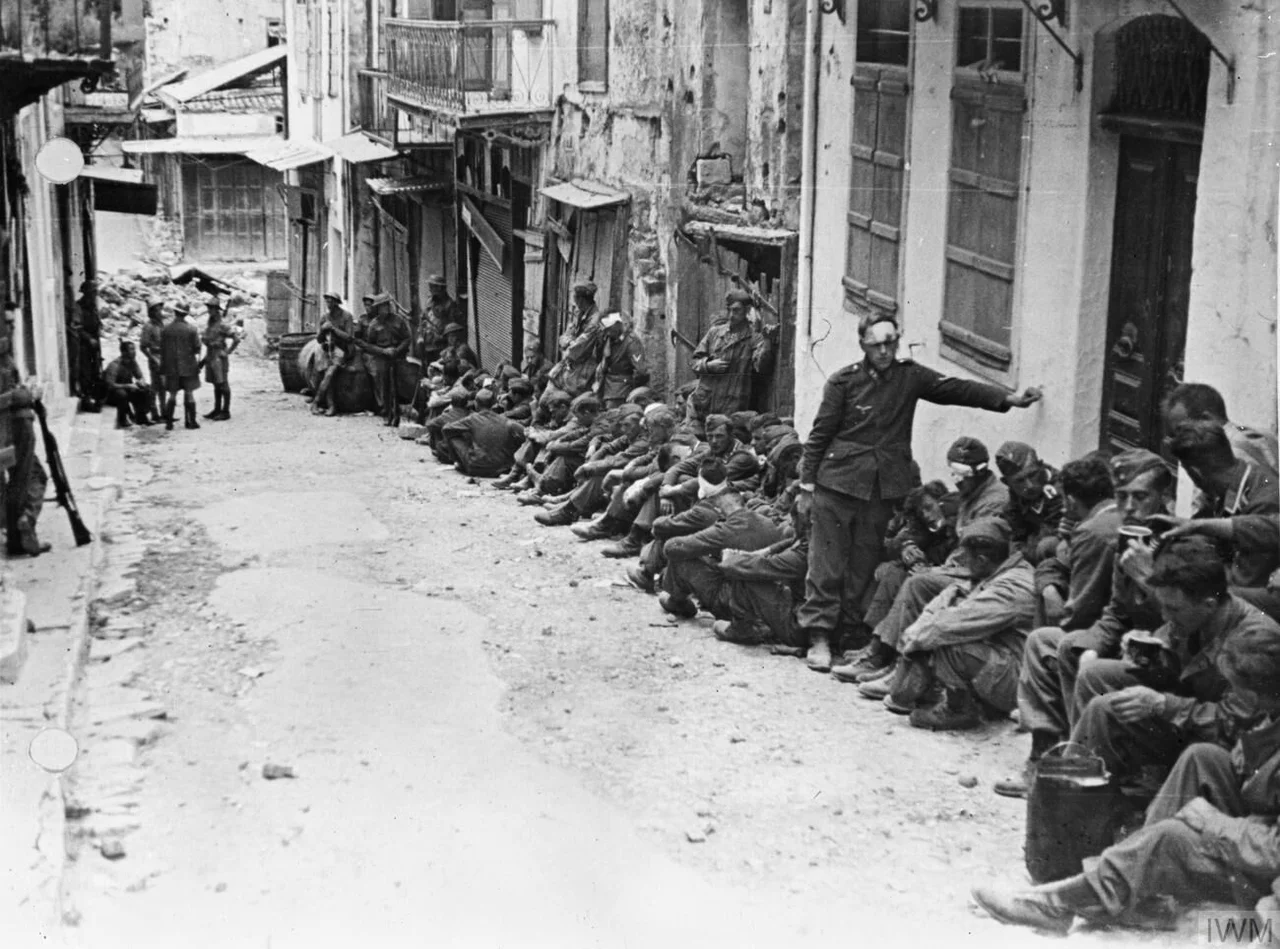

Battle of Rethymno
On 20 May 1941, an Australian battalion commander named Ian Campbell stood on a low ridge above a stretch of Cretan coastline he had been digging into for less than three weeks. He had 1,270 Australian veterans, two thousand or so under-equipped Greek soldiers - some with three rifle rounds each - eight artillery pieces, and two Matilda tanks that had a tendency to break down. Above him, the sky began to fill with German transport planes flying parallel to the coast at four hundred feet, and out of them tumbled paratroopers, weapons containers, and three men whose chutes failed to open. The thing Campbell had to do, with the equipment he had, was to keep this stretch of beach out of German hands. He almost did it.
Why Crete Mattered
Hitler had ordered the invasion of Crete to deny the British an air base in the eastern Mediterranean and protect the Romanian oil fields. The German plan, codenamed Operation Mercury, was the largest airborne operation the world had ever seen: four parachute drops along the north coast at Maleme, Chania, Rethymno, and Heraklion, each meant to seize an airfield or port for follow-on landings by mountain troops. Crete had been reinforced with the remnants of the British and Commonwealth forces evacuated from mainland Greece, most of them missing their heavy weapons. Major-General Bernard Freyberg, a New Zealander, commanded an under-equipped patchwork of 32,000 Commonwealth and 10,000 Greek troops. At Rethymno, in the center of the north coast, Freyberg gave Campbell two Australian battalions, two Greek regiments, and a battalion of well-armed Cretan gendarmerie cadets in the town.
The Drop That Went Wrong
The German plan called for the paratroopers to land at 14:00 after a softening-up bombardment. Dust storms at the airfields in mainland Greece had wrecked the schedule. Aircraft were taking off late, taking off in the wrong order, taking off without fighter escort. The bombardment finally arrived at 16:00 with fewer than twenty aircraft and accomplished little. The first Junkers Ju 52s appeared overhead at 16:15. They flew low, slow, and straight along the coast, in plain sight of dug-in soldiers who had been listening to a radio briefing about the morning's attacks at Maleme and were ready. At least seven aircraft were shot down. The German paratroopers - young men jumping headfirst from doorways at four hundred feet, unable to control where they came down - were shot in the air, drowned in the sea, impaled in canebrakes, or killed scrambling for the weapons containers that landed somewhere else. They were soldiers in their first combat jump and they were dropped into a meat grinder by mistakes that were not theirs.
The Town Held by Priests
The 2nd Battalion of the German 2nd Parachute Regiment landed near the village of Perivolia, west of Rethymno. They reached their weapons, regrouped, and marched on the town - which they had been told was undefended. They found instead the Cretan gendarmerie. Around them, armed civilians joined the fight: shopkeepers, fishermen, several priests, a monk. The Germans were beaten off. They retreated to Perivolia, where they were pinned down for the rest of the battle, bombed by their own air force, shelled by the Australians on the ridge above. Sturm, the German colonel commanding the regiment, was captured the next day. The 2nd Parachute Regiment, which had landed proud and complete, was being broken up piece by piece.
Hill A and the Olive Oil Factory
East of Rethymno, the German 1st Battalion had reached the dominant terrain feature - Hill A - and was dug in on top of it, having taken four hundred dead or wounded in doing so. Campbell counterattacked the next morning. After fierce close-quarters fighting, the Australians and the Greek 5th Regiment took the hill back, recovered their tanks and guns, and pushed the survivors into a thick-walled olive oil factory near the village of Stavromenos. For a week the Australians and Greeks attacked the factory while the Germans held out, sometimes with the Australians using captured signal panels to direct German aircraft to drop bombs on their own troops. On 23 and 24 May the surviving German paratroopers, in retaliation for the resistance, executed more than eighty Cretan civilians at Missiria. They were ordinary villagers - farmers, women, old men - whose names are listed on a memorial in the village now.
The Surrender and What Came After
Maleme had fallen. Freyberg knew the battle of Crete was lost and ordered evacuation on 27 May. He could not get the order to Campbell. Without a working code, encrypted radio messages could not be deciphered; clear messages would alert the Germans to the evacuation routes. A messenger missed his ship. Aircraft attempts to drop notes failed. On 29 May a German mountain force with tanks arrived from the east. Campbell, with no food and almost no ammunition, surrendered. Of his Australians, 96 had been killed in the fighting and 934 went into captivity. The two Greek regiments dispersed. Many of Campbell's Australians slipped into the hills with the help of Cretan villagers - hiding in farmhouses, sheepfolds, mountain caves - and 52 of them eventually escaped to Egypt. The Cretan civilians who hid them paid a terrible price. After the battle, the Germans executed 3,474 Cretans by firing squad, with thousands more killed in reprisals over the four-year occupation. The Battle of Crete cost the Germans so heavily - so many transport aircraft destroyed, so many paratroopers killed - that they never attempted another large airborne operation in the war. The places named after Ian Campbell in Rethymno today commemorate a defeat that was also, in a real and complicated sense, a victory.
From the Air
Battlefield around 35.37N, 24.52E, on the north coast of Crete near the town of Rethymno. The old airstrip near Pigi village is the geographical center of the action; the modern town of Rethymno is to the west. Heraklion International Airport (LGIR) lies about 75 km east; Chania International (LGSA) is to the west, where the Maleme battle was fought. From cruise, the entire north coast of Crete is visible as a band of beaches and small towns at the foot of the White Mountains and the Idi range. Best viewing 6,000-15,000 ft on a clear day.
Nearby Stories
- Battle of Cape Spada 17 km away
- Siege of Chandax 18 km away
- Santorini: The Volcano That May Have Destroyed Atlantis 91 km away
- Siege of Melos 111 km away
- Monemvasia Mosque 160 km away
- Battle of Derna (1805) 291 km away
- Siege of Derna 313 km away
- Battle of Sidi Barrani 404 km away