
Rhodes
Pindar told the story this way: Helios the sun god rose every morning to find the island of Rhodes waiting for him in the sea, and he loved it. He married the nymph Rhodos, and their three sons gave their names to the cities of Lindos, Ialyssos, and Kamiros. Whether or not this is why the island is called Rhodes is uncertain. The Greek word for rose, *rhodon*, sounds nearly identical, and the rhoda is a pink hibiscus native to the slopes. Some scholars argue the name comes from Phoenician *erod*, snake, because in antiquity Rhodes was overrun by them. Whatever the origin, the rose became the island's emblem, stamped on coins beside the head of Helios for nearly a thousand years.
The Three Cities Become One
Mycenaean Greeks settled Rhodes during the Bronze Age, then came the Dorians around the 8th century BC, founding Lindos, Ialyssos, and Kamiros. These three city-states joined Kos, Cnidus, and Halicarnassus in the Dorian Hexapolis, a religious and cultural league across the eastern Aegean. Then in 408 BC, the three Rhodian cities did something unusual: they fused. They built a new capital on the northern tip of the island, designed by the Athenian architect Hippodamus on the regular grid plan he had used for Piraeus, and reorganized themselves as a single state. The new city of Rhodes was a maritime experiment, and over the next two centuries it became one of the most important commercial powers in the eastern Mediterranean.
The Siege That Built the Colossus
In 305 BC, Demetrius the Besieger arrived with a fleet and a siege engineer's imagination. He built a battering ram that took 1,000 men to operate and a siege tower called the Helepolis, the City-Taker, nine stories tall and clad in iron. For a year he hammered at the walls. The Rhodians held. In 304 BC, Demetrius gave up and sailed away, leaving the gigantic siege equipment behind. The Rhodians sold the iron and bronze and used the proceeds to commission a colossal statue of Helios at the harbor, completed around 280 BC. The Colossus of Rhodes stood for 54 years before an earthquake in 226 BC snapped it at the knees. The fragments lay where they fell for centuries. In 654 AD, Arab forces shipped the bronze pieces away. The exact location of the statue is still unknown.
Roman Province, Byzantine Theme, Knights' Refuge
The Romans took Rhodes' independence after 164 BC but valued the island as a school of rhetoric where senators sent their sons. Cassius sacked the city in 43 BC; Tiberius spent his political exile here at the start of the first century. Under Byzantium, Rhodes was the center of an ecclesiastical province and the source of the Rhodian Sea Law, a code of maritime regulations that influenced admiralty law for over a millennium. Arab raiders captured the island in 654 and again in 673, and in 1309 Pope Clement V confirmed the island as the new headquarters of the Knights Hospitaller, displaced from the Holy Land. The Knights held Rhodes for 213 years, repelling the Mamluks in 1444 and the Ottomans in 1480, before Suleiman the Magnificent finally took the island in 1522.
Italian Colony, Holocaust, Greek Reunion
Italy seized Rhodes from the Ottomans in 1912 during the Italo-Turkish War. The island became the showcase of Italian colonial ambition in the Aegean, with Mussolini's architects laying out wide boulevards, restoring the medieval old town, and building grand fascist-era hotels. Italian colonists settled in farm villages with names like Peveragno Rodio and San Marco. Then in 1938 the Leggi razziali, Italy's racial laws, came to Rhodes; Jews were forced from the government and out of business. After Italy's 1943 armistice, Germans occupied the island. In July 1944 they deported over 1,700 Rhodes Jews, mostly Sephardi families whose roots ran back to the Spanish expulsion of 1492. Around 1,200 were murdered at Auschwitz. The Turkish consul Selahattin Ülkümen saved approximately 200 lives by claiming Turkish citizenship for endangered families. After German surrender in May 1945 and a brief British administration, Rhodes joined Greece in 1947. In 1949, the island hosted negotiations producing the armistice agreements between Israel and its Arab neighbors.
Spearhead Geography, Tourist Heart
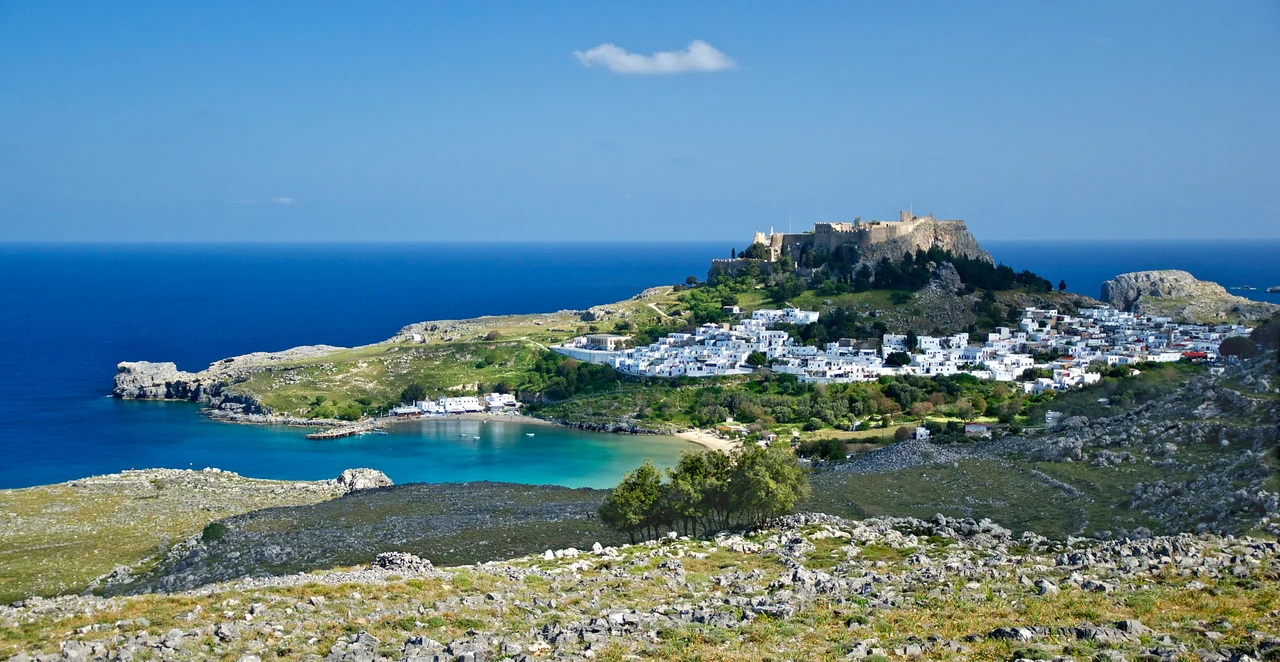
Shaped like a spearhead pointing north, Rhodes is 80 kilometers long and 38 kilometers across at its widest, with Mount Attavyros rising to 1,215 meters in the interior. Rocky shores ring strips of arable land where citrus, olives, and wine grapes grow, and pine and cypress forests cover the inland mountains. In the Petaloudes Valley, tiger moths cluster by the thousands every summer, drawn by Liquidambar orientalis trees. The southeast corner around Lindos records Greece's highest mean annual temperature and over 3,100 hours of sunshine per year. Today around 125,000 people live on Rhodes, and millions visit. In summer 2023, the worst wildfires in Greek history forced the largest civilian evacuation the country had ever attempted, nearly 19,000 people moved off the island in days. The land that gave the world the Colossus and the Rhodian Sea Law continues to absorb everything that arrives at it.
From the Air
Rhodes spans roughly 35.85°N to 36.45°N and 27.7°E to 28.25°E in the southeastern Aegean, just 18 km off the Turkish coast. The island appears as a distinctive spearhead shape pointing north, with Mount Attavyros (1,215 m) the most prominent peak in the interior. Diagoras International Airport (ICAO: LGRP, IATA: RHO) sits on the west coast 14 km southwest of Rhodes city. Best viewed from 8,000-10,000 ft for the full spearhead profile. The Acropolis of Lindos on the southeast coast and the medieval walled city in the north are the most prominent man-made features.
Nearby Stories
- Acropolis of Rhodes 24 km away
- Battle of Rhodes (1912) 33 km away
- Astypalaia 96 km away
- Toplou Monastery 130 km away
- Antalya Museum 204 km away
- Archaeological Museum of Agios Nikolaos 215 km away
- Antalya 218 km away
- Agios Neophytos Monastery 377 km away