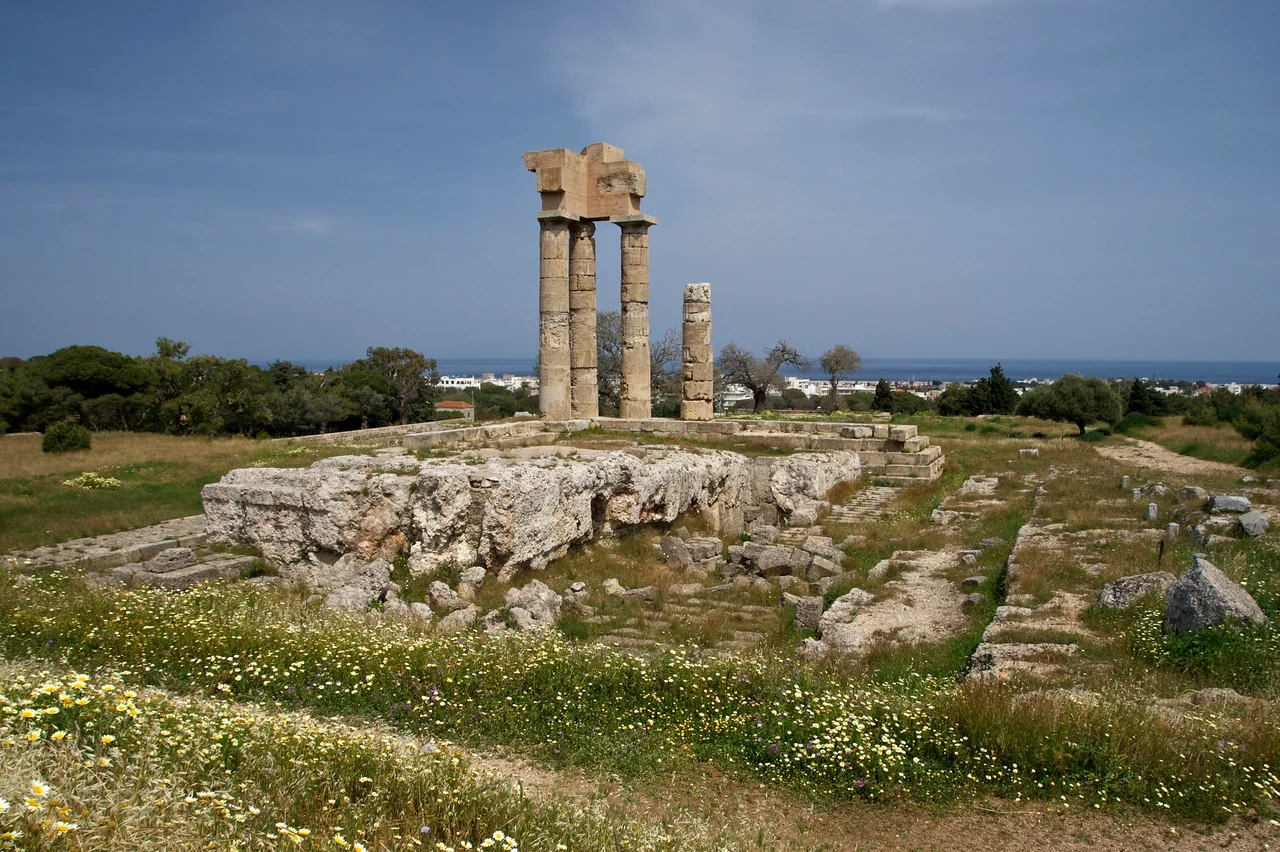

Acropolis of Rhodes
Most acropolises were built to be defended. The Acropolis of Rhodes was built to be seen. When the citizens of Lindos, Kameiros, and Ialysos merged their three island cities in 408 BC and laid out a new federal capital on the northeast tip of Rhodes, they put their temples on the highest ground and skipped the citadel walls entirely. The lower town had walls. The harbor had walls. The acropolis had columns, terraces, and an unobstructed view to the sea, where the second-century author Lucian called Rhodes the city of Helios with a beauty in keeping with that god.
Three Cities Become One
The synoecism of 408 BC was a political experiment as much as an urban plan. Lindos sat on its own dramatic acropolis on the southeastern coast. Kameiros and Ialysos held the western shore. They had spent generations as rivals, and now, with the Peloponnesian War winding down and Athens weakening, they pooled their treasuries and their citizenship to found a new capital. Strabo says Hippodamos of Miletus designed the city, though by 408 BC Hippodamos would have been an old man. Whether or not he held the pen, the plan is unmistakably his: a strict grid of equal blocks, the marketplaces and theaters at fixed nodes, the upper town reserved for sacred precincts and breathing room. The orator Aelius Aristides, four centuries later, remembered the Rhodian acropolis as terraced gardens between the temples, a deliberate openness.
Apollo on the Hill
The acropolis sits on Monte Smith, named for an English admiral who watched Napoleon's fleet from this height in 1802. Long before that, the Temple of Pythian Apollo stood on the southern terrace, smaller than the Temple of Athena and Zeus to the north but bolder in profile. Sailors approaching the harbor used its columns as a landmark. After Italian occupation forces installed artillery on the site during the Second World War, Allied bombing left the temple in pieces. The Greek Archaeological Service began rebuilding it in 1946. Today four reerected columns and part of the architrave stand again on the southern bluff, visible from the harbor as they were in antiquity, though the marble bears the scars of two wars instead of one.
The Stadium and the Vow
On the southeastern slope, the 210-meter stadium dating from the third century BC has kept its starting blocks, its sphendone (the rounded turning post), and the officials' marble seats. Athletes once ran here in honor of Helios, the sun god, during the Haleion Games. Just northwest stands a small odeon for around 800 spectators, the orchestra and a few front rows original, the rest modern reconstruction. None of this would exist if the citizens of Rhodes had not been so good at recovering. In 305 BC, when Demetrios Poliorcetes besieged the city for a year, the Rhodians tore down some of their own temples and the theater to build emergency walls, vowing to the gods that they would build finer ones if they survived. They survived. They rebuilt better. The earthquake of 228 BC knocked everything down again, and the entire Greek world sent donations to help them rebuild a third time.
What Has Not Been Found
The Acropolis Archaeological Park covers about 12,500 square meters today, protected from new construction. The Italian School of Archaeology dug here from 1912 to 1945, and Greek archaeologists have continued the work since the war. What they have uncovered is striking, but the park is also defined by what is missing. The theater of the upper town has not been found. The Temple of Helios, dedicated to the patron god whose colossal statue once straddled the lower harbor, is also somewhere underneath the modern city, location unknown. Four nymphaea, subterranean grottoes cut into the rock with cisterns and niches for figurines, suggest a culture of ritual that was as comfortable underground as on the heights. Archaeologists found Aphrodite figurines in the niches, but cannot yet say which deities the grottoes honored. Like much of Rhodes, the acropolis is still partly a question.
From the Air
Acropolis of Rhodes at 36.4402°N, 28.2109°E, on Monte Smith hill 3 km southwest of Rhodes town center. Good visual altitudes 2,000-4,000 ft over the western coast of the island. Best read from the south or southeast, where reerected Apollo columns stand against the Aegean. Diagoras Airport (LGRP) lies about 9 nm southwest. Aegean summers bring strong meltemi northerlies; autumn and spring offer steadier flying weather and clearer views to the Turkish coast 18 km east.
Nearby Stories
- Temple of Athena Lindia 23 km away
- Bodrum Castle 45 km away
- Battle of Rhodes (1912) 51 km away
- Bodrum 84 km away
- Antalya Museum 166 km away
- Antalya 175 km away
- Toplou Monastery 179 km away
- Agios Neophytos Monastery 361 km away