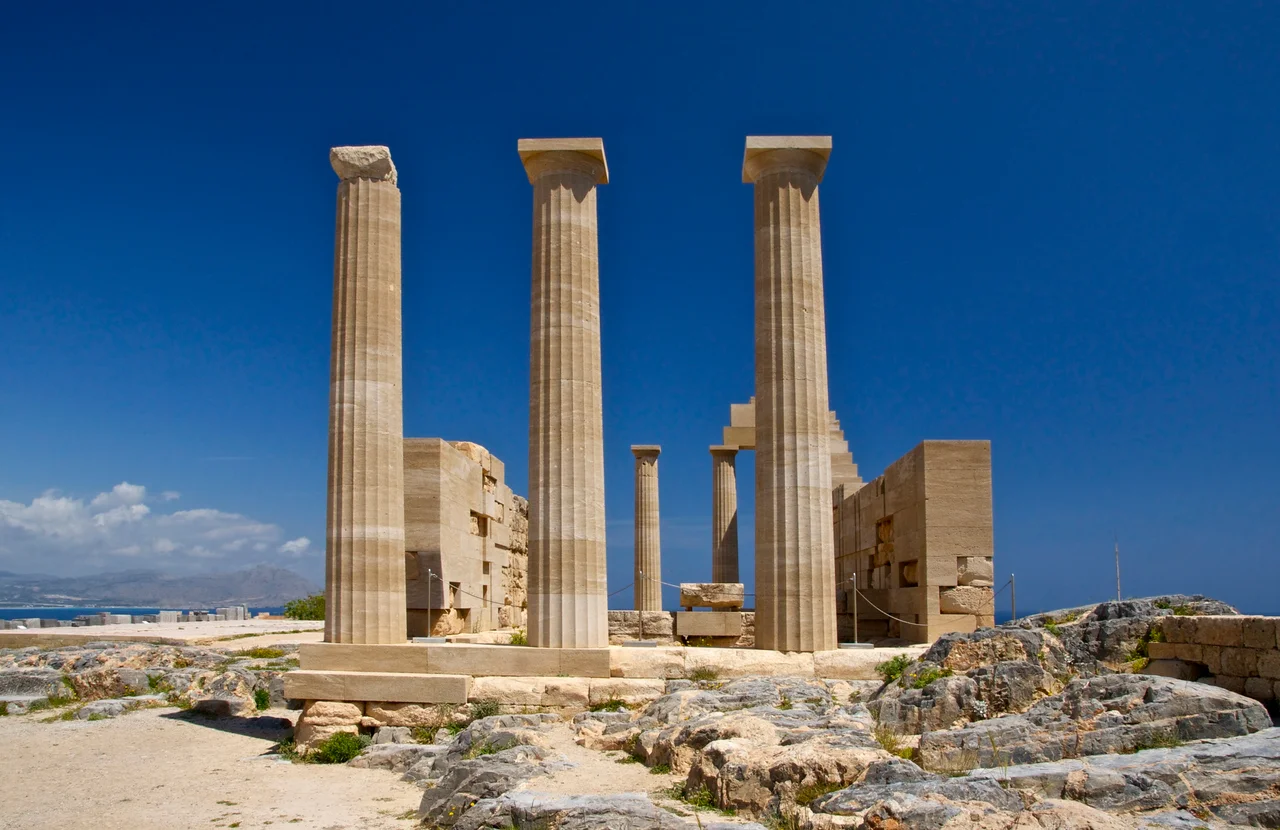

Temple of Athena Lindia
Pindar wrote a story for the people of Rhodes. When Athena was born from the head of Zeus, the gods looked down for someone to honor her with the first sacrifice on Earth. The sun god Helios, watching from his chariot, ordered his sons - the Heliadai of Rhodes - to build the first altar. They did. They built it high on the rock at Lindos, on the southeastern coast of the island, on a 116-meter cliff that drops sheer into the Aegean. But they forgot the fire. They built the altar without flame. Zeus, watching, was pleased anyway. He showered the city with gold to compensate. He also gave them, through Athena herself, the gift of craftsmanship - skills above all other men. That is the story Pindar told. Then he climbed the rock and saw it for himself: the sea below, the temple above, and the wind that has blown across the cliff for three thousand years.
The Acropolis at Lindos
Lindos was the capital of Rhodes before the city of Rhodes itself was founded in 408 BC. Its acropolis - now crowned with a tangled overlay of Hellenistic, Roman, Byzantine, and Crusader fortifications - sits at the south end of the island, on a sheer cliff above the village. Approaching from the harbor below, you climb the same path pilgrims climbed in the Archaic period. The temple is at the top, on the highest point. It looks east into the rising sun and south across an unbroken expanse of Mediterranean water. Long before Greeks dedicated this rock to Athena, a local goddess had been worshipped here, possibly cave-cult based - the temple sits above a natural cave in the cliff, which may have been the original sanctuary. By the 6th century BC the Greeks had built a stone temple here, attributed by tradition to Cleobulus, ruler of Lindos and one of the Seven Sages of Greece.
The Cult Statue
Inside the first temple stood a seated Athena wearing a polos crown - a tall cylindrical headdress - rather than the warrior's helmet familiar from Athens. Reconstructions based on votive figurines suggest this statue was distinct from the Athenas of mainland Greece. According to the philosopher Callimachus, the very first cult image at Lindos was a xoanon, a primitive wooden image, replaced later by a stone statue. The temple chronicle - inscribed on stone in the 1st century BC - traced the founding to Danaus and the Danaides, the legendary king and his fifty daughters who had escaped persecution by building the first ship and sailing to Rhodes. They put in at the harbor below the rock and dedicated their thanks to Athena before continuing to Argos. After the first temple burned in 342 BC, a new Doric temple replaced it in the late 4th century. Its standing cult statue carried a shield, still wearing the polos rather than a helmet, fastened to the wall of the cella - over life-size.
Alexander Came Here
In 332 BC, on his way to conquer Egypt, Alexander the Great visited the temple of Athena Lindia and offered sacrifice. He dedicated weapons - probably captured arms from the Battle of Issus - to the goddess. After Alexander's death, his successors followed: Ptolemies, Seleucids, Antigonids. Each in turn made offerings. The Temple Chronicle catalogued some of these gifts in extraordinary detail, listing specific donors, specific objects, the year of dedication. It also recorded miraculous interventions by the goddess - times she had visibly defended Lindos in dreams and visions during sieges. The temple thus became one of the most prestigious shrines of Athena anywhere in the Greek world, possibly the regional center of her cult, mentioned in the same breath as the Athena Polias on the Athenian Acropolis. Ancient art treasures accumulated. Works by the sculptor Boethus and the painter Parrhasios of Ephesus were among them - both lost now.
Burning the Entrails
The cult had a peculiarity. The Rhodians burned the entrails of sacrificial animals on Athena's altar, an act that may have been unique to this island. The Athenians made standard burnt offerings of meat and savor to the gods. The Rhodians burned the inedible offal - a backwards form of sacrifice, perhaps meant to give the goddess what was thought too valuable to consume otherwise, or perhaps simply preserving an older Anatolian or pre-Greek ritual form. Philostratus the Elder, writing in the 3rd century AD, contrasted the two cities directly. The Athenians, he said, made proper sacrifices and pleased Athena with the smell of burning meat. The Rhodians made what he called "fireless sacrifices that are incomplete" and yet had once received gold from the sky. The lesson he drew was complicated. The form of sacrifice mattered, but so did the love of the goddess for her people. Lindos had her love.
The View From the Rock
Italian archaeologists Maiuri and Jacopi excavated the sanctuary between 1910 and 1932, when Rhodes was under Italian control. Danish archaeologists K. F. Kinch and Christian Blinkenberg followed. The columns standing today are partly the result of 20th-century restoration; the temple itself is small, less than 8 meters wide. But the setting has not changed. Climb the steep path from Lindos village, pass through the medieval walls of the Knights of St. John (who fortified the acropolis between 1309 and 1522), and you reach the platform. The Aegean opens below you. The white village curves around the harbor 116 meters straight down. To the south, across the water, lies the open sea route to Egypt - the route Alexander took, the route the Danaides supposedly arrived by, the route that for three thousand years connected Lindos to a wider world. Athena watched all of it from her temple at the edge of the cliff. The Greeks said gold once rained here. Standing on the platform at sunrise, you can almost believe them.
From the Air
Temple of Athena Lindia sits at 36.0911 N, 28.0883 E on the acropolis of Lindos at the southeastern coast of Rhodes, 116 meters above the Aegean Sea. Best viewed at 2,500-4,500 feet on flights along the Dodecanese island chain. The whitewashed village of Lindos and its dramatic cliff acropolis are unmistakable from the air. Nearest airfield: Rhodes Diagoras International (LGRP/RHO) 50 km north on the western coast. Karpathos (LGKP) 100 km southwest. Marmaris (LTBR) on the Turkish mainland 60 km east. Summer afternoon thermals can produce strong updrafts along the cliffs.
Nearby Stories
- Acropolis of Rhodes 24 km away
- Battle of Rhodes (1912) 33 km away
- Astypalaia 96 km away
- Toplou Monastery 130 km away
- Antalya Museum 204 km away
- Archaeological Museum of Agios Nikolaos 215 km away
- Antalya 218 km away
- Agios Neophytos Monastery 377 km away