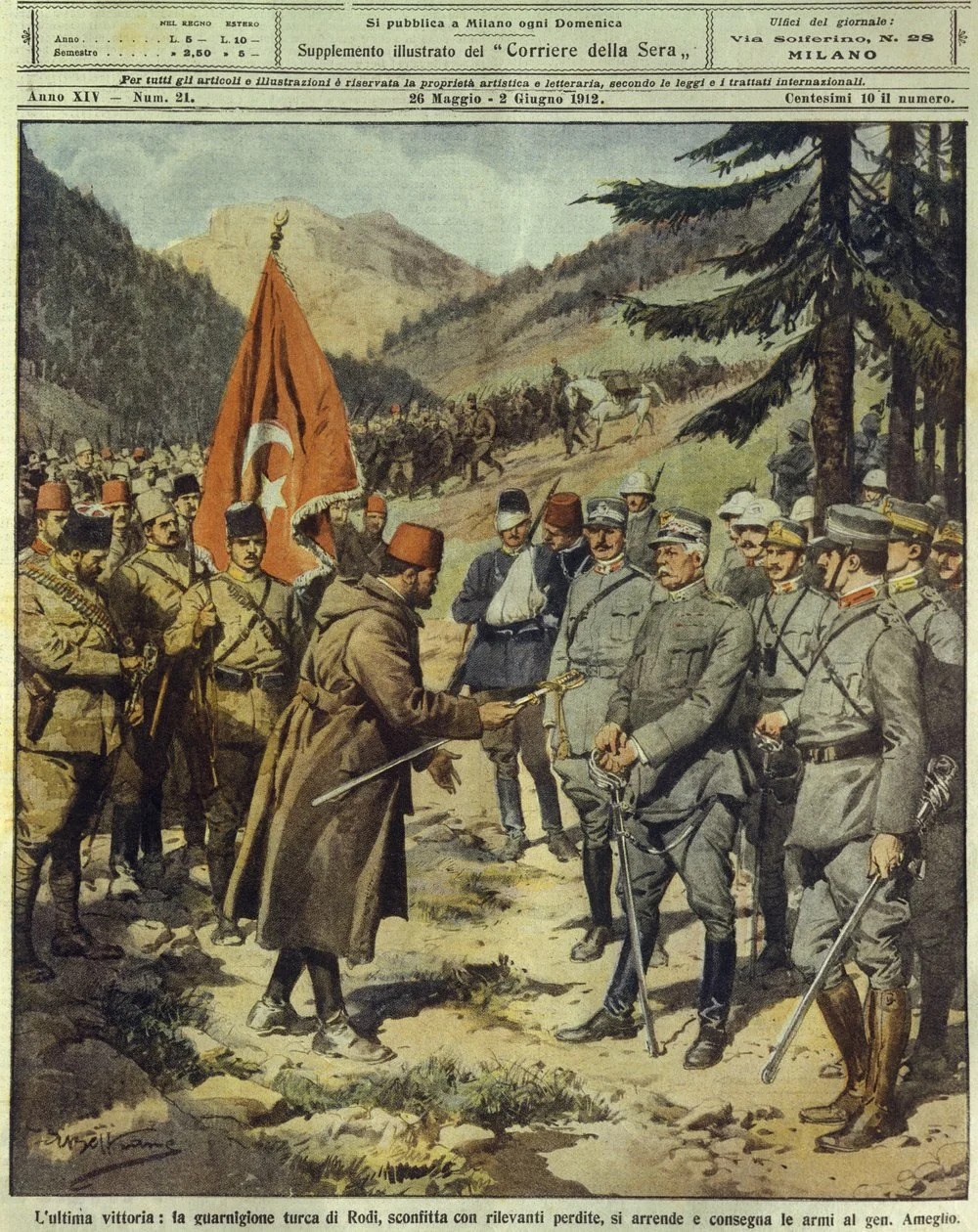

Battle of Rhodes (1912)
The Italian Royal Navy cut a single submarine telegraph cable on 1 May 1912, and Rhodes went silent. The cable was the only thing connecting the island to its Ottoman overlords on the Anatolian mainland. For three days afterward, the Turkish governor on Rhodes had no way to send for orders or report what he was seeing - which was a fleet of Italian warships off Kalithea Bay, and somewhere offshore, packed onto transports, ten thousand soldiers fresh from a year of fighting in Libya. The cable was an old technology by 1912 and the act of cutting it was deliberately archaic, almost ceremonial. It marked the line between two centuries of Rhodes's history.
How an African War Reached the Aegean
The Italo-Turkish War had begun the previous September over Libya. Italy wanted Tripolitania and Cyrenaica, the last Ottoman provinces in North Africa, and had launched the largest naval and amphibious operation Italy had attempted since unification. The campaign in the desert had been hard, slow, and expensive. By spring 1912, with no clear end in sight, the Italian government decided to put pressure on Constantinople by attacking the Ottoman islands of the Aegean. Rhodes, with its fortified harbor at the city of Rhodes - the same harbor where the Knights Hospitaller had repulsed the Ottomans in 1480 and finally surrendered to Suleiman the Magnificent in 1522 - was the most prominent prize. The Italian troops shipped from Benghazi and Tobruk were veterans of Libya: Bersaglieri (light infantry famous for their plumed hats), the Brigades Livorno and Abruzzi, and the Alpini Battalion 'Fenestrelle.' Lieutenant General Giovanni Ameglio commanded them.
The Landing at Kalithea
The Italians went ashore at four in the morning on 4 May 1912, at Kalithea Bay on the east coast of the island, about 12 km south of the city of Rhodes. There was no opposition - the bay had been chosen precisely because the Ottoman garrison was concentrated around the city itself. The disembarkation took ten hours. By 2 p.m. the troops were forming up to march north. The Ottoman defenders numbered about a thousand professional soldiers, supported by perhaps ten thousand militiamen who had been hastily recruited from the local Muslim Turkish-speaking population. The Italian command, overestimating the enemy at two to five thousand professionals, took its time and waited for full strength.
Smith Plateau and the City
The first Ottoman defensive line was at Smith Plateau, where a few hundred regulars were posted on commanding ground. The Italians attacked overland; eleven warships of the Regia Marina bombarded the position from the sea. The Ottomans were driven off with significant losses while Italian casualties were reported at seven wounded. That night the Ottoman regulars retreated into the mountains around Psithos, in the island's interior. The Italians stopped two kilometers short of Rhodes city itself. The next morning, 5 May, the city surrendered without further fighting, and Italian troops marched in. The Hospitaller fortifications - the Palace of the Grand Master, the Street of the Knights, the long walls in their honey-colored stone - had survived again, this time without being needed. The Ottomans had not even tried to use them.
The Mountains and the End
What remained was Psithos, a village high in the central spine of the island, where the Ottoman commander had concentrated his surviving forces. The Italians made additional unopposed landings at Kalavarda and Malona Bay, gradually surrounding the Ottoman position from three sides while a battleship shelled it from the fourth. On 15 May, after preparation, Ameglio attacked. The fighting at Psithos lasted nine hours. When it was over, the Ottoman commanders surrendered. The Greek Wikipedia and Italian official accounts agree on the numbers: 83 Ottoman soldiers killed, 26 wounded, 983 surrendered. Four Italians had died and 26 were wounded in the final engagement. The militia of ten thousand local Muslim civilians, having lost the regulars they were supporting, melted back into their villages. After thirteen days, the battle was over.
Four Hundred Years and Thirty More
Rhodes had been part of the Ottoman Empire since 1522 - three hundred and ninety years. In May 1912 it became part of the Italian colonial empire. The Italian occupation, originally meant as wartime leverage, was extended after the Italo-Turkish War ended later in 1912 and consolidated after the First World War, when Italy formally received the Dodecanese islands. Rhodes town under Italian rule received heavy investment in restoration of the medieval fortifications, in new public buildings in a self-conscious Italian-Aegean style, in roads, hotels, and tourist development. The Italian colonial administration was also harsh - Greek and Jewish populations faced restrictions, the Greek language was suppressed in schools, and after 1936 a Fascist regime imposed itself. Italy held Rhodes until 1943, when the Germans took over after the Italian armistice. The Jewish community of Rhodes, one of the oldest in Europe, was deported to Auschwitz in 1944; almost none survived. Greek union with Rhodes finally came in 1947. The casualties of the brief 1912 battle - perhaps a hundred soldiers in total - were small. But the displacement that followed it, in stages and over decades, was profound. The honey-colored walls of the medieval city are still there, and now host tens of thousands of summer tourists, who walk past Italian-era inscriptions without noticing them on their way to ouzo and the harbor.
From the Air
Battle sites at 36.37N, 27.22E, on the island of Rhodes in the southeastern Aegean. Italian landings were at Kalithea Bay (east coast, just south of the city of Rhodes), with the inland phase at Psithos in the central mountains. Diagoras International Airport (LGRP) is on the west coast; Karpathos (LGKP) is the next island to the south. From cruise the medieval city of Rhodes is unmistakable at the northern tip of the island - a star-shaped fortified town beside a hooked harbor. Best viewing 6,000-15,000 ft on a clear day; the Anatolian coast of Turkey is visible across a narrow strait to the east.
Nearby Stories
- Battle of Rhodes (1943) 14 km away
- Astypalaia 31 km away
- Bodrum Castle 55 km away
- 1956 Amorgos Earthquake 79 km away
- Toplou Monastery 101 km away
- Archaeological Museum of Agios Nikolaos 167 km away
- Antalya Museum 262 km away
- Agios Neophytos Monastery 443 km away