
Koufonisi
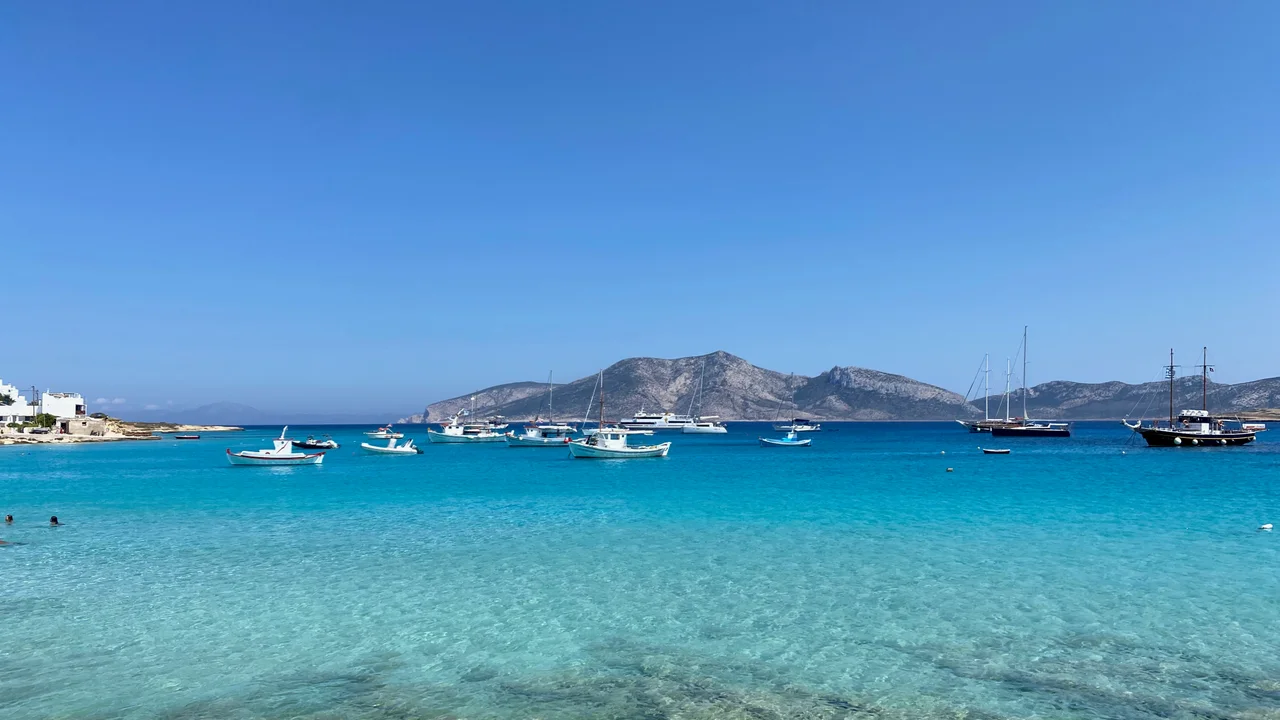
There is no airport, no taxi, barely a road. To reach Koufonisi you take a boat, and once you step off it, you walk. The whole island can be circled on foot in three or four hours, which means everything worth seeing is within reach of your own two legs. What pulls travellers across the water to this small island in the Lesser Cyclades is simple and almost absurd: the colour of the sea. Cove after cove of it, so clear and so pale a turquoise that the caiques at anchor seem to hover above their own shadows.
Following the Coast to Better and Better Beaches
The trick to Koufonisi is to keep walking. There is a small beach right in the main village, Ammos, but locals will tell you it is nothing next to what lies ahead. Set off counter-clockwise around the coast and the beaches improve with every headland: Finikas, then Italida, then Alejandra, and then the famous Natural Pool, a sea-carved basin tucked among low cliffs where the water glows an unreal blue. Keep going and you reach Pori, the island's most celebrated stretch, known for cliff-jumping and a relaxed approach to clothing. Out on the peninsula at the very end waits Gala. The southeast coast holds the best of them, because the wind usually comes from the north and leaves these sheltered shores calm and glassy.
Getting Here, Getting Around
Ferries connect Koufonisi to Naxos, to neighbouring Schinousa and Amorgos, and all the way back to Athens, and cruise ships and private boats tie up at the port as well. Once ashore, the smartest way to move is the water shuttle: small boats run up and down the coast as far as Pori, hopping between jetties for about 2.50 euros a ride, far easier than picking your way over rocky paths in the heat. Mopeds are popular with locals and can thread the narrow village lanes that cars cannot. Bringing a car is simply not worth it, the roads dwindle to dirt tracks, and a single petrol station serves the island's north. On Koufonisi, less machinery is the whole point.
Feast Days and Fishermen
Time the visit right and the island throws open its calendar. Saint George is the island's protector, and on his day, usually the 23rd of April, his icon is carried in procession along the seaside street over a carpet of rose petals while fireworks crack and every small boat in the harbour sails alongside. Tripe soup with vinegar and a stew are shared with everyone before the feast begins. On the 24th of June the captains of the caiques cook kakavia, a fishermen's soup of mixed fish, for the whole island on the pier, and music and dancing follow. On the 15th of August, mass is held at the little church on neighbouring Kato Koufonisi, after which boats race back across the strait, everyone trying to reach Pano Koufonisi first.
How to Eat, Drink, and Sleep Simply
Life here is small-scale and well stocked. The large Veneti supermarket near the port, its sign spelled out in Greek as "Beneth," carries just about everything you need, and one of the island's three ATMs stands right outside it, though there are no banks. The Giorgoula bakery turns out good bread, pastries, and savoury pies. Skip the tap water, six large bottles cost about 2.50 euros at the supermarket, and pack or buy sunscreen, because the island's real hazard is the sun. Guest houses and small hotels cluster in and near the village, and in the high season of June through August you should book ahead. If you want to sleep under the stars, free camping is allowed only on uninhabited Kato Koufonisi, just across the water.
And When You Want More Sea
Koufonisi rewards the traveller who lingers, but it also sits at the centre of a whole constellation of quiet islands. Boats run daily to Kato Koufonisi, the empty twin where the camping is, and excursions reach the protected archaeological island of Keros nearby. When you are ready to island-hop, Donoussa, Schinoussa, and tiny Iraklia lie within easy reach, larger Amorgos rises to the east, and the popular hub of Naxos is a short ferry away. But there is no rush. Most people come to Koufonisi planning a day or two and find themselves quietly extending the stay, reluctant to leave water that good behind.
From the Air
Located at 36.94°N, 25.61°E in the Lesser Cyclades, southeast of Naxos and west-northwest of Amorgos. Pano (Ano) Koufonisi is tiny, about 5.8 km2, low-lying, and ringed by pale shallows, with its smaller twin Kato Koufonisi just across a narrow strait to the south. There is no airport on the island; the nearest is Naxos Island National (LGNX), roughly 35 km northwest. From the air the islands read as a cluster of low sandy landmasses surrounded by vivid turquoise water, an excellent visual waypoint for Aegean coastal navigation. Best viewing altitude 2,000-4,000 ft AGL in calm morning conditions; the northerly meltemi wind can kick up haze and chop in summer afternoons.
Nearby Stories
- The Big Blue 15 km away
- Italian submarine Jantina (1932) 17 km away
- Archaeological Museum of Sifnos 19 km away
- Miaouli Square 20 km away
- Astypalaia 37 km away
- Ikaria 38 km away
- Milos 49 km away
- Monastery of Saint John the Theologian 58 km away