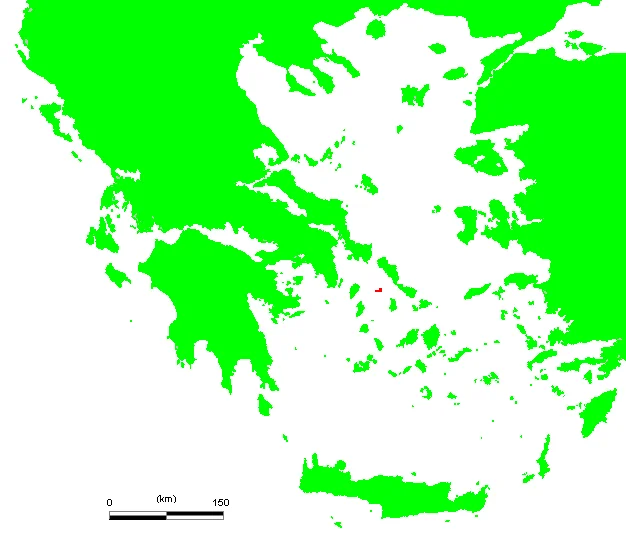

Gyaros
There is no fresh water on Gyaros. The Roman Emperor Tiberius, when senators proposed exiling a defendant there in the first century AD, rejected the idea on that ground alone: those granted their lives, he said, ought to be granted the means to live. Two thousand years later, the Greek state was less merciful. Between 1948 and 1974, more than twenty-two thousand men and women were imprisoned or exiled on this arid limestone outcrop in the northern Cyclades — people whose politics, whose wartime choices, or simply whose names on a list had made them inconvenient. The island they were sent to had been a byword for desolation since antiquity. It has not lost that meaning.
What Rome Considered Too Harsh
Roman writers knew Gyaros as a shorthand for extremity. Juvenal, composing his Satires in the early second century AD, invoked it as the ultimate image of confinement: Alexander the Great, restless and world-conquering, was like a man 'hemmed in by the cliffs of Gyara.' The island carried this reputation for a reason. Pliny the Elder recorded that it was fifteen miles in circumference and lay sixty-two miles from Andros — close enough to the busy Aegean lanes to be known, remote enough to feel like the edge of the world. The geographer Strabo stopped there in 29 BC on his way to Corinth, presumably involuntarily. Even in antiquity Gyaros had a city of some kind, but by Roman times it had declined into what Tacitus called 'harsh and devoid of human culture.' When the philosopher Musonius Rufus was banished there under Emperor Nero for his role in the Pisonian conspiracy, he joined a long line of the empire's inconvenient people, dispatched to a place that punished by its very nature.
The Red Brick Prison
In 1947 and 1948, in the violent aftermath of World War II and the opening years of the Greek Civil War, the Greek government began sending political prisoners to Gyaros. Many of them — members of the wartime resistance organization EAM, leftists, Communists, and others swept up in the conflict — were forced to build their own prison. The red brick building they constructed held approximately ten thousand inmates between 1948 and 1952. Jehovah's Witnesses who refused military service were also sent here, exiled alongside political prisoners on grounds of conscience. The conditions drew condemnation from the United Nations, and the camp was officially closed in 1952. But the infrastructure remained. So did the memory of what had been done there.
The Junta's Island
On 21 April 1967, a military coup brought a right-wing junta to power in Greece. Within hours, arrests began across the country. Within days, some of those arrested were on boats heading for Gyaros. The colonels reopened the island as a detention facility, using it until 1974. The prisoners held there during the junta years were teachers, students, trade unionists, journalists, artists, and anyone else the regime considered a threat. They lived in the decaying tent camps north of the brick prison, exposed to the Aegean wind in summer and winter alike. Some died there. The island that Juvenal had used as a metaphor for claustrophobic imprisonment had become, in the mid-twentieth century, a literal one — and its prisoners were real people, with families who did not know whether they were alive.
What Remains
The Greek Navy used Gyaros as a target range after 1974, until the year 2000. The buildings are decaying now — the brick prison, the tent foundations, the camp structures scattered across four sites. The island is closed to the public except on commemorative occasions, when survivors and their descendants travel out to hold a ceremony in the small cemetery where those who died on the island are buried. Most of those survivors were born between the 1910s and 1930s; there are fewer of them each year. Today Gyaros is best known ecologically as home to the largest population of Mediterranean monk seals in the Mediterranean — the sea reclaiming what the state abandoned. The island is quiet. It has always been that way. What changed, across two millennia of its history, was who was made to endure that quiet.
A Myth at the Margins
In Virgil's Aeneid, Gyaros and Mykonos are the two islands to which the god Apollo anchored the wandering sacred island of Delos, lashing it in place so it could serve as the birthplace of the gods. In Ovid's retelling of the war between King Minos and Athens, Gyaros is one island that refused to join the Cretan king's campaign — a small act of defiance embedded in myth. The island even appears in a pseudo-Aristotelian text that solemnly records, among other marvels, that on Gyaros the mice eat iron. These fragments are curiosities now. But they tell us something: Gyaros has always sat at the edge of the known world, mythologically and geographically, a place defined by what it lacked and by what it was used to contain. The monk seals do not know this. The wind does not know it either. But the cemetery does.
From the Air
Gyaros lies at approximately 37.62°N, 24.72°E in the northern Cyclades, roughly 15 nautical miles west-northwest of Syros. From the air the island appears as a low, arid ridge rising from the Aegean — no trees, no visible settlement, a coastline of pale limestone. The nearest active airport is LGSO (Syros National Airport), approximately 20 nautical miles to the southeast. Approach from the east gives the clearest view of the island's eastern coast and the low-lying ground where the prison camp structures stand. Altitude of 2,000 feet or above is recommended for a full overview of the island's shape. No approach or overflight restrictions are known, but the island's coastal waters are restricted by the Hellenic Coast Guard.
Nearby Stories
- Battle of Mykonos 8.8 km away
- Andros 14 km away
- Temple of Apollo (Naxos) 18 km away
- Massacre of the First Sapper Battalion 22 km away
- Brauron 28 km away
- Serifos 28 km away
- SS Heraklion 46 km away
- Emporio, Chios 77 km away