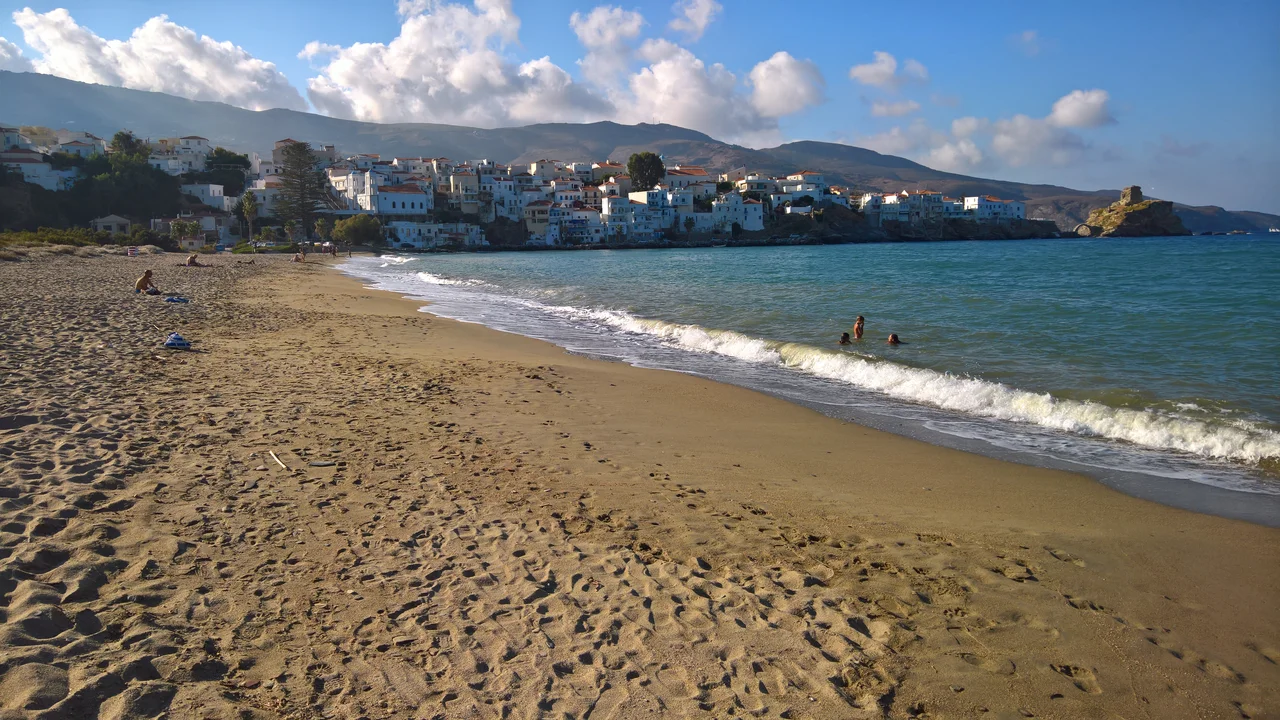

Andros
Water defines Andros in a way that is almost un-Cycladic. The islands to the south — Mykonos, Paros, Syros — are sun-bleached and spare, their beauty austere. Andros, the northernmost of the Cyclades, runs with springs. Ancient travelers named it Hydroussa — the well-watered — before they called it anything else. Waterfalls drop through gorges. Citrus and olive trees crowd fertile valleys. The mountains hold enough moisture year-round that the slopes stay green long after the other islands have dried to pale gold. This abundance shaped everything: the character of its villages, the wealth of its merchant families, and the particular self-confidence of its capital, which looks less like a Cycladic village and more like a prosperous mainland city transplanted onto a sea-cliff.
Chora: Neoclassical on a Promontory
The capital of Andros — called Chora, or simply Andros — sits at the end of a promontory that juts into the Aegean, the sea pressing in on three sides. Its main street is pedestrianized, lined on both sides with neoclassical mansions that betray the island's 19th- and early 20th-century prosperity: shipowning families who made fortunes in the merchant marine and spent some of that wealth building homes that would not have looked out of place in Athens or Syros. Pastry shops and delicatessens occupy their ground floors now. At the end of the street, a ruined Venetian castle sits on a small islet, connected to the promontory by a narrow bridge, the Aegean churning below. An award-winning Museum of Modern Art occupies two buildings just off the main square, its permanent collection of modern sculpture a reminder that Andros has long supported cultural ambitions beyond what its population might suggest.
The Name Before the Name
Greek mythology gave Andros several names before settling on the one it carries now. Hydroussa honored its springs. Nonagria and Lasia both acknowledged its lush vegetation. The name Andros itself comes, according to tradition, from the island's first settler — a hero descended from the Olympian gods, the kind of founding story that every ancient community needed. What is clearer is the historical record: by the Classical Age, Andros had a flourishing civilization centered at Paleopolis, on the island's western coast. The favored deity was Dionysus, and every three years for the first ten days of January, a festival was held in his honor — one that involved, according to tradition, water turning to wine. Whether this was symbolic or literal the sources do not clarify. In 133 BCE, the Romans took the island. By 1207 CE, Venice held it, and built the forts and towers that still mark the landscape — including the Lower Fort at Chora, the most significant of them.
Monasteries, Springs, and the Inland Roads
Getting between Andros's settlements requires transport: the island is large, its terrain mountainous, its villages widely spaced. But those who take the roads — or better, the footpaths between them — find an interior unlike anything else in the Cyclades. Monasteries appear on ridgelines. Springs emerge from hillsides with the consistency of local legend; the water quality is considered exceptional, and locals take this seriously. The northern beaches — Vlihada, Pirgos, Vitali, Zorkos — remain largely unspoiled, accessible primarily to those willing to navigate unpaved roads. The village festivals, called panegyria, once drew communities for full-day celebrations in which neighbors were welcomed into homes and fed from morning through evening. That tradition continues in modified form, centered now on village squares and church patios, the hospitality distilled but not abandoned.
The Shipowners and Their Legacy
Andros has been synonymous with Greek shipping for well over a century. The island's maritime tradition produced dynasties of shipowners whose wealth and influence extended far beyond the Aegean — families whose names appear on Greek museums, foundations, and cultural institutions. The Goulandris family, among the most prominent, endowed institutions on Andros itself as well as in Athens and internationally. This shipping wealth is legible in the built environment: the neoclassical mansions of Chora did not build themselves on farming income. The Archaeological Museum of Andros, established in 1981 with support from the Basil and Elise Goulandris Foundation, is one direct result. So is the Museum of Modern Art, an institution of genuine international quality in a town of modest size. Andros earns its cultural seriousness.
Island Food and the Dairy Tradition
The island's agricultural abundance expresses itself on the table. Andros is known for its dairy products — Volaki cheese and Kopanisti, a pungent, spicy fermented cheese whose production method varies from island to island across the Cyclades. Louza, a cured pork loin seasoned with herbs and spices, is another local specialty, alongside traditional sausages. These are not tourist confections; they are products of an island that has always fed itself from its own land and animals. The combination of fertile valleys, abundant water, and a population that maintained active farming communities even as the shipping families built their mansions gives Andros a culinary identity distinct from the drier, more austerely beautiful islands to the south. Eat here, and you taste what abundance has always meant in the Cyclades.
From the Air
Andros lies at approximately 37.83°N, 24.93°E, the northernmost of the Cyclades, clearly separated from the Greek mainland by the Cavo d'Oro (Cape Caphereus) strait and from Euboia to its northwest. The island's mountainous terrain — rising sharply from the coast — is visible from cruising altitude. The nearest major airport is LGMK (Mykonos National Airport), approximately 35 km to the southeast. There is no commercial airport on Andros; the island is served by ferry from Rafina (37 nautical miles, approximately 2 hours). Private helicopters may land at Gavrio or at Chora. The lush green valleys of the interior contrast visibly with the drier islands to the south — a reliable visual identifier when approaching from the air.
Nearby Stories
- Gyaros 6 km away
- Ftelia 18 km away
- Rhamnous 22 km away
- Massacre of the First Sapper Battalion 23 km away
- Agios Georgios (island) 33 km away
- Battle of Mykonos 48 km away
- Psara 50 km away
- Aegean Sea 60 km away