
Rhamnous
The Persians, the story goes, were so certain of victory that they brought their own marble. A great block of it, hauled across the sea to carve a trophy for the conquest of Athens. They never got the chance. After the invaders were broken, the Athenians took that same block and gave it to a sculptor, who shaped it into a statue of Nemesis, the goddess of retribution, the punisher of arrogance. And they set her on a remote headland called Rhamnous, looking out across the water the Persian fleet had crossed, so that pride itself would have a face and a coastline to haunt.
The Goddess of Reckoning
Nemesis was not a comfortable deity. She measured out what people deserved and saw that they got it, especially those who reached too high. Her great sanctuary at Rhamnous was the most important in all of Greece, and it suited her to be worshipped here, at the edge of Attica, away from the noise of the city. Two temples once stood in the precinct. The smaller and older dates to the late 6th century BC and was likely destroyed during the first Persian invasion of 480 to 479 BC, an irony Nemesis would surely have enjoyed. Over its ruins rose a temple to both Themis and Nemesis, justice and retribution paired. Latin poets later knew the goddess simply by her address, calling her the Rhamnusian virgin, dea Rhamnusia, as if the place and the power were one.
The Statue Built From Hubris
Construction of the larger temple to Nemesis began around 460 to 450 BC, and inside its cella stood the cult statue, roughly four meters tall. Pausanias credited it to Pheidias, the master who made the great Athena of the Parthenon; other ancient writers gave it to his pupil Agorakritos of Paros, and many believed Pheidias had simply let his favorite student take the honor. The Roman scholar Varro rated it the finest piece of Greek sculpture there was. On its base, carved nearly in the round, Leda presented Helen of Troy to Nemesis, a tableau about beauty and consequence that fit the goddess perfectly. Early Christians smashed the statue, but archaeologists have pieced much of it back together from hundreds of scattered fragments. Its battered marble head, drilled with holes for a golden crown, now sits in the British Museum, where its style echoes the Parthenon sculptures of 440 to 432 BC.
A Fortress Frozen in Time
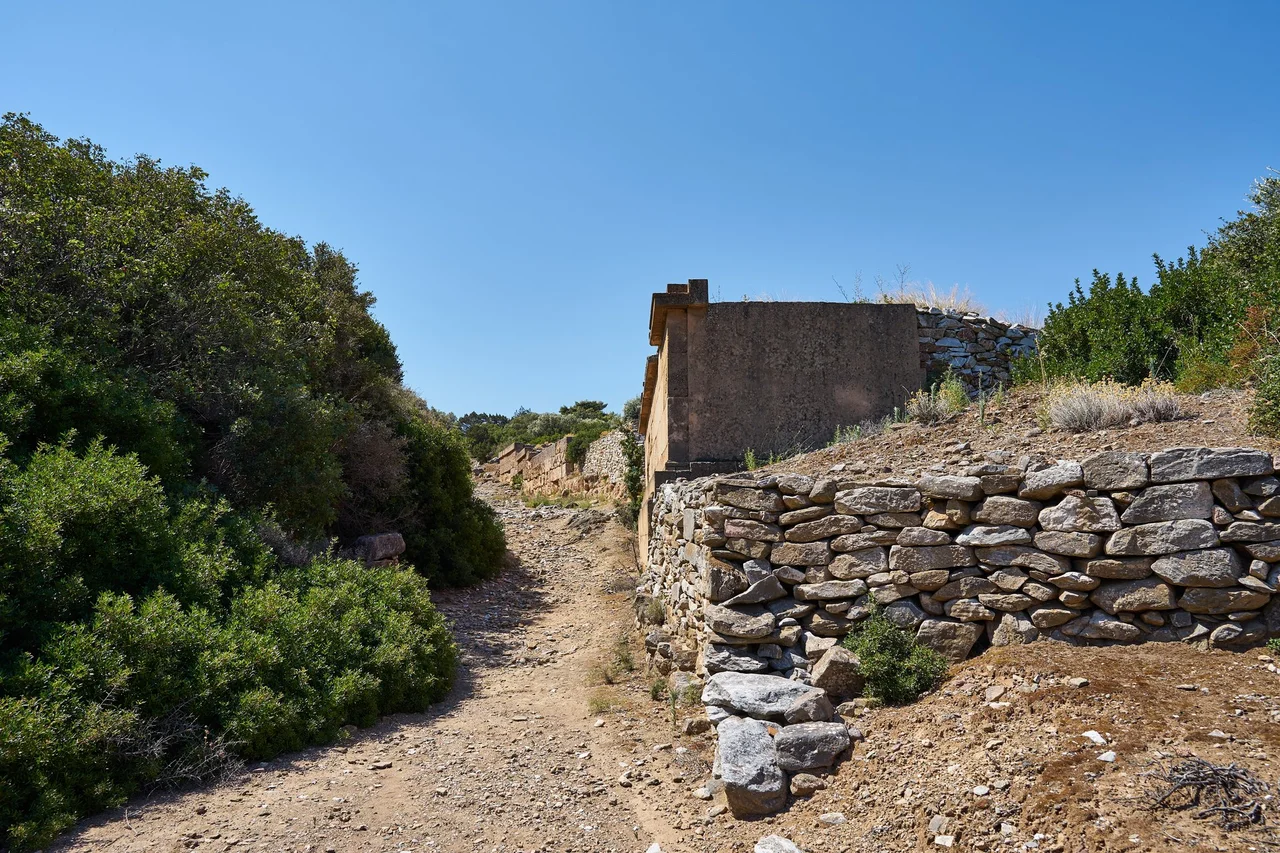
Rhamnous was more than a shrine. It was a fortified deme, the best-preserved town site in all of Attica, perched on a rocky peninsula that the sea wraps on two-thirds of its sides. A narrow ridge tethers it to the mainland; everything else is water and cliff. Athens kept a permanent garrison of ephebes here, young men watching the sea lanes through which grain sailed to feed the city during the Peloponnesian War. The acropolis crowns a hill some 28 meters high, its walls built from local marble, with a well-preserved main gate still standing. Below it lie a small theater, a gymnasium, a shrine to Dionysos, houses, and along the road to Marathon, rows of grave monuments. The town took its name from the buckthorn, a prickly shrub that still grows among the stones, and gave the world the orator Antiphon, born here.
The Temple That Was Loved
Most temples in Attica met a slow, humiliating end, quarried for their stone or carted off whole to Athens. The Temple of Nemesis was treated differently. When the Romans renewed their interest in old Greek monuments, they repaired it with care, replacing the damaged east end and even re-cutting duplicate blocks for the frieze and cornice, an expensive act of devotion. An inscription records a rededication tied to the deified Livia, wife of Augustus. The cult endured astonishingly long, outlasting the Olympian gods almost everywhere else, until the emperor Theodosius I decreed in the early 390s AD that surviving rural pagan temples be destroyed. Even then the ruins were never fully buried. The fortress and the sanctuary of the goddess of reckoning have stood visible above the Euboean Strait, watching the water, ever since.
From the Air
Rhamnous occupies a coastal headland in northeastern Attica at about 38.219 degrees N, 24.027 degrees E, overlooking the Euboean Strait near the modern village of Agia Marina in the Marathon municipality. From altitude, look for the small peninsula jutting into the strait, the silted-up ancient harbors on either side, and the line of the ridge connecting it to the hills inland. Nearest major airport is Athens International (LGAV), about 35 km to the southwest. Clear visibility across the strait toward the island of Euboea is common outside summer haze.
Nearby Stories
- German Submarine U-565 2.2 km away
- Castle of Cuppa 6.7 km away
- Zoodochos Pigi Church, Dervenosalesi 7.6 km away
- Brauron 9.1 km away
- Anthedon (Boeotia) 9.2 km away
- Battle of Andros (1790) 26 km away
- Andros 32 km away
- Aegean Sea 60 km away