.jpg)
Brauron
The girls wore honey-colored saffron robes. They ran races, performed sacred dances, and made offerings. For the duration of their time at Brauron — the ancient sanctuary of Artemis on the eastern coast of Attica — they were called arktoi: bears. They were consecrated to the goddess, set apart from ordinary life, living in the precinct of a deity who governed both the wildness of nature and the danger of childbirth. The Arkteia festival that brought them here was celebrated every four years, drawing girls approaching marriageable age from across Attica to this small inlet on the Aegean, to a sanctuary that had been sacred since the 8th century BCE and perhaps longer.
The Goddess Who Demanded Everything
Artemis at Brauron was not the gentle huntress of later artistic convention. The mythology of this sanctuary is darker and more demanding. The story that anchored the cult began with Agamemnon, who killed a stag sacred to Artemis before the fleet could sail for Troy. The goddess stopped the winds. Agamemnon was forced to offer his daughter Iphigeneia in sacrifice. In some versions, Artemis substituted a deer at the last moment and spirited Iphigeneia away to serve as priestess among the Tauri, a people of the Black Sea coast. Eventually Iphigeneia returned, and in Euripides' version, the goddess Athena commands that she will serve as keeper of the keys of the sanctuary at Brauron, die there, and be buried.
The garments of women who died in childbirth were dedicated to Iphigeneia at Brauron. The sanctuary was a place where the most dangerous passages of female life — marriageability, sexual initiation, childbirth — were brought under divine protection through ritual. Artemis was a danger to be propitiated as much as a goddess to be celebrated.
The Sanctuary at the Shore
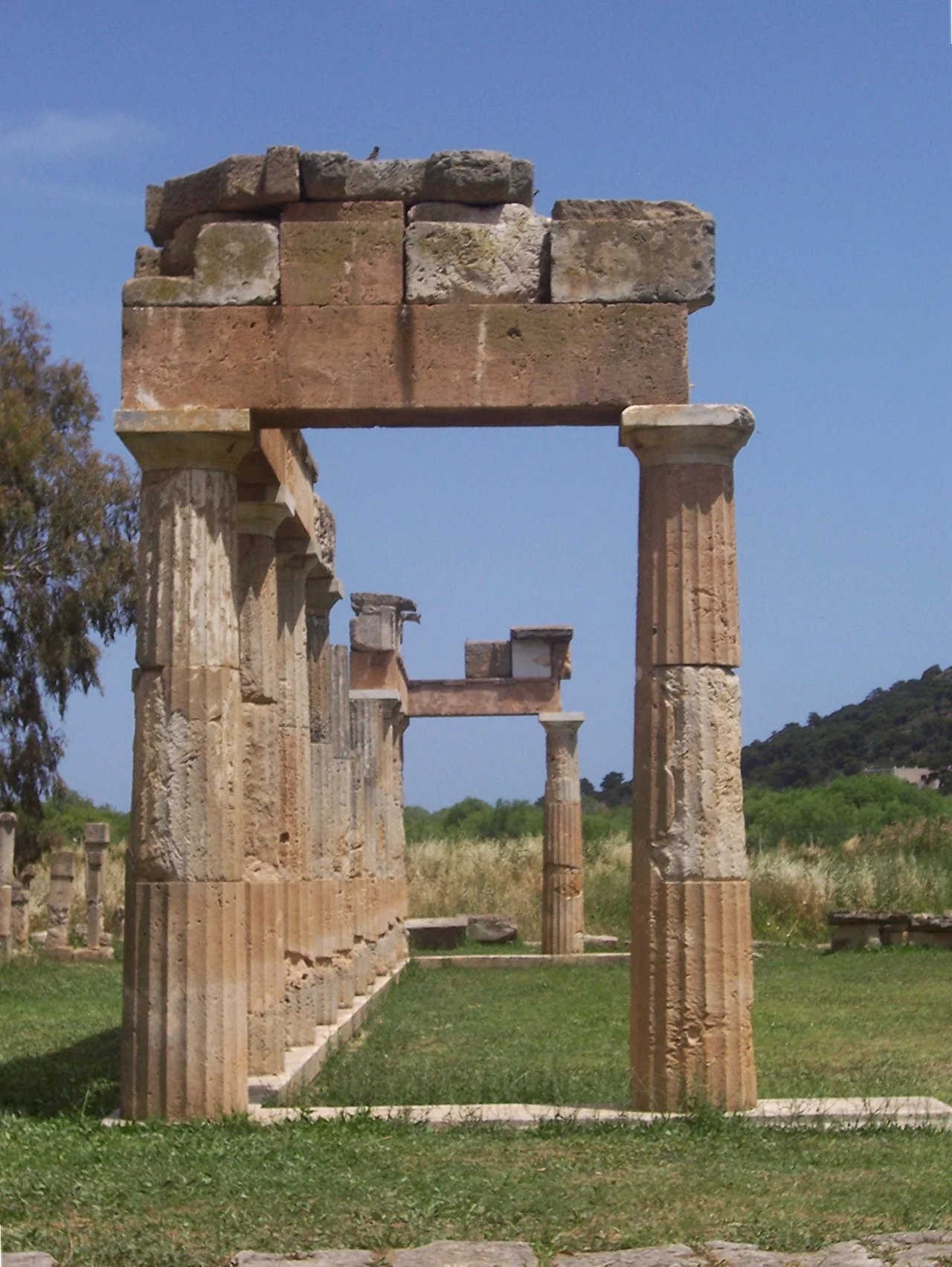
The sanctuary sits in a small inlet on the Attic coast, built around a sacred spring that had drawn cult activity since at least the 8th century BCE. The spring was the earliest focus of worship: objects were thrown into it as dedications from the beginning. Around it, over centuries, a temple of Artemis was built in the late 6th century BCE (destroyed by the Persians in 480 BCE and rebuilt in the 420s), a unique pi-shaped stoa wrapped around a central courtyard, a stone bridge over the Erasinos River — the only known Classical period stone bridge in Greece — and cave shrines cut into the rock of a nearby spur.
The stoa's nine dining rooms, each with raised platforms for eleven couches and small stone tables, are among the most complete examples of Greek ritual dining spaces known anywhere. One wall of a structure north of the stoa contained slotted bases hypothesized to have held the garments dedicated to Iphigeneia. The whole complex was silted up and abandoned after the 3rd century BCE, preserved in remarkable condition beneath layers of flood deposit.
What the Girls Left Behind
Excavations begun in 1948 by John Papadimitriou produced an extraordinary archive of material left by the worshippers at Brauron. Votive statues of young children of both sexes. Jewelry boxes and mirrors — objects associated with feminine life and preparation for marriage. And miniature kraters called krateriskoi, small vessels painted with images of young girls — nude or clothed — racing or dancing. These vessels, found in great numbers, document the Arkteia as a ritual in which girls' bodies and their physical capacities were central to the performance of devotion.
An epigram in the Anthologia Graeca preserves the voice of a girl dedicating her childhood playthings to Artemis on the eve of marriage — her dolls, her ball, her hair net, her girl's cap — as she crossed the threshold from childhood into adult life. Many such offerings were recovered from the sacred spring at Brauron. The Archaeological Museum of Brauron, a short walk from the site, holds the most important pieces.
The Long Silence and What Remains
The sanctuary was abandoned in the 3rd century BCE, possibly damaged in a flood, as tensions between Athens and Macedon made the unfortified site untenable. Pausanias, writing in the 2nd century CE, had little to say about it. A Christian basilica was built across the valley in the 6th century CE using material salvaged from the ancient structures. A small church dedicated to Hagios Georgios appeared in the 15th century, placed directly next to the temple platform.
What survived was preserved largely because of the river's silt. Today the site is quietly spectacular: the limestone stoa stands to several courses, the bridge remains, the sacred spring is still visible, and on a still morning with the Aegean audible beyond the inlet, the scale of the sanctuary — compact, intimate, built for girls in saffron robes rather than for armies or grand processions — is easy to feel.
From the Air
The Sanctuary of Artemis at Brauron is located at 37.926°N, 23.994°E on the eastern coast of Attica, roughly 35 km east-southeast of Athens. The site sits in a small coastal inlet that has silted up since antiquity, pushing the shoreline further from the sanctuary. The nearest major airport is Athens International Eleftherios Venizelos (LGAV), approximately 20 km to the northwest. From the air, the sanctuary is not immediately visible against the surrounding vegetation, but the coastal inlet and the low rock spur to the southeast mark the site. Approach from Athens heading southeast on the coastal plain; the area lies between the town of Artemida (Loutsa) to the north and Porto Rafti to the south. Recommended viewing altitude: 1,500–2,500 feet AGL. The modern settlement of Vravrona is 1 km to the southeast.
Nearby Stories
- German Submarine U-565 7.7 km away
- Gyaros 9.5 km away
- Rhamnous 9.6 km away
- Zoodochos Pigi Church, Dervenosalesi 11 km away
- Kalaureia 13 km away
- Battle of Andros (1790) 14 km away
- Agios Georgios (island) 21 km away
- Aegean Sea 72 km away