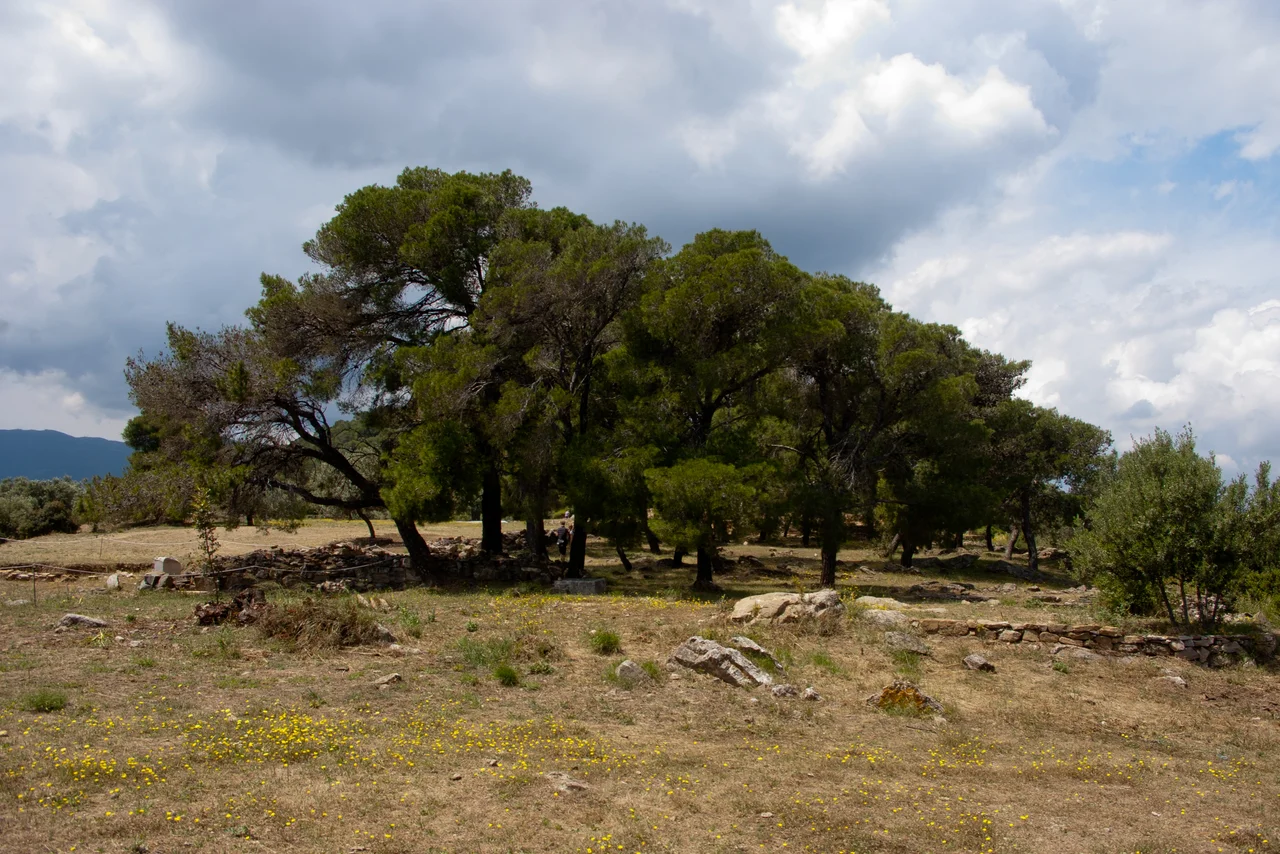

Kalaureia
On 12 October 322 BCE, Demosthenes climbed the steps of Poseidon's sanctuary on the island of Kalaureia, put a reed pen to his lips, and bit down. He had written his own exit. The most celebrated orator Athens ever produced — a man who had spent decades warning his city against the rise of Macedon — refused to fall into the hands of Antipater's soldiers. He died in the very place he had run to for protection, inside a temple that was itself defined by the idea of inviolable refuge. Kalaureia, the island just off the coast of Troezen that forms the northern half of modern Poros, has been many things over the millennia: a sacred precinct, a league-centre for rival city-states, an archaeological puzzle worked over by Swedish excavators for more than a century. But it is Demosthenes who gave it its most haunting story.
The God Who Traded an Island
Long before any temple stood on Kalaureia, the island had a theological biography. Ancient sources — Callimachus, Pausanias, Strabo citing the historian Ephorus — all passed down the same story: Poseidon received Kalaureia from Apollo in exchange for Apollo's claim on Delphi. The oracle confirmed the trade's equivalence: "For thee it is the same thing to possess Delos or Kalaureia, most holy Pytho or windy Taenarum." The island, in other words, was ranked alongside Delphi and Delos in the divine hierarchy of sacred places. Its name itself carries a pre-Hellenic epithet — Geraistos — a word from a language older than Greek, which bound Kalaureia to Poseidon sanctuaries at Geraistos in Euboea and Tainaros at the southern tip of the Peloponnese. All three functioned as asylums. The god who ruled the sea also ruled the principle of sanctuary, and Kalaureia was his most northerly refuge in the Saronic Gulf.
The Island That Was Once Called Peace
Strabo records that in the Archaic period, Kalaureia was the centre of an amphictyony — a sacred league — linking seven city-states: Hermione, Epidaurus, Aegina, Athens, Nauplia, Orchomenus, and the Prasians of Laconia. The Argives paid dues on behalf of the Nauplians; the Spartans paid for the Prasians. Whether this league was truly ancient or a later Hellenistic invention remains disputed — modern archaeologists have found no physical evidence predating the early seventh century BCE, when a peribolos wall and the sanctuary's first structures appear. What is certain is that the island was once known as Eirene, meaning Peace, a name that only makes sense if it were genuinely regarded as neutral ground. A third-century BCE plaque celebrating the "revival" of the Kalaureian League was recovered at the site, suggesting that even if the original amphictyony was partly legend, people later wanted badly to believe in it.
The Temple on the Heights
The Doric temple of Poseidon was built, archaeologists estimate, around 520 BCE — a peripteral building with six columns on each short side and twelve on each long side, measuring 27.4 by 14.4 metres. It was constructed primarily from poros stone, the pale cream limestone that gives the modern island its name, and was surrounded by a low enclosure wall with its main entrance facing east. The Swedish archaeologists who first excavated the site in 1894 found it almost completely robbed out; by the time they arrived, only foundation trenches and scattered roof tiles remained above ground. Modern excavations resumed in 1997 under the Swedish Institute in Athens in collaboration with the Greek National Heritage Board have been slowly reconstructing the sanctuary's full extent: a propylon, a colonnaded stoa with polygonal walls finished in red plaster, an inner Ionic colonnade, storehouses, possibly a bouleuterion for league meetings. In Roman times the stoas housed small commercial sheds, suggesting the sanctuary had become a market as much as a temple.
A Death in the Sanctuary
The story of Demosthenes at Kalaureia is told by Plutarch and confirmed by several ancient sources. After the death of Alexander the Great in 323 BCE, Demosthenes and his anti-Macedonian allies briefly regained influence in Athens. But Athens lost the subsequent Lamian War, and Antipater, the Macedonian regent, demanded the extradition of the ring-leaders. Demosthenes fled — first to Aegina, then to Kalaureia — and took formal sanctuary in the Poseidon temple, where Macedonian soldiers were legally barred from entering. Antipater's officer Archias followed him there and tried to talk him out. The conversation, recorded by Plutarch, was almost theatrical: Demosthenes calmly explained he had no fear of dying in the arms of Poseidon, and then — having apparently hidden poison in the reed pen he held — he bit down and died. He was sixty-two years old. The date was 12 October 322 BCE. The sanctuary of Kalaureia had sheltered its most famous fugitive, but could not save him.
What the Swedes Found
The 1894 Swedish excavation of Kalaureia holds a minor footnote in the history of archaeology: it was the first Swedish archaeological campaign in Greece. A century later, when modern work resumed, the site revealed far more than the ruined temple. Excavations around the sanctuary uncovered private buildings, communal storage pithoi, a statuette of Asklepios, statue bases that suggest a bouleuterion, and traces of a city that surrounded the sacred precinct rather than standing apart from it. The sanctuary was embedded in urban life, not isolated on a barren hilltop. PhD research by Ingrid Berg at Stockholm University, published in 2016, revisited those early 1894 finds and contextualised them within the history of Swedish classical scholarship. The Swedish Institute continues to publish excavation results in its journal Opuscula with open access — an unusually transparent archaeological programme for an ancient site of this significance.
From the Air
Kalaureia sits at approximately 37.52°N, 23.48°E — the northern, larger portion of the island-pair Poros in the southern Saronic Gulf, about 58 km south of Piraeus. From the air at 3,000–5,000 feet, it appears as the green, pine-forested northern lobe of Poros, separated from the southern volcanic Sphaeria by a narrow bridge-crossing strait. The remains of the Poseidon sanctuary are on the island's highland interior, not visible from low altitude but accessible by road. The closest major airport is LGAV (Athens International Eleftherios Venizelos), approximately 75 km to the northeast. The narrow channel between Poros and the mainland town of Galatas — barely 200 metres wide — is visually striking from altitude. In clear conditions the islands of Aegina and Salamis are visible to the north.
Nearby Stories
- Agios Vasileios, Corinthia 4.4 km away
- Nafplio 6.1 km away
- Agios Georgios (island) 6.3 km away
- Tsakonia 8.6 km away
- Saronic Gulf Islands 11 km away
- Brauron 17 km away
- Spetses 21 km away
- SS Heraklion 49 km away