.jpg)
Spetses
The island's revolution flag read simply: Freedom or Death. Spetses raised it on the morning of 3 April 1821 — the first of the Greek islands to do so — and from that moment the merchants of this small pine-forested place in the Saronic Gulf converted their trading ships into warships and entered a conflict that would last years and cost real lives. It was not an abstraction. Families on Spetses funded the war from gold they had hidden in wells. Ships and their crews did not all return. The fact that Spetses today is peaceful and beautiful, its harbor busy with horse-drawn carriages and the smell of sea pines, is in some measure the consequence of what was decided and sacrificed here two centuries ago.
Laskarina Bouboulina
Laskarina Bouboulina was born in a prison — her father died while her mother was held by Ottoman authorities — and she became one of the most consequential figures of the Greek War of Independence. A widow twice over, she used her inherited wealth to fund and arm a fleet of warships from Spetses, commanding one of them herself. Her flagship was the Agamemnon, the largest warship in the Greek revolutionary fleet at the time. She participated in the naval blockades of Nafplion and Monemvasia, two fortress-cities whose capture was essential to the revolution's progress on the Peloponnese. She was killed in 1825 in a personal dispute, years before Greek independence was formally secured. A life-sized statue of Bouboulina stands at the main dock in Spetses today. She is not a curiosity of history; she was a real commander who made choices that changed the course of a war, and the people of Spetses know it.
The Battle of Spetses, September 1822
On 8 September 1822, the Ottoman fleet moved up from Monemvasia toward Nafplion, which had been under Greek siege since spring 1821. The Ottoman ships needed to resupply the besieged Ottoman garrison. They encountered the combined fleets of Spetses, Hydra, and Psara in the waters near Spetsopoula. The Greek admiral Andreas Miaoulis, recognizing that his force was outnumbered and outgunned, ordered a tactical withdrawal into the Gulf of Argolis to draw the Ottoman fleet into less favorable waters. According to the Spetsiot local historian Anastasios Orlandos, the decisive moment came when the fireship captain Kosmas Barbatsis attacked the Ottoman flagship directly. The flagship fled to avoid the fireship, the other Ottoman ships followed, and Nafplion could not be resupplied. Two and a half months later, the fortress fell to the Greeks. Each September, on the second weekend, Spetses re-enacts the battle in the harbor — including the symbolic torching of a replica flagship. The Armata Festival is a commemoration, not a celebration of ease; the people who fought in 1822 were sailors and merchants, not a professional military, and many did not survive.
An Island Without Cars
Private automobiles are not permitted within the town limits of Spetses. The result is an island that moves at a different pace: horse-drawn carriages, bicycles, mopeds, the sound of footsteps on cobblestone. Ferries and high-speed hydrofoils from the Athenian port of Piraeus bring visitors in; they leave their cars on the mainland. The island has roughly 25 to 30 kilometers of trails encircling it, several beaches accessible by public bus, and the particular quiet of a place where combustion engines are simply absent from most of daily life. This was not always a wealthy island. Spetses declined as a maritime center through the 19th century. It was the return of Sotirios Anargyros — a descendant of an old Spetsiot shipping family who had emigrated to America in 1868 and become a tobacco tycoon — that transformed it. He returned in 1899, built the Poseidonion Hotel modeled on French Mediterranean grand hotels, and had pine seedlings planted in the hills. The island's famous woodland is largely his doing.
Pines, Pityussa, and the Literary Imagination
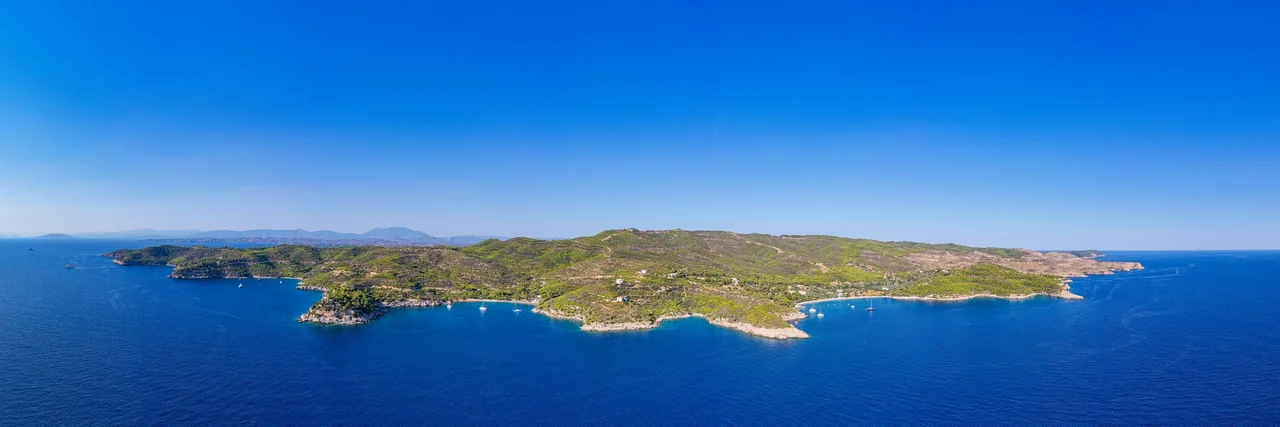
The ancient Greeks called this island Pityussa — the pine-covered one. The name fits. In the early 21st century, Spetses is among the most wooded islands in the southern Aegean, and the pine forests give it a fragrance and a shade unusual among the rocky Saronic islands. The island entered a different kind of history in 1965 when John Fowles published The Magus, a novel set on a fictionalized version of Spetses he called Phraxos. Fowles had taught English at the Anargyrios and Korgialenios School on the island between 1951 and 1953, and the landscape is present in the novel in considerable detail. The school still exists; so does the Villa Bourani, the private residence that inspired a key location in the book. More recently, Spetses appeared in Maggie Gyllenhaal's 2021 drama The Lost Daughter and Rian Johnson's 2022 mystery-comedy Glass Onion: A Knives Out Mystery — the latter used the harbour of Dapia for arrival scenes, with the villa sequences filmed at Amanzoe Resort on the nearby mainland. The island has proved useful to storytellers, which makes a certain sense: it is a place with a lot of history quietly present beneath a beautiful surface.
From the Air
Spetses lies at approximately 37.26°N, 23.14°E in the Saronic Gulf, roughly 80 km south of Athens by air. From altitude, the island appears as a pine-covered landmass with a distinct harbor town on its northeastern shore; the smaller uninhabited islands of Spetsopoula (directly to the southeast), Falkonera, and Velopoula are also visible nearby. The narrow strait between Spetses and the Peloponnese mainland village of Kosta is a useful navigation reference. Recommended viewing altitude is 3,000–6,000 feet. The nearest major airport is LGAV (Athens International Eleftherios Venizelos), approximately 80 km to the northeast. Sea conditions in the Saronic Gulf can produce surface haze in summer; visibility is clearest in spring and autumn.
Nearby Stories
- Tegea 6.8 km away
- Battle of Sellasia 7.5 km away
- Saladi Beach 8.9 km away
- Siege of Kastania 12 km away
- Metamorfosi, Laconia 16 km away
- Saronic Gulf 29 km away
- Agios Georgios (island) 47 km away
- SS Heraklion 52 km away