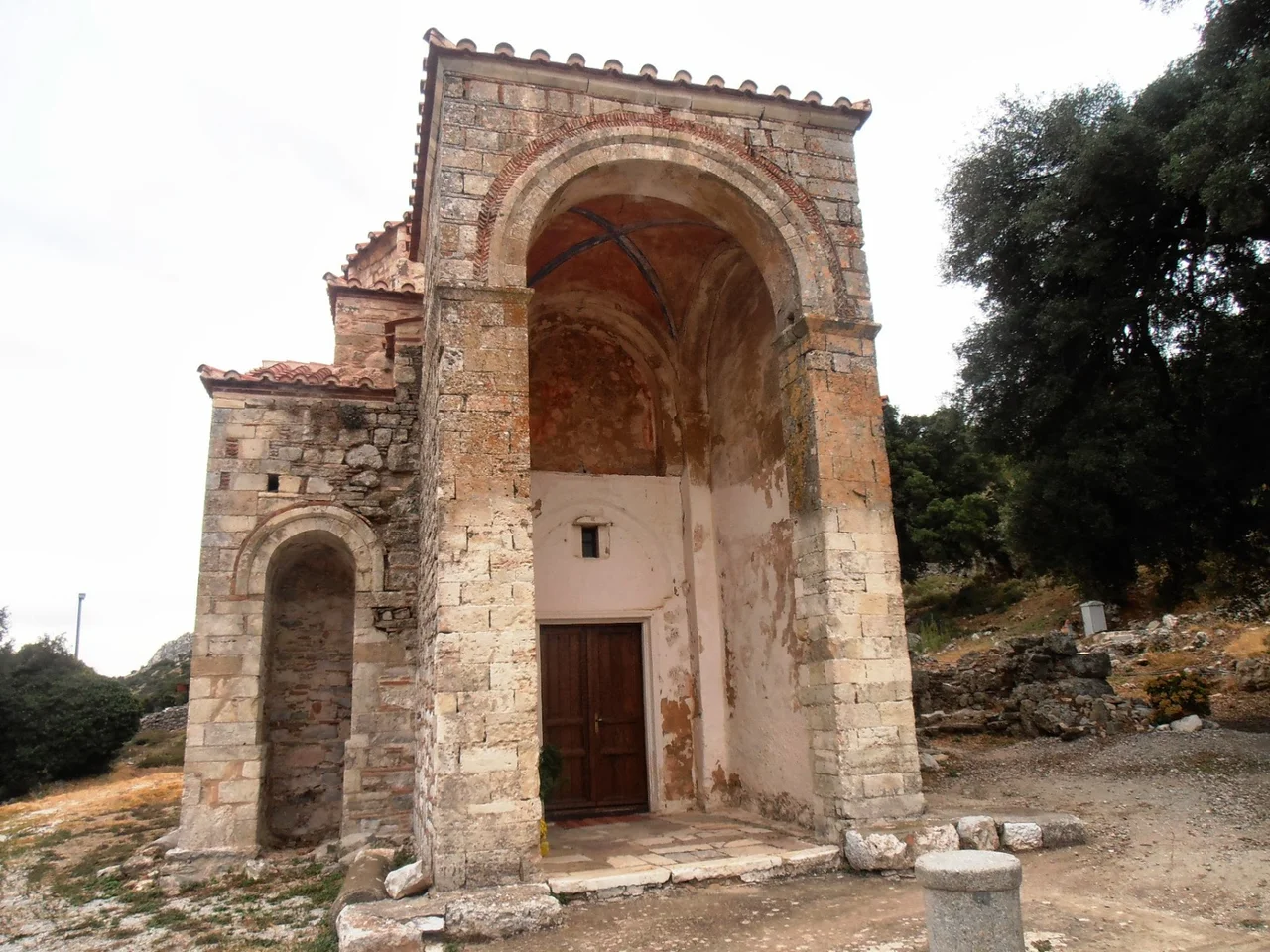

Zoodochos Pigi Church, Dervenosalesi
The little church standing in the Boeotian hills west of Pyli is not quite what it appears to be. It is not a complete building but a survivor, the entrance hall of a much grander church that no longer exists. Known as the Church of Zoodochos Pigi, "the Life-giving Spring," it began life as the narthex of a Byzantine monastery's main church, the katholikon. When that sanctuary collapsed around 1890, the porch was all that remained standing, and rather than let it fall too, the local community simply made the surviving fragment into a church of its own. What you see today is, in effect, the doorway to a vanished holy place, repurposed into the place itself.
The Lost Monastery
The monastery this church once served is something of a mystery. No surviving source or inscription names it with certainty. Scholars have proposed that it might be the "Monastery of Sterna," or possibly the Monastery to the Theometor, the Mother of God, mentioned in the medieval biography of Saint Meletius the Younger. If that identification holds, the foundation could reach back to the end of the 11th century. On the evidence of its architecture alone, the building is dated to the late 12th century. The uncertainty is its own kind of history: a community of monks lived, worshipped, and worked here, and yet their house slipped almost entirely out of the written record, leaving stones to speak where documents fall silent.
Echoes of Hosios Loukas
The katholikon, whose foundations still survive, was built in the classic Byzantine cross-in-square plan, a domed church with three semicircular apses at its eastern end. Its great distinction lay underfoot. The floor was laid in inlaid marble arranged in geometric patterns, a technique strikingly close to that of the famous monastery of Hosios Loukas not far away. That kinship is the clearest clue to the church's importance. Hosios Loukas is one of the masterpieces of middle Byzantine art, and a builder who could echo its marble floors was working in a sophisticated tradition. The collapsed sanctuary was no rustic chapel but a refined work, connected to the leading currents of the age in this corner of central Greece.
What the Centuries Left
The surviving narthex is roughly octagonal, organized around four crosswise central vaults with niches tucked into its corners, a compact and elegant space that once merely prepared worshippers to enter the larger church beyond. Beyond the church itself, the ground still holds traces of the wider monastic settlement. Portions of the surrounding walls remain, and to the north lie the foundations of the monastery's baths, dated to the 13th century. Together these fragments sketch the outline of a working community: a sanctuary for prayer, an enclosure for shelter, and bathhouses for the practical needs of monks who lived here through the medieval centuries, in a landscape far from the great cities of the empire.
A Spring in the Hills
The dedication carries its own quiet meaning. "Zoodochos Pigi," the Life-giving Spring, is one of the most beloved Marian titles in Orthodox tradition, an image of the Virgin as the source of living water and spiritual renewal. It is a fitting name for a building that has itself refused to die, the fragment that outlived the whole. The village it serves was once called Dervenosalesi and is now part of Pyli in Boeotia. Travelers passing through this rugged country, the same hills that border ancient Attica, can still find the church standing some five kilometers west of the village, a modest survivor holding the memory of a monastery whose name even the historians cannot agree upon.
From the Air
The church stands at 38.214 N, 23.470 E, in the hills of Boeotia about 5 km west of Pyli (formerly Dervenosalesi), near the border with Attica. It is a small structure set in rugged, sparsely built country, best appreciated from 1,500-3,000 ft AGL where the surrounding monastic foundations and walls can be picked out from the terrain. Nearest major airport: Athens International (LGAV), roughly 45 km southeast. The famous Byzantine monastery of Hosios Loukas, a stylistic cousin, lies to the west. Clearest light in spring and autumn.
Nearby Stories
- Spata 1.1 km away
- Helios Airways Flight 522 5.7 km away
- Anthedon (Boeotia) 6.1 km away
- Euboea 8.2 km away
- Salamis Island 9.9 km away
- Davleia 11 km away
- Corinthia 11 km away
- Mount Helicon 14 km away