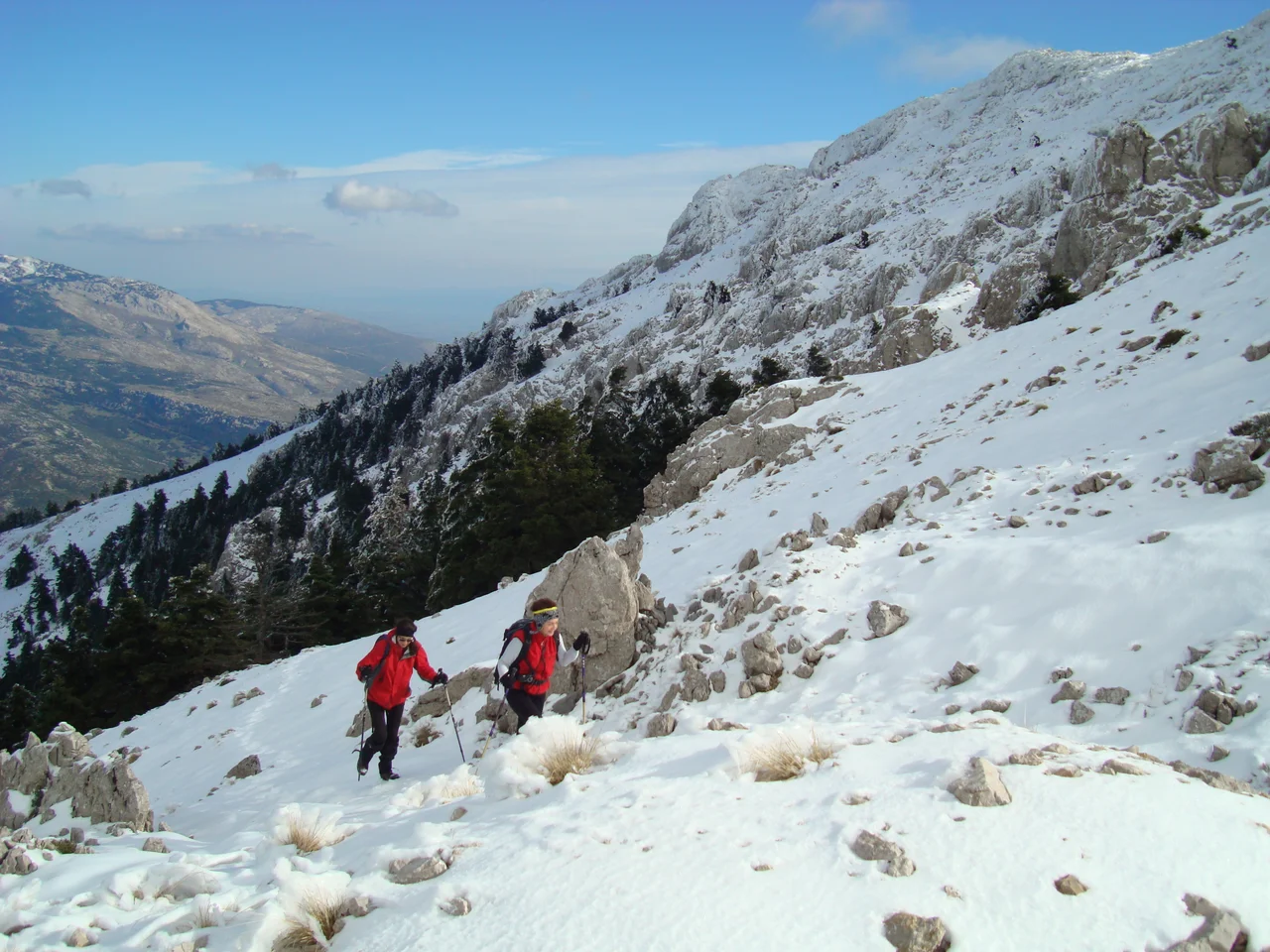

Mount Helicon
The poet Hesiod was pasturing his sheep on these slopes, somewhere in the eighth or seventh century BC, when the Muses appeared to him. They gave him a staff of laurel and breathed into him the gift of song, and from that moment Mount Helicon became the mountain of poets — not metaphorically, but in the way Greeks meant such things: a real place where the divine touched the human, where inspiration was not an idea but a spring you could drink from. For two and a half millennia afterward, every writer who claimed the Muses as patron was, in some sense, making a pilgrimage back to this green mountain rising above the Boeotian plain.
Where Pegasus Struck the Rock
The mountain carries two sacred springs, the Aganippe and the Hippocrene, both bearing the Greek word for horse — híppos — in their names. The Hippocrene spring has the more dramatic origin story: the winged horse Pegasus, cantering across the mountain, struck the rock with his hoof with such force that water burst from the spot. Ancient Greeks understood this water as a source of poetic inspiration, and the connection is not arbitrary. Pegasus was born from the blood of Medusa, a creature of the underworld, and his spring at Helicon bridged the chthonic and the divine. Drinking from the Hippocrene, poets believed, was drinking from something that came up from the earth's deep places and was transformed into a gift of the sky. The spring Aganippe, named for a naiad, was considered similarly sacred, and the sacred grove around it was filled with statues when the traveler Pausanias visited in the second century CE — images of Apollo and Dionysus, of the nurse of the Muses, of the legendary poet Linus carved into a cave-like recess in the rock.
The Valley of the Muses
Below the summit, in a fertile valley near the ancient settlements of Thespiai and Ascra — Hesiod's own home village — a cult center grew in Hellenistic times, dedicated to the Muses themselves. The Valley of the Muses became a place of pilgrimage and performance, where statues of famous poets stood in a grove and the tripod Hesiod had won at a poetry contest in Chalcis was still on display centuries later when Pausanias came through. Homer, notably, was absent from the grove. A scholar has observed that Homer's presence would have complicated things: Hesiod and Homer were seen as rivals for supremacy in epic poetry, and the Contest of Homer and Hesiod was a well-known ancient text. The Helicon cult was Hesiod's territory. Homer had to go elsewhere to be worshipped. At 1,749 meters, the mountain itself is substantial — roughly 10 kilometers from the northern shore of the Gulf of Corinth, its summit visible from much of Boeotia on a clear day.
Poetry Written in Stone and Water
The third-century BC poet Callimachus dreamed of being young again and conversing with the Muses on Helicon. In his Aitia, he placed himself consciously in Hesiod's footsteps, turning the mountain into a kind of literary genealogy — a place poets returned to, even in imagination, to claim legitimacy. Ovid, writing in Latin, sent the goddess Minerva to visit the Muses on Helicon in his Metamorphoses, confirming the mountain's authority across languages and cultures. The Homeric Hymn to Poseidon, probably from the seventh century BC, hailed the god as "Lord of Helicon," connecting the sea deity to this inland mountain in a way that still puzzles scholars. Callimachus also placed the episode of Tiresias, who stumbled upon Athena bathing and was blinded but given the gift of prophecy, on Helicon's slopes — linking poetry and prophecy as twin gifts of the same sacred ground. The mountain's capacity to generate stories about itself is, in its own way, a kind of mythology within mythology.
Monks, Musicians, and Milton
The monastery of Hosios Loukas stands on Mount Helicon — a UNESCO World Heritage Site, built in the tenth century CE and famous for its Byzantine mosaics. The monks who have lived here for centuries occupy the same mountain the ancient Greeks consecrated to creative inspiration, a continuity across faiths that is quietly remarkable. John Milton opened Paradise Lost by invoking "th'Aonian mount" — Helicon — and asking for inspiration higher than the pagan Muses could offer. Torquato Tasso called on "Elicona" in Gerusalemme Liberata. The Four Seasons released an album called Helicon in 1977. Seamus Heaney wrote "Personal Helicon," drawing on Narcissus and the mountain's spring. Mogwai recorded New Paths to Helicon in their BBC sessions. The mountain's imaginative hold on writers, composers, and musicians across twenty-five centuries is unlike that of almost any other landscape on Earth — not because of what it looks like, but because of what Hesiod claimed happened there, one morning, while his sheep grazed.
From the Air
Mount Helicon sits at approximately 38.352°N, 22.825°E in the Boeotia region of central Greece, rising to 1,749 meters. It is visible as a prominent summit northwest of Athens, roughly 80 kilometers from LGAV (Athens International Eleftherios Venizelos). Approaching from the south over the Gulf of Corinth, the mountain appears as a broad green massif above the coastal plain. A safe viewing altitude of 8,000–10,000 feet clears the summit with margin. Mountain weather can develop rapidly; afternoon updrafts on the southern slopes are common in summer. The nearest significant airport to the west is LGRX (Araxos), approximately 120 km across the Gulf of Corinth.
Nearby Stories
- Battle of Vasilika 7.9 km away
- Siege of Negroponte (1470) 8.5 km away
- Battle of Kalavryta 13 km away
- Church of the Nativity of the Theotokos, Limni 14 km away
- Pellene 16 km away
- Panagia Varnakova Monastery 18 km away
- Megara 21 km away
- Karpenisi 41 km away