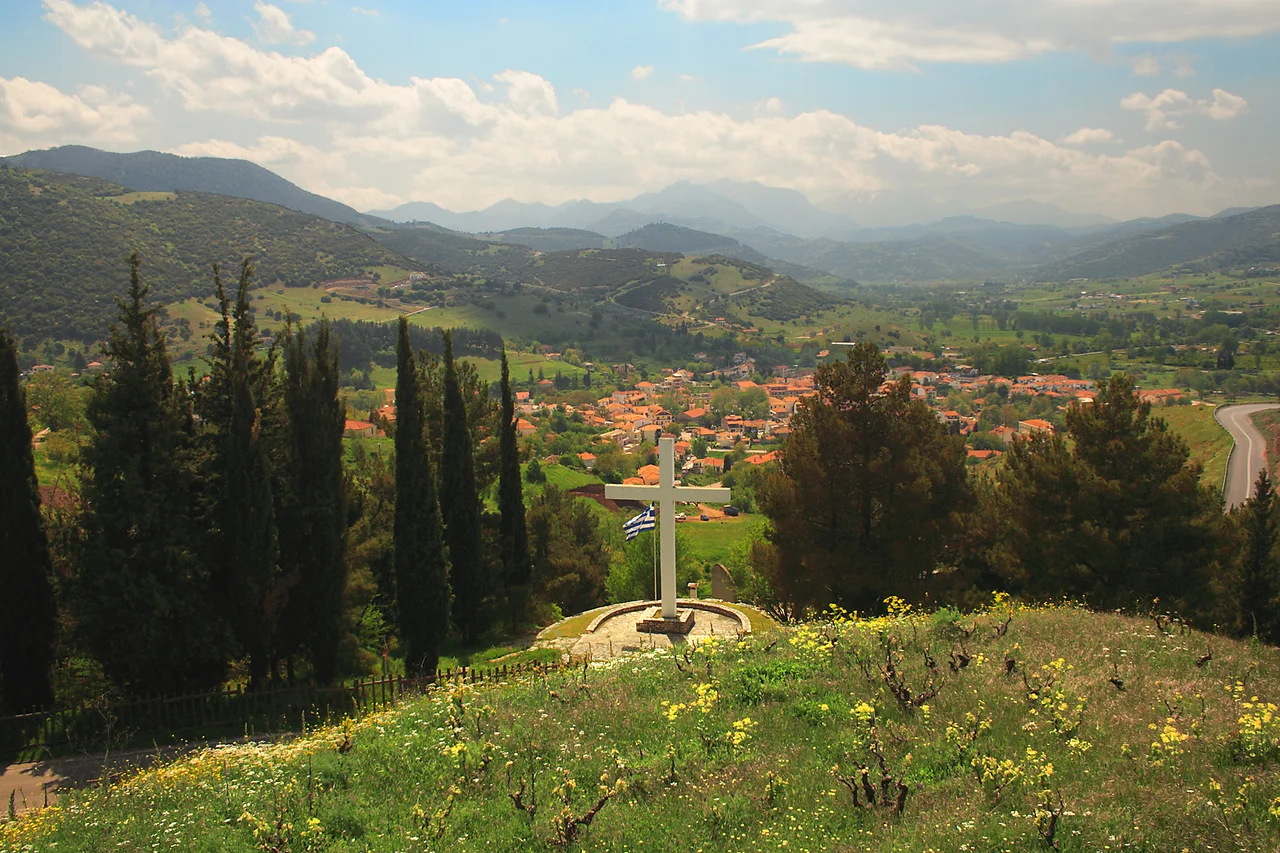

Battle of Kalavryta
At 4:30 in the morning on 11 April 1948, Democratic Army fighters moved into Kalavryta from every direction at once. A specially trained detachment had already slipped inside the town in the dark, setting grenades against machine-gun positions before the outer forces launched their attack. By noon, the railway station and the hilltop fortress of Kastro had fallen. The garrison's commander, Lieutenant Colonel Nikolaos Arvanitakis, was still holding two gendarmerie outposts. He would surrender the next day — and then die by his own hand.
A Town Worth Taking
By early 1948, the communist Democratic Army of Greece (DSE) controlled most of the mountain ranges of the Peloponnese — Taygetus, Parnon, Mainalo — but the town of Kalavryta, administrative center of its province, remained in government hands. For the DSE, the prize was practical as well as symbolic: Kalavryta's warehouses held clothing, food, ammunition and United Nations Relief and Rehabilitation Administration supplies. The town's relative isolation from other government garrisons made it vulnerable. And capturing it openly, in a direct assault rather than ambush, would demonstrate that the DSE could fight a conventional urban battle and win. DSE commander in chief for the Peloponnese, Stephanos Giouzelis, put together a force of roughly 1,000 to 1,100 fighters drawn from multiple mountain battalions.
A Plan Built on Intelligence
The assault was planned in detail by Kostas Kanellopoulos, chief of staff of the DSE Peloponnese, beginning on 25 March 1948. DSE drew intelligence from fighters native to the region and from underground party cells inside the town. They knew the garrison's five fortified positions: Kastro, the power station, Agia Aikaterini, the railway station and the Katsini residence — all ringed with barbed wire and booby traps. They knew the defending force totaled roughly 700 National Guardsmen, 80 gendarmes and 100 militiamen. To prevent reinforcements arriving from Aigio on the coast, DSE mined the bridges of the Diakopto–Kalavryta rack railway. An ambush was set at Vlacherna to delay any army brigade advancing from Tripoli. Telephone lines would be cut at the last moment. On paper, the attacking force was actually outnumbered — which made the planning all the more careful.
Thirty Hours of Fighting
The battle ran through two days. Agia Aikaterini fell within half an hour of the opening attack. Mega Spilaio monastery, guarding the road to Aigio, fell at 6:30 a.m. By 8:00 the DSE had encircled the garrison headquarters. Royal Hellenic Air Force planes flew over the city at 9:00 a.m. but could not fire without risking their own side. The railway station and Kastro gave way by noon. One gendarmerie building caught fire after being hit with incendiary rounds in the evening; DSE fighters pulled seventeen imprisoned leftists out before it burned. By nightfall, Arvanitakis held only two outposts. During the night his gendarmes slipped out of the town and reached Diakopto undetected. Arvanitakis stayed. In the morning, DSE returned. At noon on April 12, Arvanitakis and DSE commander Kanellopoulos — who knew each other as graduates of the Hellenic Military Academy — negotiated the surrender of six officers. Arvanitakis then died by his own hand.
Victory and Its Limits
The haul from the warehouses was substantial: four heavy mortars, four Vickers machine guns, 80 submachine guns, 200 rifles, 85,000 rounds of ammunition, 400 million drachmas, 200 sheep and goats, and thousands of kilograms of flour and sugar. But the victory carried the seeds of its own undoing. DSE commander Giouzelis, over the objection of Kanellopoulos, insisted on an offensive against the nearby village of Goura rather than dispersing as planned. The Greek Army's 72nd Brigade exploited the delay, encircling the Helmos massif. The captured weapons cache — requiring at least 220 pack animals to move — was found and seized by government troops. Seven badly wounded DSE fighters left in a cave on Helmos were discovered by a government patrol and executed. On 15 April, government authorities shot 25 political prisoners in Sparta in reprisal. The disagreement between Giouzelis and Kanellopoulos over what went wrong continued to divide DSE's officer corps for months.
The Larger War
The fall of Kalavryta, alongside the July 1948 Battle of Chalandritsa, stood as the DSE's most significant victories in the Peloponnese. These successes, combined with the violence of government paramilitaries in the countryside, helped convince a portion of the peninsula's population that the communist Provisional Democratic Government was a viable alternative. By November 1948, DSE's Peloponnese strength had grown to 4,870 combatants. But the government held advantages in numbers and supply the DSE could not overcome: Operation Peristera, launched in December 1948, destroyed DSE's Peloponnese forces entirely by March 1949. Kalavryta changed hands again without a shot. The town would be left to make its peace with two very different wars — one fought in 1943 by an occupying army against civilians, and one fought in 1948 between Greeks.
From the Air
Kalavryta is located at approximately 38.03°N, 22.12°E in the highlands of Achaea, roughly 750 meters above sea level. The Vouraikos gorge, site of the famous rack railway line from Diakopto, runs north from the town toward the Gulf of Corinth coast. The nearest major airport is LGRX (Araxos/Patras), approximately 60 km northwest at 38.15°N, 21.42°E. The Helmos massif (Aroania), rising to 2,341 meters, is visible to the southeast as a prominent landmark when approaching from altitude.
Nearby Stories
- Pellene 3.9 km away
- First Siege of Missolonghi 5.5 km away
- Battle of Manolada 8.4 km away
- Barony of Akova 8.7 km away
- Desfina 11 km away
- Panagia Skafidia Monastery 15 km away
- Battle of Naupactus 15 km away
- Tomb of Clytemnestra 24 km away