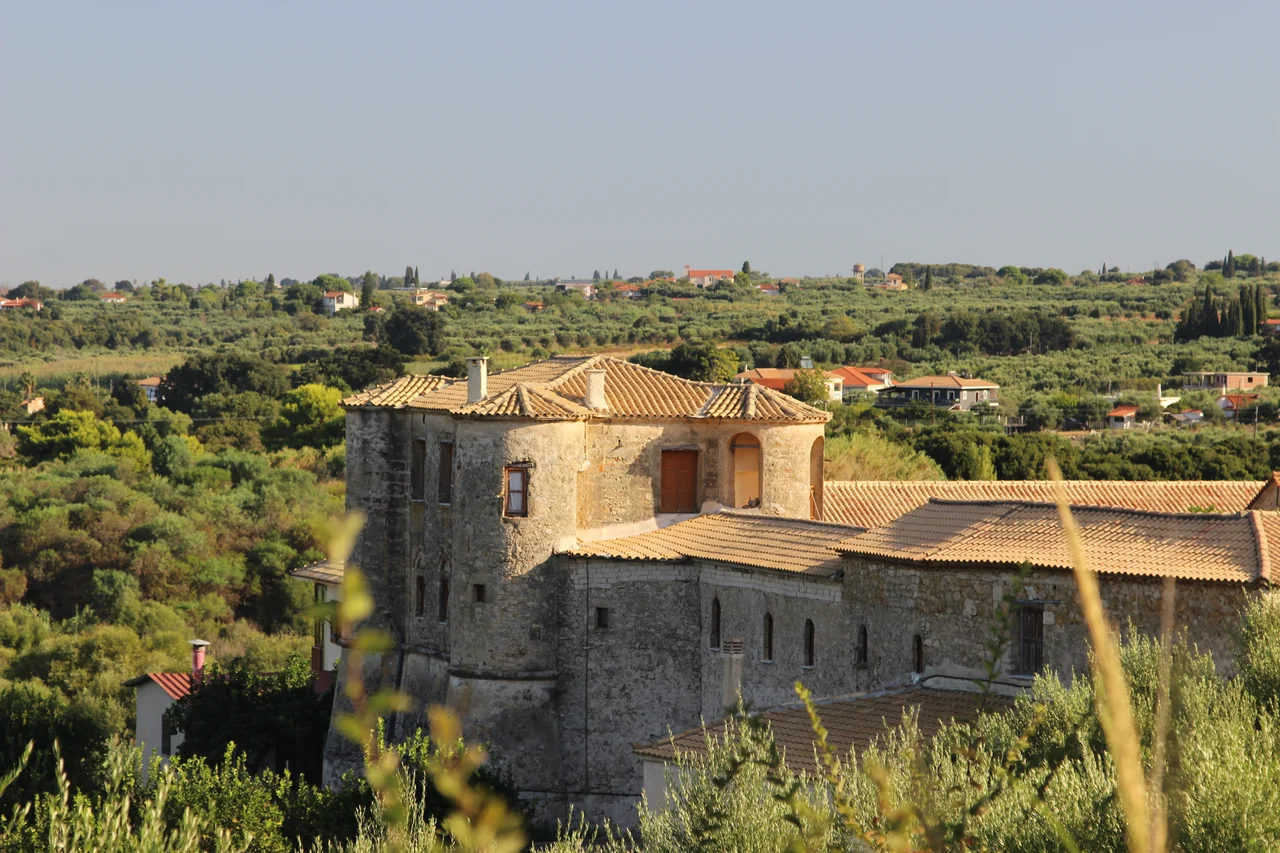

Panagia Skafidia Monastery
The traveler approaching from the coastal road sees the battlements before anything else — a medieval fortress wall rising from a strip of land between river and sea, closer to the water than a monastery has any right to be. Inside those walls is not a castle but a convent: the Panagia Skafidia Monastery, founded around the tenth century, dedicated to the Dormition of the Theotokos, and inhabited today by four nuns who maintain a library of handwritten liturgical manuscripts that is older than most of the surrounding landscape has been cultivated.
Built at the River's Mouth
The monastery stands at the mouth of the Iardanos river, where it meets the Ionian Sea 12 kilometers outside Pyrgos. The location is ancient in ways the monastery's own history reflects: the river Iardanos appears in Strabo as a geographic reference point for this stretch of coast, and the site near the river mouth was significant long before the first Byzantine builders arrived. What they constructed around the tenth century was a monastery encased in a defensive perimeter — the medieval fortress walls that still command the approach from landward. The structure announces itself to the coast as a fortified place, which was practical: coastal monasteries in Byzantine and medieval Greece were attractive targets for raiders who came by sea, and the fortress wall was not decorative. The monastery is formally part of the Holy Metropolis of Elis and Olena.
A Treasury Behind the Walls
The monastery's interior holds what generations of women chose to keep. Sacred vessels, embroidered vestments, reliquaries, old coins, votive offerings, liturgical icons — the accumulated devotion of roughly a thousand years of continuous occupation. The hand-embroidered banner of the monastery depicts the Theotokos, made by women whose names are not recorded but whose needlework has survived them. The library is the most historically significant part of the collection: manuscripts on liturgical practice, church music, hagiography, and local history, including records of the monastery's participation in the Greek Revolution of 1821. That participation mattered. Greek monasteries served throughout the revolutionary period as meeting places, supply depots, and sources of funds and fighters for the cause of independence.
The Women Who Kept It
Monasteries survive because someone decides to stay. At Panagia Skafidia, the community of women who have inhabited this fortress by the sea across the centuries are largely unnamed in the historical record — they tended the manuscripts, maintained the icons, embroidered the banners, and kept the walls — but the Abbess Makaria Efstratiou (known as Makaria II) leads a community of four nuns today. Four people keeping a thousand years of institutional memory. The manuscripts do not catalog themselves; someone has to know where they are, what they say, and why they matter. The archive of the monastery contains handwritten books touching on subjects from liturgical chant to the history of the building itself. The nuns are that archive's custodians.
Where the Wall Meets the Sea
Standing at the edge of the monastery grounds, you see the Ionian in one direction and the fortress wall in the other. The Iardanos river is narrow here at its mouth, and the strip of land the monastery occupies between river and sea is not wide. Beyond the wall to the west, the water is blue and clear enough that the stones of the river bottom are visible. Beyond the wall to the east, the road leads back to Pyrgos and then to the rest of Greece. The monastery sits between those two worlds — the sea it has faced for over a millennium and the country it helped preserve — in a fortress that was built for defense but has served, far longer than any army, as a place of prayer.
From the Air
Panagia Skafidia Monastery is located at 37.701°N, 21.326°E on the Ionian coast of Elis, 12 km northwest of Pyrgos. From the air, look for the mouth of the Iardanos river and the compact walled complex sitting at the coastal edge where river meets sea. The medieval fortress walls are visible from altitude as a rectangular enclosure close to the waterline. Nearest major airport is LGRX (Araxos), approximately 35 km to the north. Approach from over the Ionian at 2,000–4,000 feet heading east; the coast road and the river mouth provide clear orientation landmarks. Morning light from the east falls directly on the seaward face of the monastery.
Nearby Stories
- Phigalia 6.2 km away
- Thelpusa 7.3 km away
- County Palatine of Cephalonia and Zakynthos 8.7 km away
- Ionian Islands 11 km away
- Battle of Manolada 12 km away
- Achaea (Ancient Region) 14 km away
- Strofades 31 km away
- Valletta 581 km away