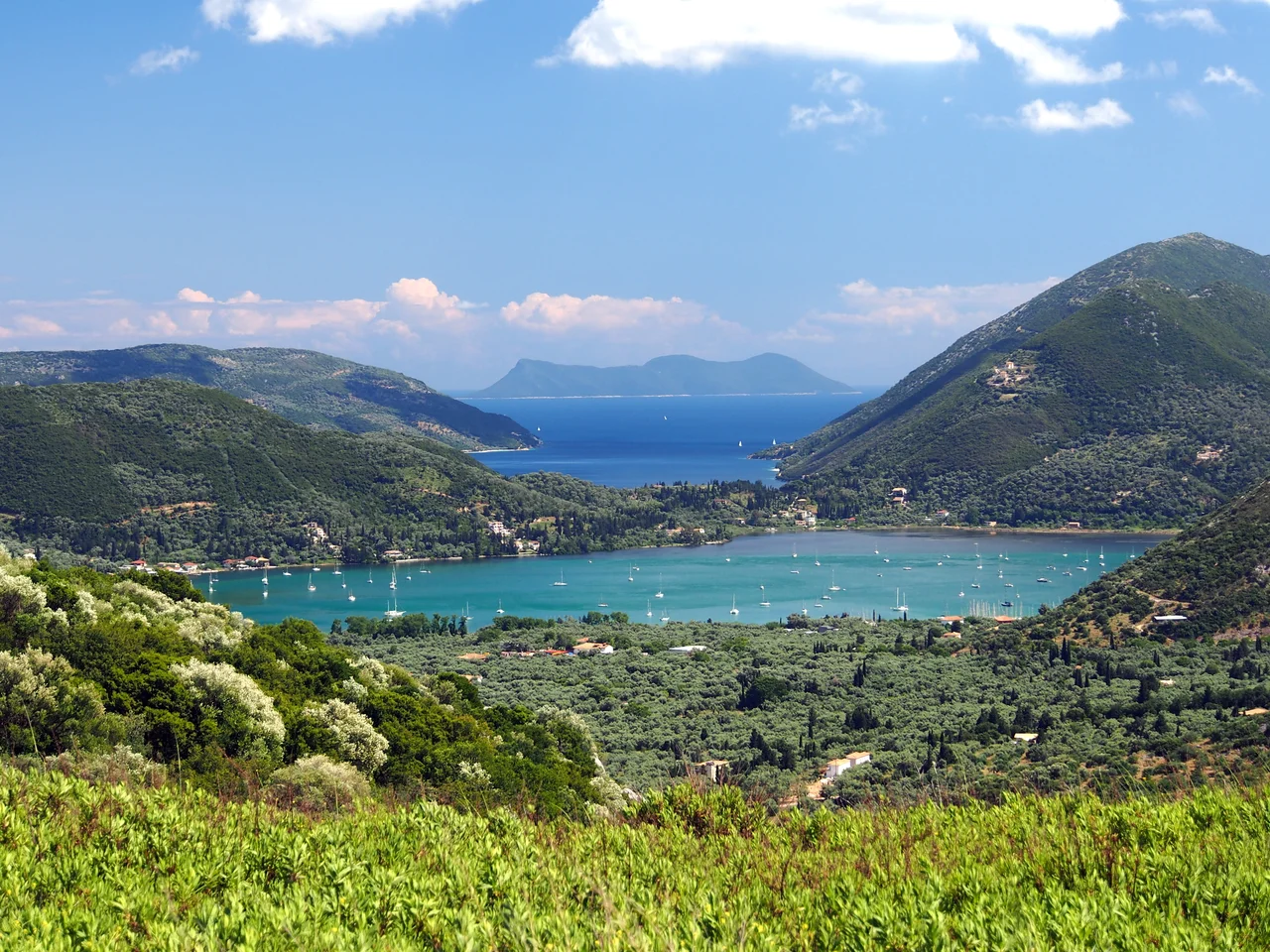

Ionian Islands
When the Ottomans swept through Greece in the 15th century, they took almost everything. Almost. The seven Ionian Islands — Corfu, Paxi, Lefkada, Ithaca, Kefalonia, Zakynthos, and Kythera — remained in Venetian hands, protected by the Republic of Venice's maritime power and the islands' value as waypoints for trade with the Levant. For roughly four centuries, while the Greek mainland lived under Ottoman administration, the Ionian Islands lived under the Lion of St. Mark. That difference shaped everything: the architecture, the music, the cuisine, the Catholic minorities, the local aristocracies, the distinct cultural identity that Greeks call Heptanesian — from Heptanesa, 'Seven Islands,' the other name by which the Ionians have always been known.
The Long Venetian Shadow
Venice began acquiring the Ionian Islands piecemeal after the Fourth Crusade dissolved the Byzantine Empire in 1204. Corfu came first, then the others — Zakynthos passed permanently to Venice in 1482, Kefalonia and Ithaca in 1483, Lefkada in 1502. Kythera had been in Venetian hands since 1238. By the time the Ottomans made serious attempts to seize the islands, Venice had built fortresses, established garrisons, and woven the islands into its commercial network.
The Ottoman campaigns largely failed. The islands became, as Wikipedia's own article puts it, 'the only part of the Greek-speaking world that did not come under Ottoman rule.' That distinction was not merely symbolic. It meant the islands kept their Orthodox monasteries and churches without the constraints that operated on the mainland. It meant a Greek merchant class could develop and accumulate capital. It also meant that thousands of mainland Greeks fled here during the centuries of Ottoman rule, bringing their scholars, their manuscripts, and their tradition of Greek learning to islands that could receive and preserve them.
Venetian was the official language. Many Greeks adopted it for social advancement. But the majority of the population remained ethnically, linguistically, and religiously Greek — and when Venetian settlers came, many of their descendants eventually assimilated into the Greek majority.
Passed Between Empires
Venice fell to Napoleon in 1797, and the islands went with it. By the Treaty of Campo Formio, they became French départements — Mer-Égée, Ithaque, Corcyre. The French reorganization lasted barely two years before a combined Russian-Ottoman fleet under Admiral Ushakov evicted them. The victors established the Septinsular Republic in 1800: the first time Greeks had governed themselves, however partially, since the fall of Constantinople in 1453.
That experiment in self-governance lasted until 1807, when the Treaty of Tilsit handed the islands back to France. Then came the British, who captured Zakynthos, Kefalonia, and Kythera in 1809 and took Lefkada the following year. The French held Corfu until 1814. The Congress of Vienna formalized British control in 1815 under the name 'United States of the Ionian Islands,' a protectorate rather than a colony. The British improved roads, introduced a constitution, and brought thousands of Maltese workers to the islands. They also brought cricket, which is still played on Corfu — the only place in Greece where the game took hold.
Once Greek independence was secured in the 1820s and 1830s, pressure for union — Enosis — grew. The British resisted for years, partly because the islands made useful naval bases. But in 1864, as a gesture of goodwill toward the new King George I, Britain transferred the islands to Greece. On May 21, 1864, the Ionian Islands officially became Greek.
The 1953 Earthquake That Remade the Southern Islands
On August 12, 1953, a magnitude 7.2 earthquake struck the Ionian Islands with maximum intensity rated Extreme on the Mercalli scale. Kefalonia and Zakynthos were practically levelled. The destruction was so complete that the islands were essentially rebuilt from nothing over the following years, under a strict new construction code designed specifically to withstand future earthquakes.
That rebuilding explains much of what visitors see today on Zakynthos and Kefalonia. The charming traditional streetscapes that feel so Venetian in character are, in fact, reconstructions — careful recreations of what was lost, built with modern seismic standards beneath their historic facades. The irony is that the rebuilt islands have proven more resilient than the originals: subsequent earthquakes, including the magnitude 6.8 quake of 2018, caused significantly less damage than might otherwise have been expected.
Corfu, further north and less exposed to the 1953 rupture, retained more of its original architecture. Its old town — a UNESCO World Heritage Site since 2007 — preserves centuries of Venetian, French, and British layering in stone.
Islands in Literature and Life
The Ionian Islands have always attracted writers. Homer set the Odyssey in these waters; Ithaca was Odysseus' home. Ioannis Kapodistrias, born on Corfu to a Venetian-descended family that had Hellenised into Greek culture, became the first Governor of independent Greece. Gerald Durrell's My Family and Other Animals (1956), describing his childhood on Corfu in the 1930s, continues to bring British tourists to the island. Captain Corelli's Mandolin, set on Kefalonia during the Italian occupation of World War II — when the Germans replaced the Italians in 1943 and deported Corfu's centuries-old Jewish community to their deaths — gave international readers a frame for what the war looked like here.
Today the islands' major industry is tourism. Corfu, Zakynthos, and Kefalonia rank among Greece's top ten airports by international arrivals. The summer crowds are dense on the most popular beaches. But the island interiors — the olive groves, the Venetian villages, the Byzantine monasteries — remain quieter, shaped by histories that package tours rarely reach.
From the Air
The Ionian Islands stretch along the western coast of Greece from Corfu in the north (approximately 39.6°N) to Kythera in the south (36.2°N). The group is centered roughly around 37.8°N, 20.7°E for the main southern islands. LGZA (Zakynthos 'Dionysios Solomos' Airport) serves the southern cluster, while LGKF (Kefalonia Airport) and LGKR (Corfu International 'Ioannis Kapodistrias' Airport) serve the middle and northern islands respectively. Flying north to south along the western Greek coast at cruise altitude reveals the entire chain in sequence: first the green mass of Corfu, then Lefkada connected to the mainland by a causeway, then the mountainous mass of Kefalonia, then flatter Zakynthos, with the tiny Strofades just visible to the south on clear days. The islands are notably green compared to most Aegean islands, benefiting from higher rainfall and winter westerlies.
Nearby Stories
- Saint Gerasimos Monastery 3.1 km away
- Chlemoutsi 4.4 km away
- Hellenic Trench 9.6 km away
- 2018 Ionian Sea Earthquake 11 km away
- Battle of the Echinades (322 BC) 18 km away
- Alpheus (deity) 32 km away
- Achilleion (Corfu) 158 km away
- Valletta 528 km away