
Alpheus (deity)
There was a belief in antiquity that if you threw a cup into the Alpheus River in the Peloponnese, it would resurface in a freshwater spring on the island of Ortygia, near Syracuse in Sicily. The Mediterranean lay between these two points — hundreds of kilometers of open sea — yet the ancients were certain of the connection. They explained it as the act of a god. Alpheus, whose name means "whitish" in Greek and whose waters still run pale with limestone sediment, was not merely a river but a divine being: a passionate hunter who had been transformed, who had crossed impossible distances for love, whose current flowed not just through the Arcadian highlands but beneath the sea floor itself, all the way to Sicily. Coins minted in Syracuse around 485 BC depicted his face on the obverse — a river god honored in a city that believed itself founded in his wake.
Child of the Titans
Like most of the river gods in Greek myth, Alpheus traced his lineage to the Titans Oceanus and Tethys, the great primal couple who, in Hesiod's cosmology, gave birth to all the world's rivers and springs. This genealogy placed the Alpheus not merely in the hierarchy of minor nature spirits but in the oldest and deepest layer of divine creation — older than the Olympians, older than Zeus, sprung from the primordial waters that surrounded the world. The river god fathered a dynasty of heroes. His son, through Telegone daughter of Pharis, was Orsilochus, a king. His grandson was Diocles. His great-grandsons were Crethon and Orsilochus — soldiers who fell at the hands of Aeneas during the Trojan War, their deaths recorded in Homer's Iliad. Through his daughter Melantheia, Alpheus became an ancestor of Eirene, goddess of peace, through Poseidon. The river that descended from the roof of the world ran through the genealogies of the greatest stories the Greeks told.
The Chase Across the World
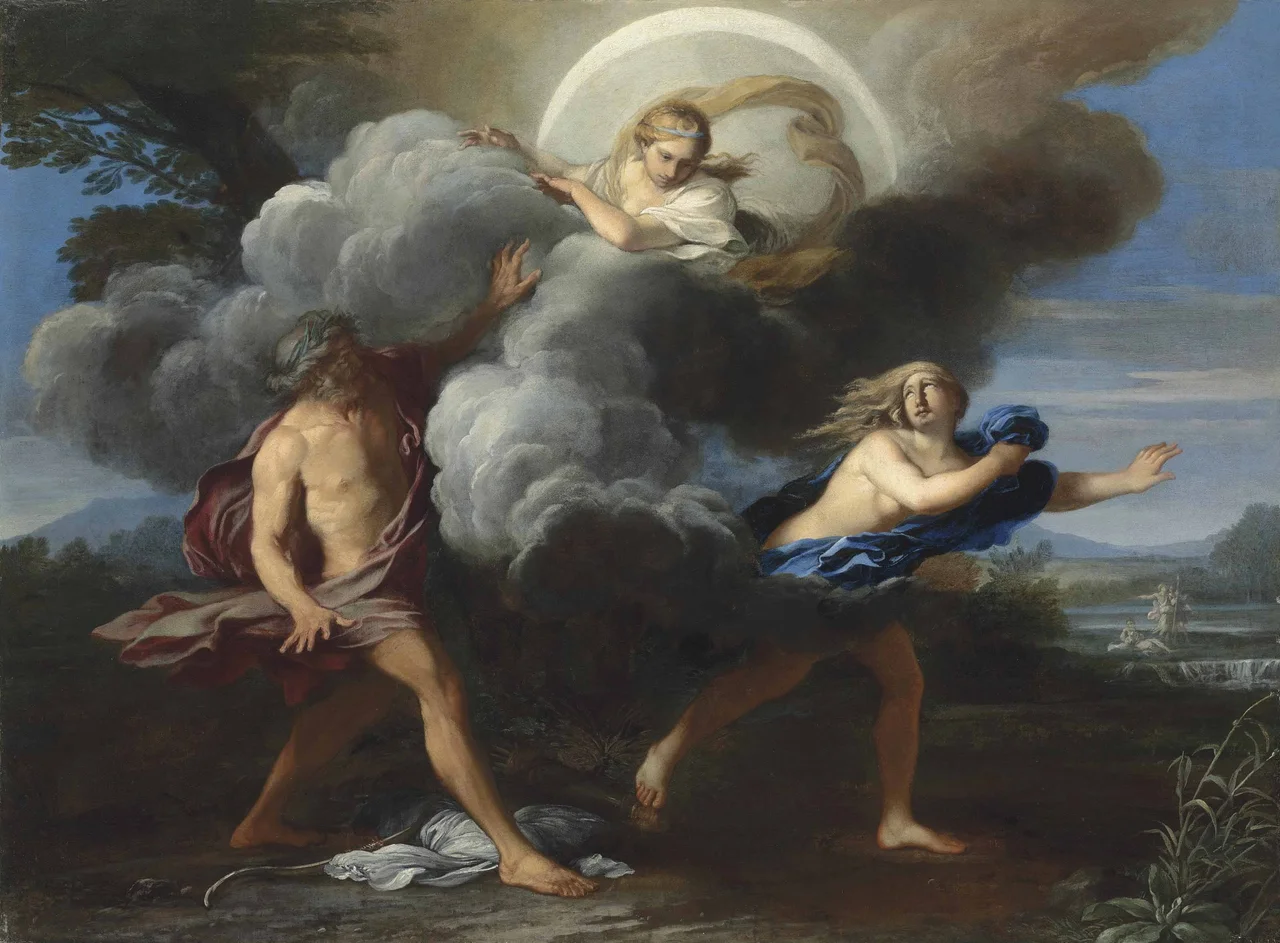
The myth that eclipses all others in the story of Alpheus is the pursuit of Arethusa. In Pausanias's version, Alpheus was a hunter who fell in love with the nymph Arethusa — and when she refused him and fled to the island of Ortygia near Syracuse, Alpheus transformed himself into a river. The stream flowed from the Peloponnese beneath the sea, crossing the Mediterranean underwater, until it emerged at Ortygia and mingled its waters with Arethusa's spring. In Ovid's telling, Arethusa was bathing in the Alpheus River in Arcadia when the river god surprised her, rising from his waters in pursuit. The goddess Artemis took pity on the fleeing nymph and transformed her into a stream that dove underground, traveling the length of the Greek world beneath the rock and sea, surfacing finally in Syracuse — where Artemis also had a temple, under the name Alphaea. Both versions arrive at the same geography: a river that begins in the Peloponnese and ends, impossibly, in Sicily.
The Belief Behind the Myth
The myth of Alpheus and Arethusa almost certainly grew from a real hydrological observation, or at least a real popular belief. The limestone terrain of the Peloponnese is riddled with sinkholes, underground rivers, and springs that emerge at unexpected points — phenomena that geologists call karst hydrology. In a world without hydrogeology, the sight of a river vanishing into the ground and reappearing elsewhere, sometimes at a spring on the coast, was mysterious and suggestive. The ancient Greeks noticed a similarity between the Alpheus's pale, whitish water and the freshwater spring at Ortygia in Syracuse — a spring famous enough to become a symbol of the city. From that observation, the myth constructed a narrative: the river's water does not merely look the same; it is the same, flowing underground all the way from Arcadia. Plutarch, writing in a different tradition, offered yet another origin story for the name: Alpheius was a son of the sun god Helios who killed his brother Cercaphus in a contest, and, tormented by grief and pursued by the Erinyes, leapt into the river Nyctimus, which then took his name. A god of rivers, it seems, required a dramatic entry into his element.
Olympia and the Shared Altar
The Alpheus River flows directly through Olympia — past the sacred precinct of Zeus, past the stadium where the ancient Games were held every four years. This was not accidental from the ancient perspective. At Olympia, Alpheus and Artemis shared a single altar, a fact noted by the ancient sources as an allusion to the river god's love for the goddess. The connection between the hunter-river and the goddess of the hunt was encoded in the very liturgical landscape of the most sacred site in the Greek world. Artemis herself had a cult name at the sanctuary of Letrini, near the coast of Elis — Artemis Alphaea — commemorating the pursuit. The myth had physical monuments: temples, altars, and cult practices that kept the story alive across centuries and linked the Alpheus's course, from the mountains of Arcadia to the sea, to the divine genealogies of the Olympian world. When you trace the Alpheus River today, from its sources in the highlands to its mouth on the Ionian coast, you are following the path a god once took — or so the ancient Peloponnesians believed.
The River That Crossed the Sea
The face of Alpheus appeared on the silver tetradrachms minted by Gelon, tyrant of Syracuse, around 485 BC. These were among the most accomplished coins produced in the ancient Greek world — beautifully engraved, wide-circulated, and explicitly mythological in their program. Putting Alpheus on Syracuse's currency was a claim: this city is founded on the story of the river that followed Arethusa beneath the sea. Syracuse's identity, projected outward through the most durable medium available, was bound to the Peloponnese by an underground current. The Alpheus River — the modern Alfeios — still runs from the mountains of Arcadia to the Ionian Sea, still pale and fast-moving in the spring melt. The spring at Ortygia in Syracuse still flows. Whether the two are connected in any geological sense is beside the point. For more than two millennia, the idea of their connection has been one of the more beautiful geographical myths in the world.
From the Air
The Alfeios River (ancient Alpheus) flows at approximately 37.61°N, 21.45°E where it crosses the coastal plain of Elis near Olympia, before reaching the Ionian Sea. From altitude, the river is one of the most prominent features of the western Peloponnese — a wide, pale channel cutting through green agricultural land, clearly visible from cruising altitude. Olympia's sacred precinct sits on the north bank of the river at approximately 37.64°N, 21.63°E. The nearest major airport is LGRX (Araxos Airport), approximately 50 km to the north along the Gulf of Patras coast. Flying at 4,000 to 5,000 feet along the river valley on a clear day, the pale limestone-laden water of the Alfeios is distinctive — living up to the ancient name that simply described what you could see.
Nearby Stories
- Aroanios 4.6 km away
- Kyparissia 4.7 km away
- Strofades 7.6 km away
- Arcadia (region) 9.1 km away
- Longanikos 9.5 km away
- HMS Perseus (N36) 21 km away
- Astras 23 km away
- St. Mark's Roman Catholic Church 34 km away