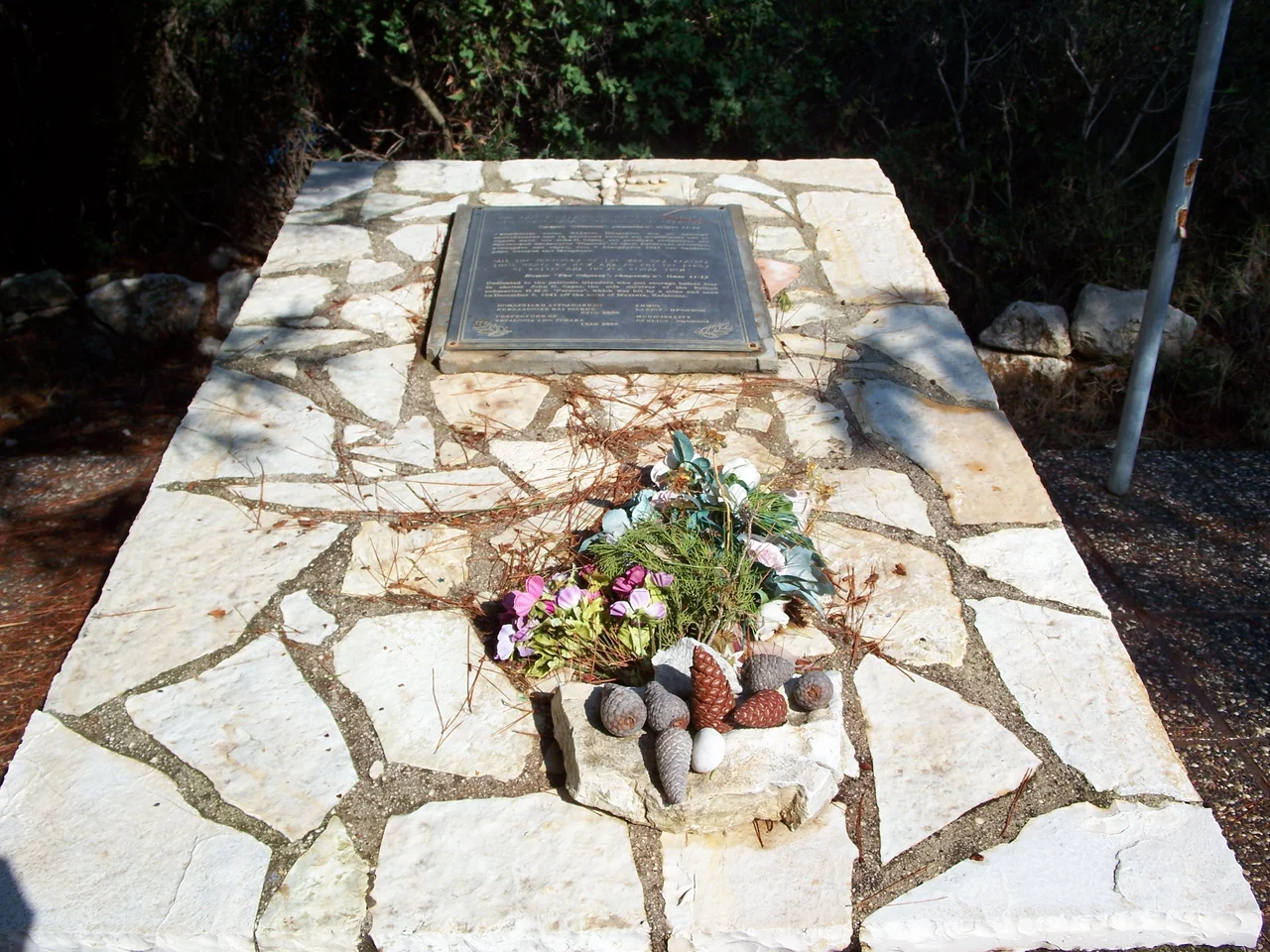

HMS Perseus (N36)
Sixty men went down with HMS Perseus on the night of 6 December 1941. The Parthian-class submarine hit an Italian mine at 10 pm while transiting the Ionian Sea north of Zakynthos, sinking quickly in 52 metres of water. Of the 61 people on board, one survived: John Capes, a 31-year-old leading stoker who was not even part of the regular crew but hitching a passage to Alexandria. His escape from the sunken wreck — using emergency gear in the dark, at depth, alone — is one of the most extraordinary survival accounts of the Second World War.
The Men and the Mission
Perseus was built at Barrow-in-Furness and launched in 1929, one of the Parthian class — submarines significant for being the first Royal Navy boats fitted with the Mark VIII torpedo. By 1940 she had been transferred from the China Station to the Mediterranean, where the strategic situation demanded everything of every vessel. Her duties included the Malta run: ferrying vital supplies to the besieged island under constant threat of air and surface attack.
By late 1941 she was attached to the 1st Submarine Flotilla at Alexandria, under Lieutenant-Commander Edward Nicolay, who had earned the Distinguished Service Order for sinking an Italian tanker and a merchant ship earlier that autumn. Perseus sailed from Malta on 26 November 1941 with orders to patrol east of Greece on her transit to Alexandria. She apparently torpedoed a target on 3 December. Three days later, in the darkness between the islands, the mine found her.
From the Seabed to the Shore
Four men attempted the escape. Capes and three others reached the engine room's Twill Trunk escape hatch and pulled on Davis Submerged Escape Apparatus — rubber breathing bags designed to carry a man to the surface from a sunken submarine. The depth was 52 metres, far beyond what the apparatus was rated for. Only Capes completed the ascent alive.
From the surface, he faced a five-mile swim in December waters to the coast of Cephalonia. He made it. Greek islanders found him and hid him, at considerable personal risk, for the next 18 months. In the summer of 1943 they smuggled him aboard a caique — a traditional wooden sailing vessel — and he reached the Turkish port of Izmir, from where he eventually returned to Britain. He received the British Empire Medal for what he had endured. The three men who died alongside him in the escape attempt, and the 57 who never left the boat, received no second chance.
Doubt and Discovery
For decades, Capes's story was treated with skepticism in some quarters. The accepted view held that a free ascent from 52 metres with the Davis apparatus was simply not survivable. Then in 1997 a Greek dive team led by Kostas Thoctarides located Perseus on the seabed, and the wreck settled the argument. The submarine lay largely intact — a starboard list, a crack near the bow from the mine impact, but her hull otherwise in good condition. The compass still pointed to her last course. The engine room escape hatch was open, exactly as Capes had described it. Divers also found the anchor of an Italian mine close to the wreck, confirming what had long been suspected about the cause.
A bottle of rum Capes said he drank from before escaping — a detail that seemed embellished in retellings — was reportedly found inside. The sea had preserved what the doubters could not: physical evidence that one man really had come out of there alive.
Remembrance
In May 2000, memorial ceremonies were held on Cephalonia over two days. Relatives of the men who died came, as did members of the Submarine Old Comrades Association. John Capes's daughter attended. So did some of the islanders who had sheltered her father, and a crew member of the caique that had carried him to safety. It was a gathering shaped by gratitude and grief in equal measure.
The wreck of HMS Perseus lies at 37.90°N, 20.90°E, between Cephalonia and Zakynthos. It is a war grave. Divers visit it, drawn by the intact state of the hull and the weight of the story attached to it. The compasses still work. The men who remained aboard are still there.
From the Air
HMS Perseus sank at approximately 37.90°N, 20.90°E, in the strait between the islands of Cephalonia and Zakynthos in the Ionian Sea. From altitude, both islands are clearly visible — Cephalonia (ICAO: LGKF) to the north, Zakynthos (ICAO: LGZA) to the south. The wreck site lies roughly 7 miles north of the northern tip of Zakynthos, in open water. Approach from the east via the Greek mainland coastline, descending toward the Ionian island chain. Visibility in this region is typically excellent in summer; winter conditions can produce low cloud over the mountains of Kefalonia. The recommended viewing altitude for both islands together is around 8,000–10,000 feet.
Nearby Stories
- Alpheus (deity) 0.8 km away
- Chavriata 4.3 km away
- Santameri Castle 17 km away
- Battle of the Echinades (322 BC) 24 km away
- Calydon 27 km away
- 2018 Ionian Sea Earthquake 34 km away
- Hellenic Trench 36 km away
- Valletta 557 km away