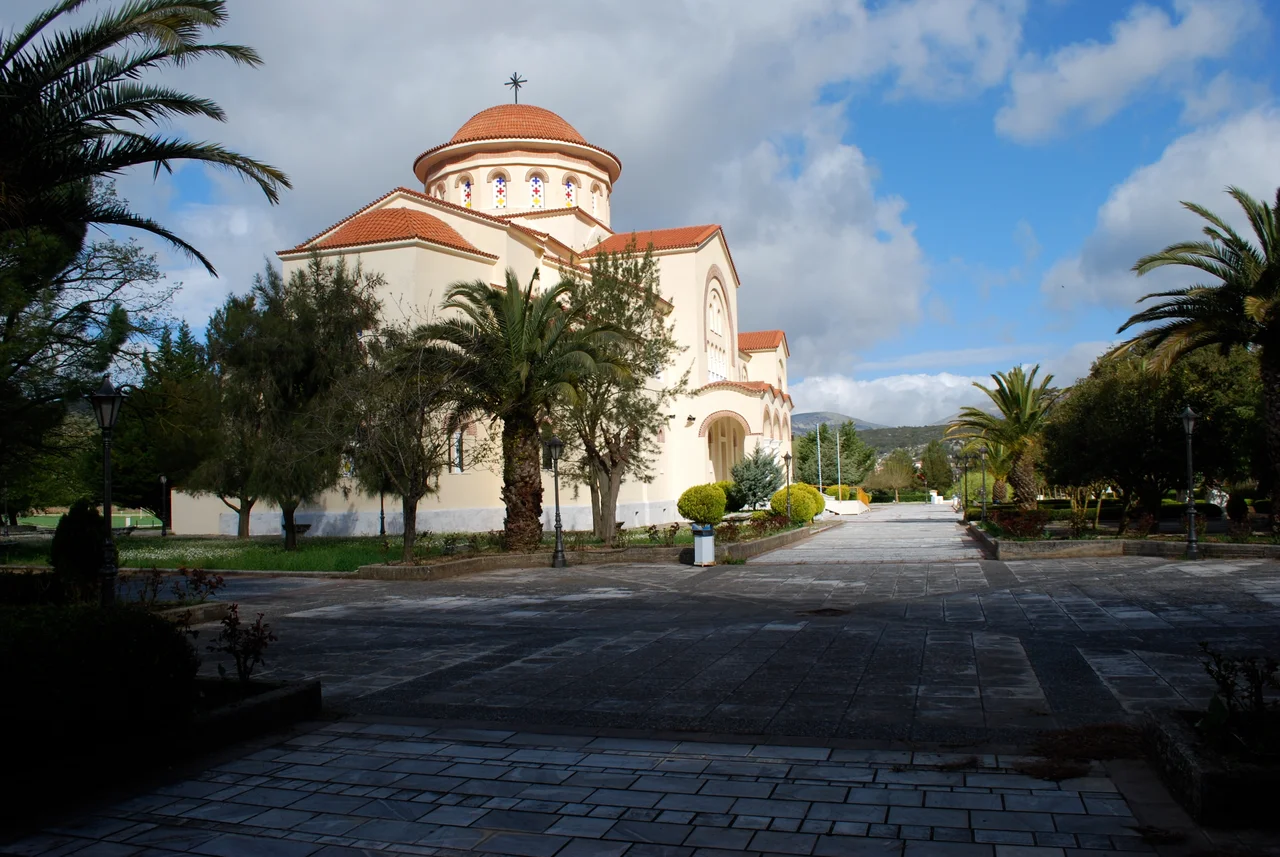

Saint Gerasimos Monastery
Twice a year, the residents of Cephalonia carry the silver reliquary of Saint Gerasimos through the streets in procession. People travel from across the island, and from the diaspora, for these feast days — 16 August and 20 October — arriving at the monastery in the plain of Omala, beneath the forests of Mount Ainos, to venerate a man who died here in 1579 and whose body, by the testimony of centuries, has not decayed. This is the spiritual centre of the island, in a way that is not merely metaphorical. When Cephalonians speak of their patron saint, the tone is familiar rather than reverential — the familiarity of a community that has been in relationship with the same protector for a very long time.
The Man Who Became a Saint
Gerasimos was born in Trikala in the Peloponnese in 1509, into a family of minor nobility. He spent years as a wandering monk, moving through the holy sites of the Orthodox world — Jerusalem, Sinai, Constantinople — before arriving in Cephalonia in the 1550s. A priest named George Valsamos granted him the use of land in the valley of Omala, and there, on the ruins of an older monastery dating to around 1200, during the era of the Crusades, he built the community that would become his home for the rest of his life.
Gerasimos established a nunnery he called New Jerusalem. He dug wells with his own hands. He planted the three large plane trees that still stand in the monastery courtyard today, four and a half centuries later. He lived in a hermitage — a narrow underground cell accessible through a passage and a nearly vertical iron staircase, barely large enough to kneel in — until his death on 15 August 1579. He was canonized by the Ecumenical Patriarchate in 1622.
The Incorrupt Relics
At the centre of the monastery's sacred life is something that defies easy categorisation in secular terms: the body of Saint Gerasimos has, by consistent testimony and examination across the centuries, remained free from the decay that follows death. The relics rest in a silver urn in the church, and pilgrims come to venerate them, to place their petitions, to seek the saint's intercession in matters of illness and misfortune.
Cephalonians particularly invoke Saint Gerasimos in cases of mental illness — a tradition with deep roots in the island's religious culture, which holds that the saint has a particular compassion for those whose minds are suffering. The monastery welcomes the afflicted alongside the merely devout. Whether one approaches this as a matter of faith or of anthropology, the continuity is striking: the same man, in the same place, venerated by the same community, for more than four hundred years.
A Place Built on Older Places
The monastery that visitors see today is the result of many layers. The original structure from around 1200 was already old when Gerasimos arrived. What he built was itself extended, damaged by earthquakes, repaired, and expanded over the subsequent centuries. The most recent rebuilding followed the catastrophic 1953 earthquake that destroyed much of Cephalonia; the monastery, like the island's other communities, had to reconstruct itself from near-ruin.
The monastery is dedicated formally to the Dormition of the Virgin Mary — a dedication carried over from the earlier structure — while simultaneously bearing the name of the saint who built it. This doubling is characteristic of how religious sites accumulate meaning over time: each layer of dedication remains present, even when a newer one seems to dominate. In the monastery grounds, the three plane trees planted by Gerasimos himself provide the most direct material link to the sixteenth century, their trunks now immense, shading the courtyard in summer.
The Valley of Omala
The monastery stands in the plain of Omala, a fertile valley at the foot of Mount Ainos — at 1,628 metres, the highest peak on Cephalonia and home to one of Greece's rare stands of Abies cephalonica, the Kefalonian fir, for which the species was named. The valley is productive agricultural land, its currant vineyards and olive groves stretching toward the mountain slopes. In summer, after the main tourist season on the coast, the valley retains a quieter working atmosphere.
The village of Valsamata, near the monastery, gave its name to the priest George Valsamos who deeded the land to Gerasimos — a small etymological circle completed over five centuries. From the monastery's grounds on a clear day, the summit of Mount Ainos is visible above the trees, the dark mass of fir forest distinguishing it from the bare limestone ridges that characterise much of the island. The saint chose well. The valley is genuinely beautiful, and the mountain above it has the quality of providing a fixed point in a landscape that has otherwise changed enormously since 1560.
From the Air
The Monastery of Saint Gerasimos sits in the Omala valley at approximately 38.166°N, 20.589°E, near the foot of Mount Ainos in the centre-south of Cephalonia. Mount Ainos, rising to 1,628 metres, is visible from altitude and identifiable by its darker forested slopes. The monastery itself is a white-walled compound in the broad green valley floor. Nearest airport: Kefalonia International Airport (LGKF), approximately 18 km to the south, on the island's southern coast near Argostoli.
Nearby Stories
- Glarentza 5 km away
- The Septinsular Republic 5.8 km away
- Battle of the Echinades (322 BC) 8.1 km away
- Hellenic Trench 19 km away
- Ionian Islands 22 km away
- Stratos 27 km away
- Achilleion (Corfu) 119 km away
- Corfu 153 km away