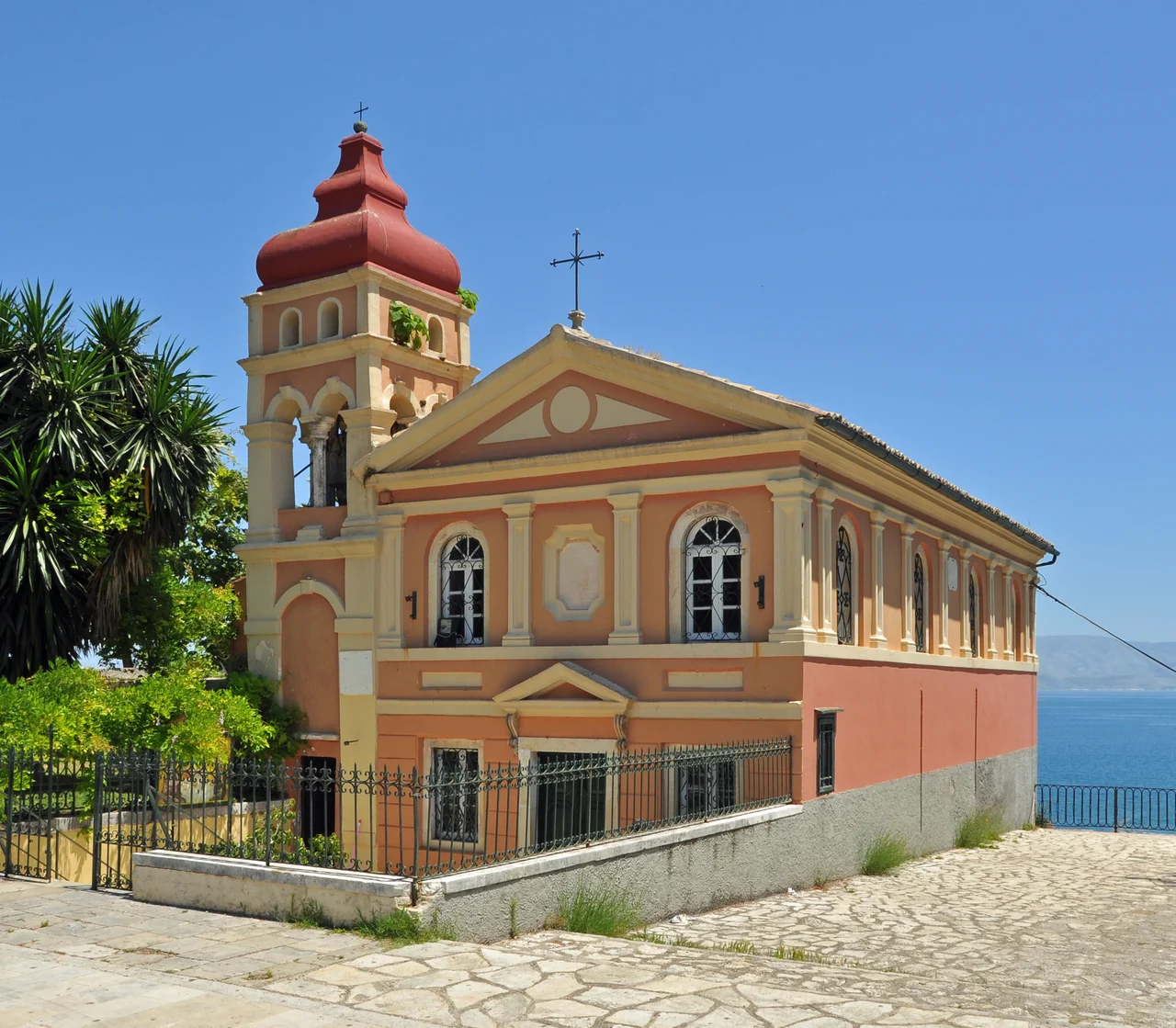

The Septinsular Republic
The fall of Venice in 1797 left seven Ionian islands suddenly without a master. The French took them briefly, long enough to abolish the local nobility, install printing presses, and introduce the revolutionary idea that ordinary people should govern themselves. Then the French left too, evicted by a joint Russian and Ottoman fleet in 1798 and 1799. What followed was something no one had quite expected: the creation, in 1800, of the first self-governing Greek state since the Ottoman conquest of Constantinople in 1453. It was called the Republic of the Seven United Islands — the Septinsular Republic — and it lasted just seven years. Those seven years, turbulent and constitutionally inventive, changed the course of Greek history.
Centuries Under Venice, Then a Door Flew Open
The Ionian Islands — Corfu, Paxoi, Lefkada, Cephalonia, Ithaca, Zakynthos, and Kythira — had been Venetian possessions for centuries, the only part of the Greek world to escape Ottoman conquest. They were a place of unusual cultural exchange, described by historians as 'Greek culture's window on the West,' through which Italian Renaissance ideas, Catholic church architecture, and eventually Enlightenment thought filtered into the wider Greek world. Under Venice, society was strictly stratified: a hereditary nobility, an urban merchant class, and a rural peasantry who had little say in anything. The nobility ran everything; the commoners endured. When the French arrived in 1797 and abolished noble titles overnight, the commoners were exhilarated. The French installed the islands' first public education system and brought in the first printing presses in what is now Greece. For two years, the old order was simply gone.
A Republic Born of Compromise and Disappointment
The Ionian islanders had been promised the right to choose their own form of government. The Ecumenical Patriarch of Constantinople himself had issued a proclamation to that effect. What they received instead was considerably less. The Treaty of Constantinople of 1800, concluded between Russia and the Ottoman Empire, created the Republic of the Seven United Islands — but as a vassal state paying an annual tribute of 75,000 piastres to the Ottoman Sultan, and under heavy de facto Russian influence. The new constitution, the so-called 'Byzantine Constitution,' reinstated the nobility, reversed the gains of the merchant class, and restored something close to the old Venetian order. The Lion of Saint Mark returned to the flag, holding a bundle of seven arrows. Suggestions that the flag include a rising phoenix — a more revolutionary symbol — were rejected. It was, in the words of the era, a disappointment. The islanders had wanted a republic of equals. They received an aristocratic federation controlled from abroad.
Seven Years of Rebellion and Constitution-Writing
The Republic's short life was anything but quiet. In Cephalonia, armed mobs seized the government house in Argostoli in August 1800. Class rivalries between the rival towns of Argostoli and Lixouri fuelled successive revolts; the young Ioannis Kapodistrias — later the first governor of independent Greece — cut his political teeth here, mediating between factions and drafting compromises. In Zakynthos, the island actually seceded briefly in February 1801, raising the British flag instead of the Republic's, and was only brought back into line when Ottoman and British warships appeared offshore. A 64-member 'Honourable Deputation' of common people and merchants in Corfu drafted an alternative constitution proposing a 240-member council of citizens elected by general suffrage. In 1803, a new constitution of 212 articles was passed — including jury trials, personal liberties, and a clause requiring Greek to become the sole language of administration by 1820. Three years later, Russian pressure produced a third constitution, more restrictive than its predecessor.
The Men Who Shaped What Came Next
The Septinsular Republic served as a crucible for figures who would define modern Greece. Ioannis Kapodistrias arrived as an imperial commissioner in 1800 and left as one of the most skilled diplomats in Europe, eventually becoming Greece's first head of state after independence. It was on Lefkada in 1807 — during the defence of the island against Ali Pasha of Yanina's forces — that Kapodistrias first met the klepht captains who would later command the Greek War of Independence: Katsantonis, Kitsos Botsaris, and most notably Theodoros Kolokotronis. The Republic's 'Greek Legion,' raised from Souliot refugees and other mainland Greeks who had fled to the islands, fought at Naples in 1805. The Republic introduced Greek as a language of official record, and intellectuals like Adamantios Korais dedicated works to it. In seven fractious years, it laid the institutional groundwork for the state that would eventually emerge in 1821.
Tilsit, Napoleon, and the End
The Republic's fate was decided not in the Ionian but at Tilsit, in East Prussia, in July 1807, where Napoleon and Tsar Alexander I met on a raft in the middle of the Niemen River and divided Europe between them. The Ionian Islands, ceded to France, passed out of Russian control. French troops landed on Corfu on 20 August. General César Berthier, contrary to his own instructions to preserve the Islands' constitution, declared the annexation of the Septinsular Republic to France on 1 September 1807. The Republic had lasted seven years and three constitutions. The British occupied most of the islands between 1809 and 1814, and eventually the islands became the 'United States of the Ionian Islands' under British protection — before finally uniting with the Kingdom of Greece in 1864. But the Septinsular Republic was the beginning. For the first time since 1453, Greeks had governed themselves. The experiment, however imperfect, proved it was possible.
From the Air
The Septinsular Republic encompassed seven islands stretching roughly 300 km from Corfu in the north to Kythira in the south. The central islands — Lefkada, Cephalonia, Ithaca, and Zakynthos — lie in the core of the Ionian Sea. Coordinates for the historical capital, Corfu town: 39.62°N, 19.92°E. Lefkada, the island most directly involved in the Republic's military crisis of 1807, sits at approximately 38.72°N, 20.65°E. The nearest major airport for this region is LGPZ (Aktion National Airport near Preveza), on the mainland coast east of Lefkada, which served as an ancient crossroads between these island territories and the Greek mainland. Flying south from Corfu toward Lefkada at 8,000–12,000 feet, the chain of Ionian islands is visible stretching away to the south, each one a separate political entity in the Republic's federal structure.
Nearby Stories
- Battle of the Echinades (322 BC) 2.4 km away
- Cephalonia 6.3 km away
- Battle of Olpae 12 km away
- Battle of Preveza (1911) 18 km away
- Oeniadae 21 km away
- Hellenic Trench 58 km away
- Achilleion (Corfu) 80 km away
- Corfu 114 km away