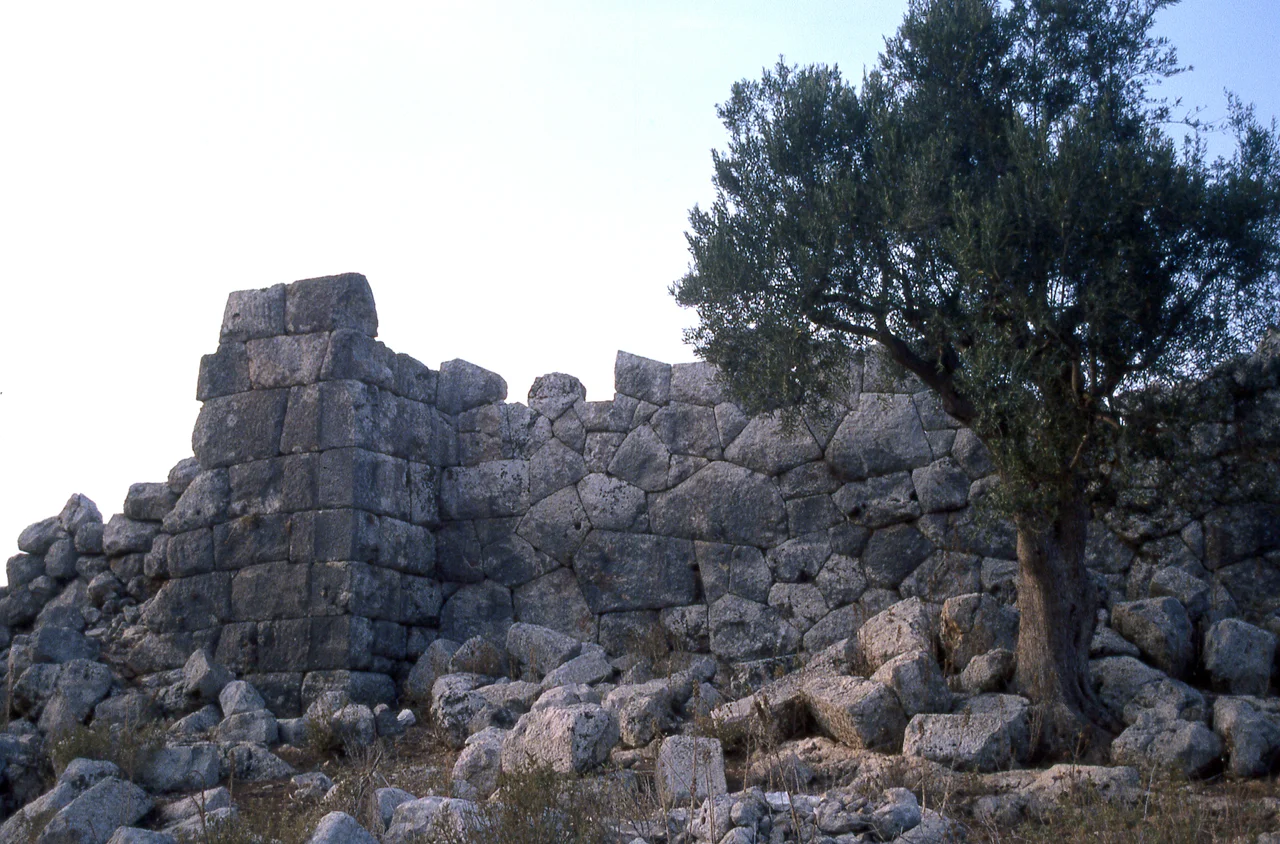

Oeniadae
Pericles came here with the full might of Athens and went home empty-handed. In 454 BCE, the most powerful statesman in the Greek world laid siege to Oeniadae, a fortified Acarnanian town on the west bank of the Achelous River — and could not take it. The marshes that surrounded the site on all sides made it inaccessible by land in winter, and the town's natural defenses proved stronger than Athenian ambition. Pericles withdrew. Oeniadae stood.
A City Named for a Mythic King
Oeniadae takes its name, according to ancient tradition, from Oeneus — the mythical king of Calydon, hero of Aetolian legend, whose family tree tangled with Troy, with Meleager and the Calydonian Boar, and with the wine-dark origins of this whole region. The town occupied a commanding position at the southwest corner of ancient Acarnania, set back about 16 kilometers from the mouth of the Achelous River. Its territory, the district called Paracheloitis, extended on both sides of the river and was unusually fertile. The marshes surrounding the settlement were not merely a nuisance for attackers; in winter they were impassable, making the town effectively an island without being one. Its site is near the modern village of Trikardo, in the same landscape of river delta and wetland that defined it in antiquity.
Against Athens, Against Everyone
Oeniadae enters the historical record around 455 BCE, when Messenian exiles settled at Naupactus by Athens attacked and briefly held the town, before the Acarnanians drove them out. Athens at that point regarded Oeniadae as an enemy — one reason the Messenians had targeted it. Pericles tried and failed to reduce the town in 454 BCE. During the Peloponnesian War, Oeniadae was the only Acarnanian town besides Astacus to side with Sparta rather than Athens. In 429 BCE, the Athenian admiral Phormion led an expedition into Acarnania and chose not to march on Oeniadae at all — it was winter, and the marshes made the attempt pointless. The following year Phormion's son Asopius sailed up the Achelous and ravaged the surrounding territory but could not take the town itself. It was not until 424 BCE that the Athenian general Demosthenes, working alongside Acarnanian allies, finally compelled Oeniadae to join the Athenian alliance. The town had held out against Athens for thirty years.
Between Macedon, Aetolia, and Rome
After the classical period, Oeniadae passed through several hands. In the time of Alexander the Great, the Aetolians expanded their power to the west bank of the Achelous and seized the town, expelling its inhabitants with what the sources describe as exceptional cruelty — harsh enough that Alexander threatened them with retribution, though he died before acting on it. The Aetolians held Oeniadae until 219 BCE, when Philip V of Macedon took it, recognized its strategic importance, and began fortifying the citadel and connecting it to the harbor and arsenal with defensive walls. In 211 BCE the Romans under Marcus Valerius Laevinus captured the town and gave it to their Aetolian allies. By 189 BCE, after the peace following the Roman-Seleucid War, it was returned to the Acarnanians. After that, Oeniadae fades from the historical record — still present in the time of Strabo, but diminishing.
The Ship-Sheds Carved in Stone
What makes Oeniadae unusual among ancient sites is not its walls or its political history but its shipsheds: structures cut from the living rock to shelter warships. These neosoikoi, carved into the hillside above the harbor, are among the best-preserved ancient shipsheds in the Greek world. They demonstrate that Oeniadae was not simply a land fortress but a naval base of real consequence — able to build, shelter, and deploy ships on the Achelous and into the Gulf of Patras beyond. Philip V of Macedon recognized this when he began connecting the arsenal to the citadel. The ruins visible near Trikardo today include the shipshed complex, the circuit walls, and portions of the harbor infrastructure that once made this backwater town a place serious commanders could not ignore.
What the Marshes Preserved
The same seasonal flooding that made Oeniadae impregnable to winter campaigns has contributed, in a perverse way, to the preservation of its ruins. The wetland landscape around the Achelous delta has limited modern development, leaving the archaeological site relatively intact. The area near Trikardo, where Oeniadae's remains lie, is still wetland at its edges — the river still floods, the land is still low. Archaeologists have documented the walls, the harbor, the shipsheds, and the street layout of a town that fought Athens, frustrated Alexander's allies, and outlasted several empires before quietly disappearing from the record. In a region dense with ancient sites, Oeniadae stands out for the specificity of what it left behind.
From the Air
Ancient Oeniadae is located at approximately 38.409°N, 21.196°E, near the modern village of Trikardo in the Achelous River valley of western Greece. From the air at 3,000–4,000 feet, the broad Achelous River delta is the dominant feature — the river meanders south through flat agricultural and wetland terrain before reaching the Gulf of Patras. The ruins are not visible to the naked eye at altitude, but the landscape of the lower Achelous valley, with its seasonal flooding and marshy edges, is exactly as described in ancient sources. The nearest major airport is LGRX (Araxos), approximately 70 kilometers to the southeast along the Gulf of Patras coast. Missolonghi and its lagoon are visible roughly 25 kilometers to the south-southeast.
Nearby Stories
- Taphians 2.4 km away
- Nafpaktos 3.2 km away
- Ithaca (island) 6.6 km away
- Achaea (Ancient Region) 8.5 km away
- Battle of Manolada 13 km away
- Castle of Saint George, Cephalonia 17 km away
- Acarnania 18 km away
- Greece 41 km away