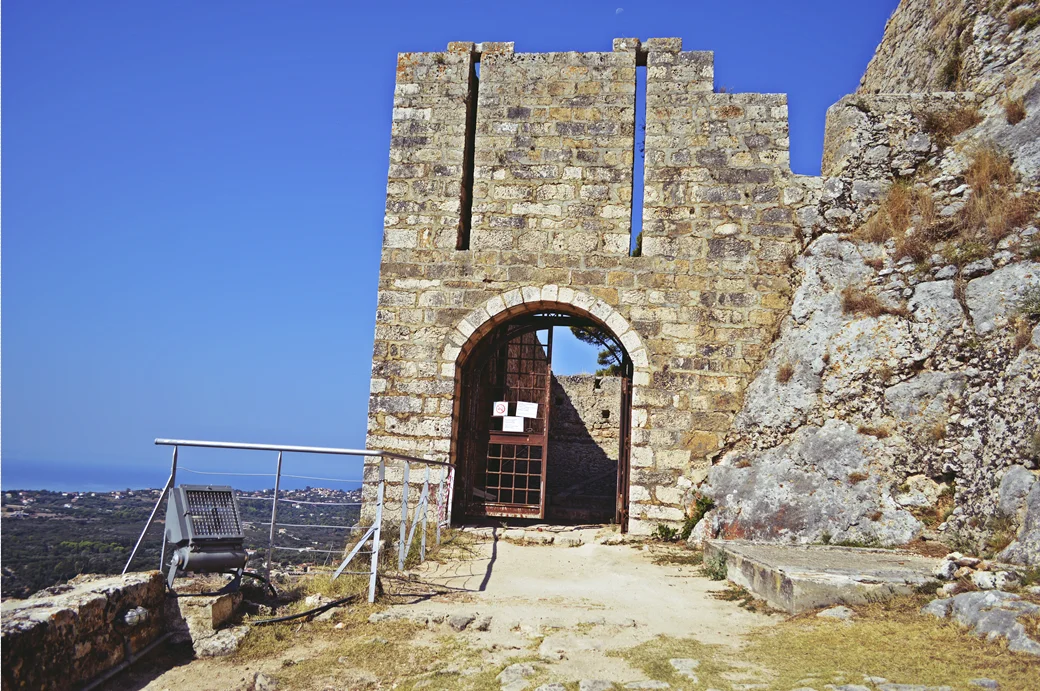

Castle of Saint George, Cephalonia
Robert Guiscard, the Norman duke who had terrorized Byzantium for decades, came to Cephalonia in 1085 and died here. His son Roger Borsa had brought the Italo-Norman army to besiege the Castle of Saint George, the Byzantine fortress on a 320-metre limestone hill in the island's southwest. The siege failed. Malaria, not Greek defenders, broke the Norman force, and Guiscard — one of the most feared military commanders in Europe — died on the island he had come to conquer. The castle held. This would become a pattern: the Castle of Saint George held, or was taken, or was lost, or was rebuilt, across six centuries of Ionian history, outlasting every power that thought it owned it.
The View That Made It Valuable
The castle's location explains its entire history. Set on a limestone ridge 320 metres above sea level in southwestern Cephalonia, it commands the fertile Livatho valley below and the Bay of Livadi to the south — the island's main anchorage and therefore its strategic heart. From the walls, any fleet approaching or leaving the island is visible. The village of Kastro, the modern name for the settlement that grew around and below the fortress, still sits in the shadow of those walls today, about 7 km southeast of the present capital, Argostoli.
The Muslim geographer al-Idrisi visited the island and the castle town in the middle of the 12th century and described both as flourishing. His account is one of the earliest outside Byzantine sources for the castle's character as a genuine urban settlement, not merely a military installation. People lived here, traded here, were born and buried here.
Besieged, Captured, and Reshaped
The castle's documented history begins in 1085 with the failed Norman siege. In 1099, a Pisan fleet under Dagobert of Pisa — on its way to the Holy Land — raided the island but could not take the fortress. Then in 1125 or 1126, a Venetian fleet succeeded where the Normans and Pisans had not: the castle fell. The capture had immediate diplomatic consequences. The Byzantine Emperor John II Komnenos was compelled to reconfirm the trading privileges that his predecessors had granted to Venice in 1082 — the Venetians used the castle as leverage. They also took something more personal: the relics of Donatus of Euroea, which they transported to the church of Santa Maria e San Donato in Murano.
The castle was formally named after Saint George for the first time in a document of 1264, the name derived from a small church inside the original Byzantine fortification. In the later 14th and early 15th centuries, it became the residence of the Tocco family, rulers of both the county palatine of Cephalonia and Zakynthos and the Despotate of Epirus on the Greek mainland. The Tocco rebuilt and expanded the castle to serve as a proper feudal court. An earthquake in 1469 caused heavy damage. The castle recovered. It always recovered — until the Ottomans came.
The Ottoman Sack and the Venetian Reconstruction
In August 1479, Ottoman forces captured the island, besieged the fortress, and killed most of the garrison. The surviving inhabitants were carried off to resettle Constantinople. The fortress sat in Ottoman hands, emptied of its people, for two decades.
In 1500, the Venetians besieged and retook it after three months of fighting that left the castle extensively damaged. What followed was one of the most significant construction efforts in the island's history: from 1504 to 1594, Venetian engineers rebuilt the castle on a larger scale, adding three bastions outside the main enceinte, which now measured 600 metres in perimeter. A settlement grew inside the walls. By the time of a census in 1583, the castle and its borgo outside the walls together held 859 inhabitants. The 16th-century Castle of Saint George was an urban fortress — not a military outpost but a town, with houses, churches, cisterns, barracks, storage rooms, and gunpowder stores all packed within its walls.
Gradual Abandonment and What Survives
In 1757, the Venetians moved the administrative seat of the island to Argostoli, the coastal town on the western bay that offered better harbor facilities. The castle settlement began to empty out, slowly at first, then more decisively. World War II caused further damage. The 1953 Ionian earthquake — which devastated much of Kefalonia — shook the walls again.
What survives today is substantial. The Venetian-era enceinte, with its single gate and three bastions, stands in good condition. So do the garrison chapel dedicated to the Virgin Mary, the Roman Catholic church of Saint Mark, the Greek Orthodox church of Saint Nicholas, the Venetian provveditore's residence, barracks, cisterns, and gunpowder stores. A small portion of the original Byzantine walls also survives. The castle is open to visitors, and the views from the walls — over the Livatho valley, toward the bay, across the hills of Cephalonia — are the same views that made this hill worth fighting for in 1085, and again in 1126, and again in 1479, and again in 1500.
From the Air
The Castle of Saint George is located at approximately 38.139°N, 20.553°E on a prominent limestone ridge in southwestern Cephalonia, Greece. From the air, the fortified hilltop is clearly visible above the village of Kastro, roughly 7 km southeast of Argostoli. The Livatho valley spreads below the castle to the north, and the Bay of Livadi is visible to the south — the same strategic geography that made this site so contested for centuries. Nearest airport: LGKF (Kefalonia International Airport, Argostoli), approximately 9 km to the northwest. Recommended viewing altitude: 2,000–3,500 ft for the best view of the castle's relationship to the valley, bay, and surrounding Cephalonian terrain.
Nearby Stories
- Myrtos Beach 3.7 km away
- Oeniadae 13 km away
- Glarentza 14 km away
- Panagia Skafidia Monastery 23 km away
- Hellenic Trench 29 km away
- St. Mark's Roman Catholic Church 29 km away
- Achilleion (Corfu) 139 km away
- Valletta 535 km away