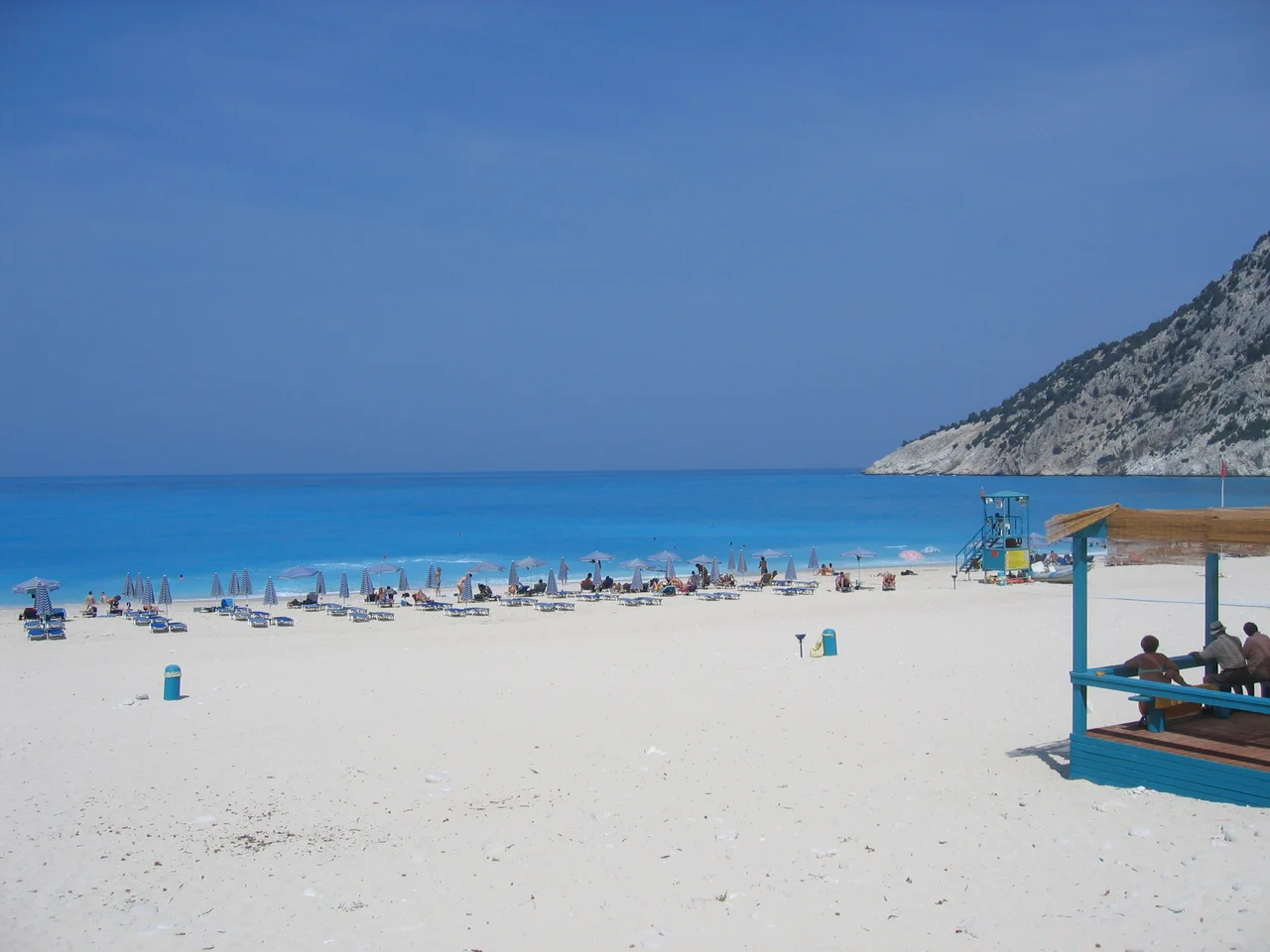

Myrtos Beach
The road down to Myrtos Beach is a 2-kilometre series of hairpin turns carved into the cliff face above the water. From the top, before you descend, you can see the whole beach at once — a white arc about 800 metres long, framed on both sides by steep headlands, with water so turquoise it looks wrong, like a travel poster rather than a real place. The descent concentrates the view, turn by turn, until you arrive at the bottom and discover that it is real: the pebbles actually are that white, the water actually is that colour, and the mountains pressing in from both sides actually do create the feeling of being inside something dramatic and specific to this coast.
Marble in Every Direction
Myrtos Beach is a product of its geology. The surrounding landscape is largely composed of marble — metamorphosed limestone that breaks down over time into the round, white cobblestones that cover the beach. Near the water's edge the stones grade down from cobbles to pebbles, the result of wave energy acting on the steep slope at the shoreline's edge, where an abrupt drop in the sea floor concentrates the force of each wave. As those waves sweep along the beach they carry with them the finest particles of marble dust, creating turquoise sediment plumes that follow the curve of the shore. The colour of the water at Myrtos is not a trick of the light; it is the accumulated geology of the Agia Dynati and Kalon Oros mountains dissolving into the sea.
Two Mountains and a Bay
Myrtos lies in the region of Pylaros, in the northwest of Cephalonia, in a bay enclosed between two mountains: Agia Dynati to the north and Kalon Oros, which rises to 901 metres, to the south. The mountains do not just provide the scenic framing that makes the beach so photogenic; they also channel the waves. Longshore drift shapes the shoreline over time as currents push along the coast, gradually redistributing the marble material and maintaining the characteristic arc of the beach. The headlands shelter the bay from certain wind directions while exposing it fully to others, and the wave energy on a rough day can be considerable. Myrtos is beautiful, but it is not always calm.
Famous Enough for Film
Myrtos Beach has appeared in numerous best-beach lists — it has been described as one of the most dramatic beaches in Greece, with its 800-metre arc of dazzling white pebbles — but its most specific claim to cinematic fame is a scene from the 2001 film Captain Corelli's Mandolin, in which the beach was used as the location for a mine explosion sequence. The film was based on Louis de Bernières' 1994 novel set on Cephalonia during the Italian and German occupation of World War II. That the production chose Myrtos for a scene of devastation rather than romance speaks to the way the beach's drama can cut both ways — it is not simply pretty but genuinely monumental, the kind of landscape that can hold weight.
Getting There
The village of Divarata sits at the top of the road that descends to Myrtos, and the hairpin approach — roughly 2 kilometres of switchbacks — is itself a kind of experience. Arriving by private car, you park at the base of the cliffs. Tavernas in Divarata serve food above, looking down over the beach from a height that makes the white arc below look almost abstract. During the summer high season the municipality of Pylaros runs a public bus service from Agia Efimia harbour to the road above the beach, with a short walk down. For a beach this famous the infrastructure is deliberately limited, which helps it remain something to seek out rather than simply stumble into.
From the Air
Myrtos Beach lies at 38.34°N, 20.54°E on the northwest coast of Cephalonia, between the mountains Agia Dynati and Kalon Oros. From the air at 2,000–4,000 feet, the white crescent of pebbles is strikingly visible against the dark blue of the Ionian Sea — one of the most recognisable coastal features in Greece from altitude. The mountains flanking the bay create a distinct V-shaped gap in the coastal ridge. The nearest airport is LGKF (Kefalonia International Airport), approximately 35 km south by road. Pilots should be aware of potentially turbulent airflow around the mountain ridges flanking the beach, particularly in northwesterly winds.
Nearby Stories
- Castle of Saint George, Cephalonia 1.4 km away
- Italian torpedo boat Sagittario (1936) 5.9 km away
- Oeniadae 8.9 km away
- Glarentza 23 km away
- Battle of Olpae 31 km away
- Hellenic Trench 39 km away
- Achilleion (Corfu) 100 km away
- Corfu 133 km away