
Battle of Olpae
The battle was won, but Demosthenes did not take the city. He could have. By the end of two days of fighting near the fort of Olpae in 426 BC, the Ambraciot army had suffered roughly a thousand dead, the Spartan commander Eurylochus had been killed in the fighting, and the surviving Peloponnesian officers were negotiating their own escape from a situation that had collapsed around them. Ambracia lay open. The Acarnanians and Amphilochians, Demosthenes's local allies, said no. They did not want a powerful Athens controlling the Ambracian Gulf any more than they wanted Sparta there. The result was a hundred-year peace treaty — a negotiated settlement where a victory could have produced an occupation. Demosthenes had shown what his army could do. He had also shown that strategy meant knowing when to stop.
Into the Gulf
In 426 BC, three thousand hoplites from Ambracia invaded Amphilochian Argos in Acarnania and occupied the fort of Olpae, a position on the Ambracian Gulf. Ambracia was a Corinthian colony and a Spartan ally; taking Olpae was part of a plan to extend Peloponnesian influence over the northwest Greek coast, a region Athens had been working to bring under its control. The Acarnanians, whose territory was being invaded, sent for help — both to Demosthenes, the Athenian general, and to twenty Athenian ships operating nearby under the commanders Aristotle and Hierophon. Meanwhile, the Ambraciots made their own appeal for reinforcement. Eurylochus of Sparta marched his army through Acarnanian territory without being detected — a significant accomplishment that gave the Peloponnesian side a larger combined force. The two armies faced each other across a ravine, and both spent five days making preparations.
The Ambush That Turned the Battle
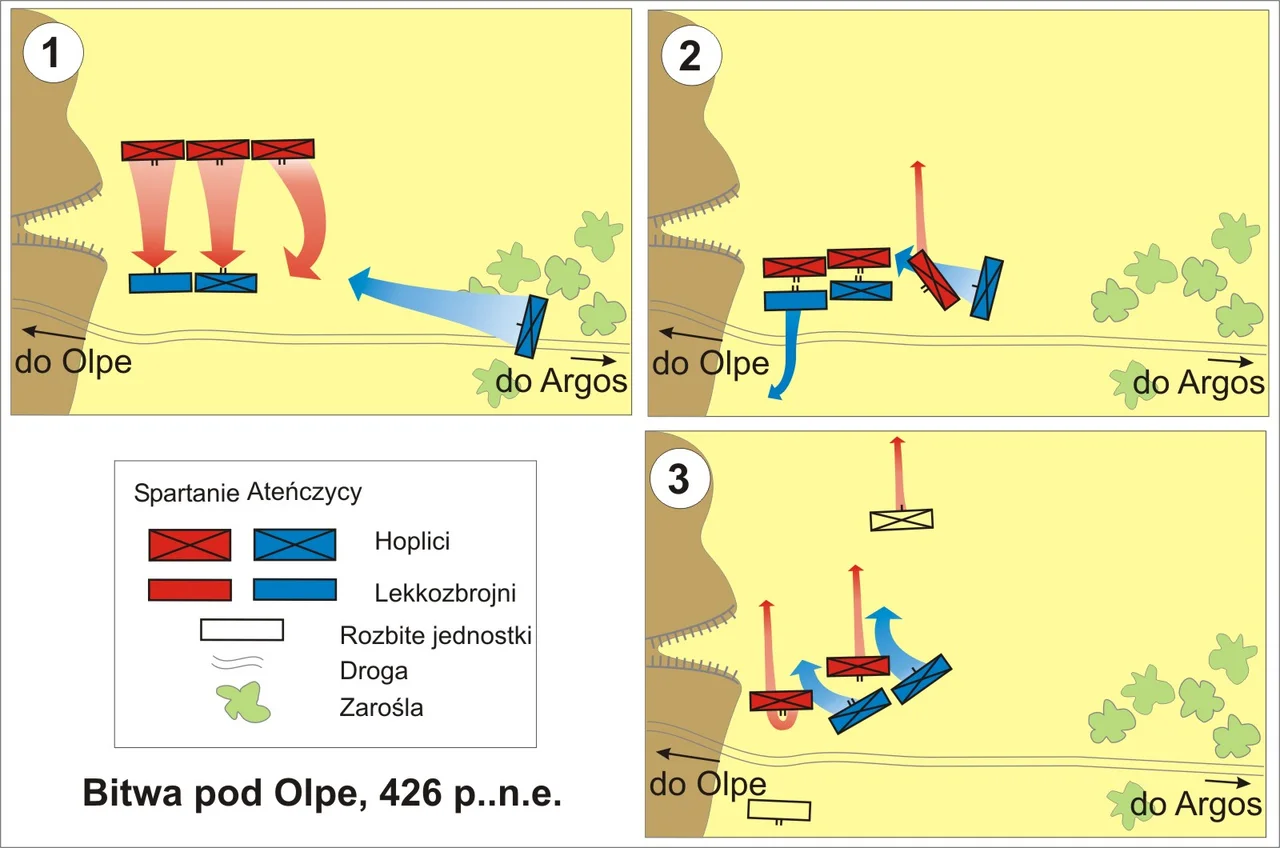
Demosthenes understood that his army was outnumbered. He responded by concealing four hundred Acarnanian hoplites in the terrain before the battle began, ready to emerge when the fighting was underway. When the lines engaged, Eurylochus moved his left wing outward to try to envelop Demosthenes's right — a maneuver that was working, threatening to surround the Athenian and Messenian troops, when the hidden Acarnanians broke cover and struck. The sudden attack from an unexpected direction caused panic through the Peloponnesian formation. Eurylochus was killed in the fighting. On the other side of the field, the Ambraciots had actually defeated the Acarnanian and Amphilochian left wing, driving it back toward Argos — but when those Ambraciot troops turned and found the rest of the army in chaos, they were themselves defeated on their return. The battle ended after dark, with Demosthenes's forces victorious. About three hundred of his men had died in the fighting.
A Calculated Disgrace
Menedaius, the Spartan officer who took command after Eurylochus fell, came to Demosthenes the next day to arrange terms. Demosthenes agreed to let the Spartan and Peloponnesian commanders escape — but publicly, ostentatiously, while the Ambraciot rank and file were refused the same terms. This was deliberate. As Thucydides recorded, Demosthenes intended "to discredit the Lacedaemonians and Peloponnesians with the Hellenes in those parts, as traitors and self-seekers." Allowing Spartan officers to save themselves while abandoning their Ambraciot allies was the message. Some Ambraciots tried to slip away with the Peloponnesian column; the Acarnanians, who had agreed to let Menedaius go, chased the rest and killed around two hundred. The surviving Ambraciots and Peloponnesians found shelter with Salynthius, king of the Agraeans, in neighboring territory.
The Night at Idomene
Before Demosthenes could consolidate his position, a second Ambraciot army was already marching toward Olpae from the city, unaware of what had happened. They camped at Idomene on the road to the fort. Demosthenes moved at night, sending an advance force to hold the higher ground, then following with his main army. In the darkness, he had his troops approach calling out the same watchword as the Ambraciot army — creating enough confusion that the sentries delayed raising an alarm. The surprise was nearly total. Most of the second army died at Idomene; those who survived fled into the hills or into the sea, where the twenty Athenian ships were waiting. By the time the two days of fighting were finished, Ambracia had lost around a thousand men in total. Thucydides would describe the losses as among the worst suffered by a single Greek city in the entire Peloponnesian War.
The Peace That Followed
Demosthenes's allies refused to let him press further. The Acarnanians and Ambraciots — despite having been enemies days before — signed a hundred-year peace treaty. The Acarnanians' reasoning was straightforward: they did not want Athens to become the dominant power in the gulf any more than they had wanted Sparta. The treaty bought them security without trading one master for another. Demosthenes returned home with his ships and his victory, having reshaped the strategic situation in northwestern Greece without acquiring the territory that might have made Athens dangerous there. The fort of Olpae and the fields around it returned to the quiet they held before the armies arrived. What remained was the outcome: Ambracia shattered, Sparta embarrassed, and a hundred-year commitment to peace signed among people who had just been killing each other.
From the Air
The Battle of Olpae took place at approximately 38.95°N, 21.15°E, near the Ambracian Gulf in western Greece — the same body of water that gives the action its geographic context. The nearest airport is LGPZ (Aktion National Airport), about 20 km to the west-northwest, where the gulf narrows toward its opening into the Ionian Sea at Preveza. From altitude, the Ambracian Gulf is one of the most recognizable features of the western Greek coast — a large, nearly enclosed lagoon connected to the sea by a narrow passage. The fort of Olpae stood on the southern shore; the plain of Amphilochian Argos lay further east along the same shoreline. Flying at 6,000–8,000 feet provides a clear view of both the gulf and the hill country to the east where Eurylochus marched his army without being detected. Summer visibility across this section of western Greece is typically excellent.
Nearby Stories
- Battle of Preveza (1911) 1.8 km away
- Stratos 4.1 km away
- 2015 Lefkada Earthquake 12 km away
- Cichyrus 18 km away
- Greece 19 km away
- Karditsa 21 km away
- Saint Augustine of Hippo and Seraphim of Sarov Monastery 26 km away
- Phaneromeni Monastery, Lefkada 29 km away