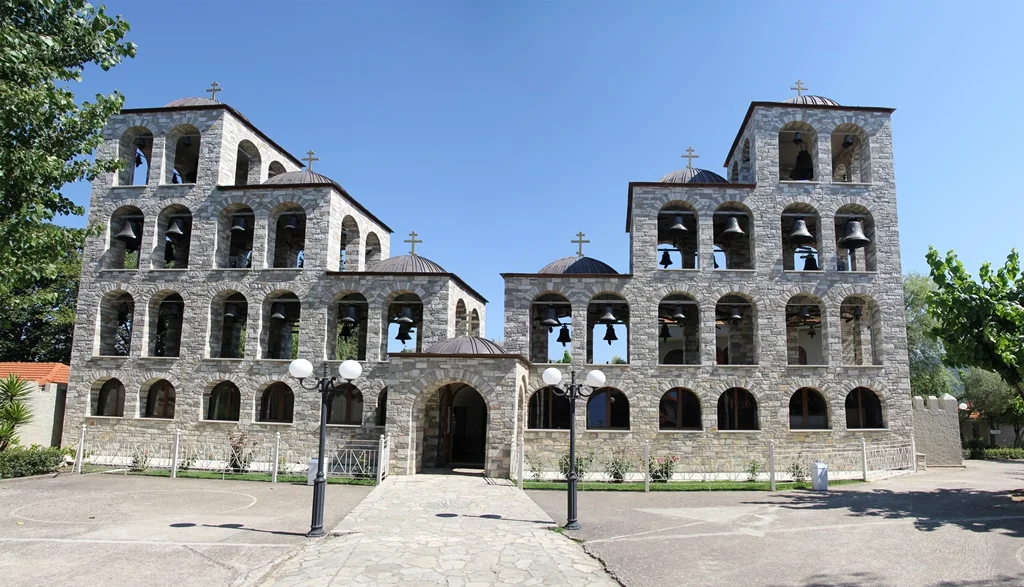

Saint Augustine of Hippo and Seraphim of Sarov Monastery
Saint Augustine of Hippo died in 430 AD in North Africa, watching the Vandals besiege his city. Saint Seraphim of Sarov died in 1833 in Russia, kneeling before an icon. The two men lived fourteen centuries apart, spoke different languages, belonged to what became different branches of Christendom, and never could have imagined being commemorated together in a monastery on a Greek mountain above the Gulf of Corinth. Yet here, in the hills northeast of Nafpaktos, they share an altar.
Two Saints, One Mountain
The monastery's dedication is its most distinctive feature — and its most deliberate theological statement. Saint Augustine of Hippo is the towering intellectual of the Western Latin Church, the author of the Confessions and The City of God, canonized in the Catholic tradition and increasingly recognized in Orthodox circles. Saint Seraphim of Sarov is one of the most venerated figures in Russian Orthodoxy, a 19th-century monk and mystic known for his gentleness, his gift of healing, and the famous instruction to seek inner peace as the root of all spiritual transformation. Placing them together in an Orthodox monastery in Greece is not an accident of convention — it is a statement about the wholeness of the Christian tradition, East meeting West in a shared dedication.
How It Began
The monastery's history begins not with monks but with children. In 1984, Archimandrite Nektarios Moulatsiotis returned to the village of Trikorfo in Phocis with the intention of building Christian youth camps. The land was there; the idea was to create a place where young people could spend summers in the mountains. The monastery itself followed: the first monks arrived in 1991, and the community began to take formal shape. On August 15, 1993 — the Feast of the Dormition — the main church and its bell tower were founded. The bell tower carries 62 bells and 400 other signs, conceived by the founder as an echo and revival of the legendary bell tower of Hagia Sophia in Constantinople, which fell silent when the city fell to the Ottomans in 1453. The first Divine Liturgy was celebrated on June 15, 1994, on the feast day of Saint Augustine and his mother, Saint Monica.
The Arrival of Seraphim
The inclusion of Saint Seraphim of Sarov in the monastery's dedication is explained by the community through a specific series of events. During a camping session in 1990, while Elder Nektarios led a common prayer and asked for a sign from God, witnesses described bright beams of light surrounding the space. The date was July 19 — which is the feast day of Saint Seraphim (the translation of his relics) — though at the time, according to the monastery's account, no one present yet knew who Seraphim of Sarov was. Two further events in subsequent years, described by the community as miraculous, reinforced the connection. The bell tower was inaugurated on July 19, 1994, Seraphim's feast day. The monastery took its full name, joining the North African bishop and the Russian staretz under a single roof in the forested hills of Phocis.
The Church Within
The katholikon — the main church of an Orthodox monastery — is built on a cruciform plan with a central dome. Its iconostasis, the carved wooden screen that separates the nave from the sanctuary, was made by hand in Agiasos on Lesvos, one of Greece's traditional centers of woodcarving. The frescoes inside depict scenes from the lives of both patron saints and passages from the Old Testament. In the sanctuary, a wood-carved tabernacle covers the main altar table, its canopy held up by four carved angels. Three altar tables stand in the sanctuary: the central one dedicated to Augustine and Seraphim, and the flanking two to Saint Nicholas and Saint Sophia. The overall effect is of considerable craftsmanship applied to an unusual combination of traditions — Eastern Orthodox in form, but deliberately reaching across the division between Rome and Constantinople that hardened in 1054.
From the Air
The monastery is located at approximately 38.45°N, 21.92°E, at an altitude of 600 meters in the hills of Phocis near the village of Trikorfo, about 13.5 km northeast of Nafpaktos. The wooded hillside setting means the monastery is visible from the air as a compact cluster of white-walled buildings among the trees, with the bell tower as the most prominent vertical feature. Nearest major airport: LGRX (Araxos), approximately 55 km to the southwest across the Gulf of Corinth. Recommended viewing altitude: 3,000–4,000 feet over the Phocis foothills, with the gulf and the mountains of Nafpaktia visible to the south and southwest.
Nearby Stories
- Desfina 2.7 km away
- Pleuron (Aetolia) 2.8 km away
- Pellene 12 km away
- Achaea 12 km away
- Mendenitsa 13 km away
- Battle of Manolada 13 km away
- Amphilochian Argos 26 km away
- Prousou Monastery 29 km away